

From conventional engineering methods to AI-assisted, technology-driven transit; India’s oldest metro railway has evolved over five decades into a model for modern urban mobility.
India’s urban transit ecosystem has witnessed a rapid transformation over the past two decades, driven by rising urbanisation, increasing commuter demand and the need for sustainable mobility solutions. Among the country’s metro systems, the Kolkata Metro holds a unique position, not only as India’s oldest metro railway but also as a system that has experienced the full arc of technological evolution in urban rail infrastructure.

A Pioneer in India’s Metro Rail Development
Construction of the Kolkata Metro began in 1972, at a time when many of the technologies that define modern metro systems today were not available. The first operational stretch opened in 1984, marking the launch of India’s first metro rail service.
The early phases of the project were executed without the support of technologies such as tunnel boring machines (TBMs), advanced signalling systems, or integrated operational platforms that are now considered standard in urban rail projects. Instead, engineers relied on conventional construction techniques and limited automation capabilities.
Over the decades, the system has gradually upgraded its infrastructure and operational frameworks, moving from manual and semi-automated processes toward digitally integrated rail operations.
Transitioning to Next-Generation Signalling
A major leap in technological adoption has been the integration of Communication-Based Train Control (CBTC) signalling in the Kolkata East-West Metro, one of the most significant recent additions to the city’s metro network.
CBTC represents one of the most advanced signalling architectures currently deployed in global metro systems. The technology enables continuous communication between trains and control systems, allowing trains to operate with higher precision and safety.
In this system, train operations are largely automated. The driver’s role is limited to opening and closing the doors, while the train’s movement, speed regulation, and safe separation between trains are managed by the system itself. Real-time communication between trains and control systems ensures optimal headway management and operational efficiency.
Such technologies enable more reliable scheduling, improved safety standards, and enhanced passenger capacity, critical factors for metro networks in densely populated urban environments.
Integrated Passenger Information and Amenity Systems Alongside operational technologies, the metro network has also invested in enhancing passenger experience through advanced information systems.
Modern Passenger Information Systems (PIS) and Passenger
Information Display Systems provide real-time updates on train arrivals, platform information, and service alerts. Additionally, the implementation of Passenger Amenities and Passenger Information Systems (PAPIS) integrates passenger communication and service facilities within stations and trains.
These systems play a crucial role in improving commuter convenience and operational transparency, particularly in high-density transit corridors where efficient crowd flow management is essential.
Centralised Command and Control Architecture
Another key technological pillar in Kolkata Metro’s modernisation journey is the establishment of centralised command infrastructure.
The network operates through an Operational Control Center (OCC) supported by a Backup Control Center, creating a resilient command framework capable of monitoring the entire metro network in real time. Through large-scale monitoring systems and integrated dashboards, operators can track train movements, manage station operations, and oversee passenger flow across the network. Such centralised command centres are increasingly becoming the backbone of modern metro operations, enabling faster decision-making and coordinated responses to operational challenges.
Setting the Stage for Future Metro Systems
The evolution of Kolkata Metro reflects a broader shift in India’s urban rail sector, from infrastructure-centric projects to technology-enabled mobility ecosystems.
Having experienced both the early limitations of metro construction and the capabilities of modern automation technologies, the system offers valuable insights for upcoming metro projects across the country. As Indian cities continue to expand their mass transit networks, the integration of advanced signalling, automation, and passenger information systems will remain critical to ensuring efficient and scalable urban mobility.
For Kolkata Metro, the journey from conventional engineering methods to AI-assisted train management underscores the sector’s technological transformation and signals the direction that future metro systems in India are likely to follow.
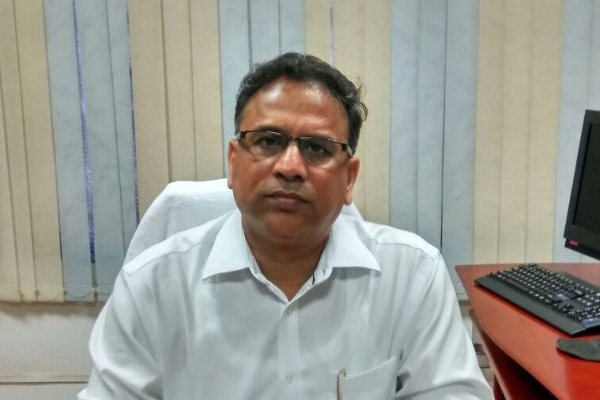
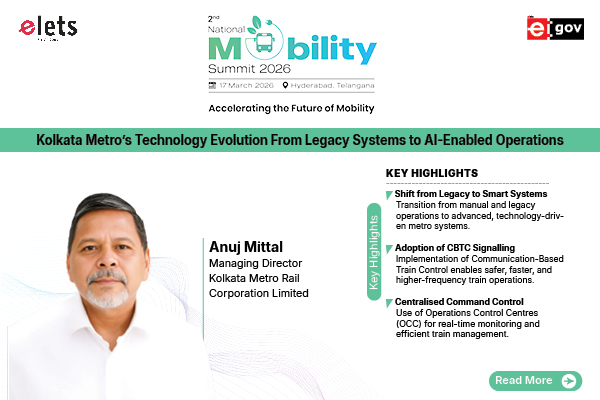
Views expressed by: Shri Anuj Mittal, Managing Director, Kolkata Metro Rail Corporation Limited, at the National Digital Innovation Summit 2025, in Guwahati.