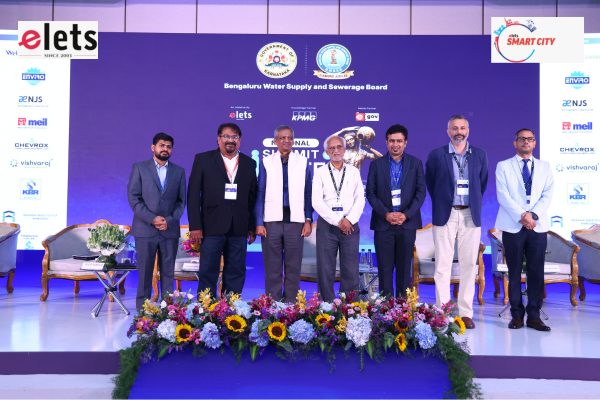
As artificial intelligence moves from pilot projects towards real-world deployment, India’s water utilities are entering a new phase of digital transformation. The focus is shifting beyond data collection and dashboards towards converting operational data into actionable intelligence, improving efficiency and enabling utilities to move from reactive management to predictive decision-making. A dedicated panel on “Transforming Utilities through AI: Real-World Solutions & Implementation Pathways” at the National AI Summit on Water 2026, held in Bengaluru on 27 May, brought together technology experts, utility engineers, researchers and entrepreneurs to examine how AI can reshape the way water infrastructure is designed, operated and maintained. The summit focused on how AI, IoT, digital platforms and advanced analytics can strengthen efficiency, resilience and long-term water security.
The discussion explored the technology stack required to make AI useful in the water sector, from sensors and communication networks to computing, modelling, automation, cybersecurity and emerging agentic AI systems. Speakers highlighted applications ranging from demand-supply modelling and automated treatment plants to predictive maintenance, non-revenue water reduction and real-time risk assessment. At the same time, the panel stressed that AI cannot simply be placed over weak infrastructure or unreliable data. Successful implementation will require solutions designed around India’s operating conditions, stronger field-level capacity, secure digital infrastructure and a clear understanding of how AI can complement rather than replace human expertise.
Speaker Perspectives
Dr Vijaysai P., Head – Water Technology Centre, L&T WET Innovation Centre, Kancheepuram
Dr Vijaysai P. highlighted the growing role of AI in empowering water-utility operators and supporting better operational decision-making. He pointed to applications across operational excellence, energy efficiency, cost management, process control and water quality, while emphasising that data remains the foundation of these systems. For utilities, the value of AI lies in turning operational information into actionable insights that can improve performance rather than simply adding another technology layer to existing infrastructure.
He also stressed that successful AI adoption requires organisation-wide readiness. Utilities need to understand what an AI solution is intended to achieve and how it will be integrated into existing operations. He noted that solutions designed for India must reflect local engineering conditions, cost constraints and infrastructure realities rather than simply replicate models developed for advanced economies. This creates an opportunity to build India-specific AI solutions that can improve the productivity of existing manpower while making utility infrastructure more reliable.
Dr S. D. Sudarsan, Executive Director, C-DAC Bengaluru
Dr S. D. Sudarsan positioned AI as a tool for addressing one of the water sector’s fundamental challenges: matching available water supply with changing demand. He argued that utilities need stronger demand-supply modelling capable of understanding different requirements, including drinking water, domestic consumption and industrial use. Such systems require collaboration between computational capabilities, academic research and engineering expertise to determine water availability, demand patterns and the treatment requirements at different points in the system.
He outlined a three-layer approach involving modelling and demand-supply management, automated engineering systems, and transparency for users. He also emphasised the importance of combining process-based models with data-driven approaches: engineering principles can provide boundaries and safety parameters, while real-world data captures actual operating conditions. Bringing both together can help create more reliable AI models with appropriate safeguards, enabling utilities to move towards more intelligent and responsive operations.
Sri Keshva Nand Semwal, Executive Engineer, Uttarakhand Peyjal Nigam
Sri Keshva Nand Semwal highlighted the distinctive challenges of deploying AI in Uttarakhand’s water infrastructure, where utilities operate across difficult terrain and significant variations in elevation. The state has 107 urban local bodies, including 11 corporations, with settlements ranging from around 300 metres to 2,000 metres in altitude. While most systems continue to rely on conventional controls, IoT- and sensor-based technologies are beginning to be introduced in parts of Dehradun, creating an early foundation for smarter utility management.
Source sustainability, natural disasters, remote infrastructure and high pumping costs were identified as major challenges. Depleting springs and streams require scientific assessment, while flash floods and landslides can disrupt infrastructure and remote pumping stations can be difficult to access. With some systems requiring water to be lifted to elevations of around 1,500 metres, affordability also becomes a key consideration. Against this backdrop, AI can help utilities move from reactive to predictive management, particularly in areas such as non-revenue water, source sustainability, water quality and infrastructure monitoring.
Mr Ganesh Shankar, Founder & CEO, FluxGen
Mr Ganesh Shankar brought an entrepreneur’s perspective to the need to digitise water systems, drawing attention to how Bengaluru’s water landscape has evolved from dependence on wells to piped supply, overhead tanks, sumps and increasingly tanker-dependent supply. He argued that making water data more transparent and accessible can help utilities and communities better understand the systems they depend on. AI can then build on this data to support interventions in areas such as rainwater harvesting, wastewater treatment and lake management.
He also identified AI as a potential response to the shortage of specialised technical talent in the water sector. Generative AI could make expert knowledge more accessible by allowing utility personnel to ask complex operational questions using existing data. Such systems could help identify potential wastewater-treatment failures, chemical shortages, financial losses or excessive energy consumption without requiring every utility to maintain a large pool of specialised experts. The opportunity, therefore, is not simply to automate tasks but to make scarce technical knowledge more widely available across the water sector.
Col. Gurjyot Singh Shergill (Retd.), General Manager (Product Engineering), Tata Communications
Col. Gurjyot Singh Shergill emphasised that communication infrastructure will be critical to connecting field-level sensors and actuators with AI platforms. As utilities become increasingly dependent on real-time information, communication networks effectively become the central nervous system linking physical infrastructure with digital intelligence. Data must travel securely through multiple layers before it can be integrated, processed and used for real-time monitoring and decision-making.
He also cautioned that water infrastructure must be treated as critical infrastructure, making cybersecurity and resilience essential from the beginning of any AI deployment. City-scale systems will require redundancy, fallback mechanisms, failsafe controls, encryption, authentication and clear segregation between information technology and operational technology. Sustainability must also be considered at the deployment stage, particularly the ability of utilities to maintain AI systems after initial project funding or subsidies end.
Mr Ravitej Hegde, Director & CEO, ParyAI
Mr Ravitej Hegde argued that the water sector is currently using only a fraction of AI’s potential, with many applications still focused on dashboards, alerts, data analysis and predictive insights. He pointed towards agentic AI as the next stage, where systems could move beyond presenting information to making decisions and triggering actions. He also highlighted computer vision as a potential way of enabling AI systems to observe treatment plants and identify operational conditions in ways similar to experienced engineers and plant managers.
The opportunity becomes particularly significant in complex treatment plants, where thousands of parameters can be generated every second and multiple layers of operators, engineers and managers are involved in decision-making. Agentic AI could potentially integrate these functions into a digital operational layer, with instruments collecting information, PLCs triggering actions and AI supporting the decision-making process. By combining AI with expertise spanning hydraulics, physics, chemistry, biology and ecology, utilities could move towards more responsive and increasingly autonomous treatment operations.
Key Insights
- AI must move beyond dashboards: The next phase of water-sector AI will involve prediction, decision support and automated intervention.
- Data is the foundation: Reliable sensors, field systems and communication networks are essential for generating usable AI outputs.
- Indian utilities need context-specific solutions: AI systems must reflect India’s infrastructure, cost, manpower and operating conditions.
- Predictive management can reduce operational risk: AI can help utilities anticipate non-revenue water, source depletion, water-quality issues and equipment failures.
- Agentic AI could transform utility operations: Future systems may move from analysing information to triggering operational actions.
- Cybersecurity must be built in: Critical water infrastructure requires secure communication, IT-OT segregation, redundancy and failsafe mechanisms.
- AI can address the talent gap: Generative AI can make specialised technical knowledge more accessible to utility personnel.
- Computing must connect with engineering: AI models need to be linked with physical infrastructure and field-level expertise to create deployable solutions.
- Automation needs organisational readiness: Technology adoption requires utility staff and institutions to understand how AI systems fit into existing operations.
- Sustainability must extend beyond deployment: Utilities need viable models for maintaining AI systems after initial project funding ends.
Read more: AI-Powered Circular Water Economy: Building Smarter, Safer and More Sustainable Water Systems
Conclusion
Across technology, engineering, utility operations and entrepreneurship perspectives, the panel converged on a clear message: India’s water utilities need to move beyond simply collecting and visualising data towards predictive intelligence, automated decision-making and real-time operational management. AI can help utilities understand complex systems, anticipate risks, optimise processes and improve service delivery, but these capabilities depend on the quality of the underlying infrastructure and data.
The discussion also made clear that AI cannot function as a standalone layer placed over existing utility systems. Reliable sensors, communication networks, computing infrastructure, automation and skilled personnel must work together. For India, this also means developing solutions that reflect local operating realities rather than importing technology without adapting it to the country’s diverse infrastructure and resource constraints.
As water systems become increasingly connected, cybersecurity and resilience will become equally important. AI-enabled utilities will depend on communication networks and operational technologies that must remain functional even during equipment failures, network disruptions or cyber incidents. Designing redundancy, authentication, encryption and failsafe mechanisms into these systems will therefore be as important as developing the AI models themselves.
Ultimately, the next generation of intelligent water utilities will be defined not by how much technology they deploy, but by how effectively they convert data into intelligence, intelligence into decisions and decisions into measurable outcomes. If India can combine AI with engineering expertise, secure digital infrastructure, domain knowledge and stronger institutional capacity, the technology can help utilities shift from reactive service delivery towards more predictive, efficient, resilient and increasingly autonomous water management.