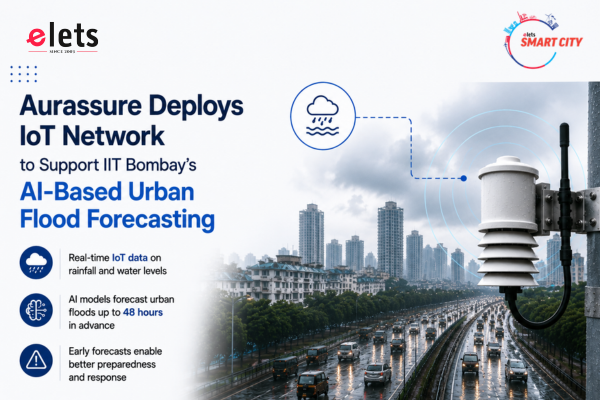
Aurassure has deployed an Internet of Things (IoT)-based monitoring network to support artificial intelligence (AI) research at IIT Bombay aimed at improving urban flood forecasting. The initiative is designed to strengthen the availability of real-time environmental data and enable the development of AI-driven systems capable of forecasting urban flooding up to 48 hours in advance.
The deployment focuses on collecting granular, real-time information on rainfall and other environmental conditions that influence urban flooding. IoT sensors installed across selected locations continuously capture localised data, providing researchers with a more detailed understanding of how rainfall translates into water accumulation and flooding across dense urban environments.
The data generated through the monitoring network will support IIT Bombay’s research into AI-based flood prediction models. By combining real-time sensor inputs with historical and other relevant datasets, researchers can develop predictive models capable of identifying potential flood risks before they become critical. Early forecasts could help city authorities improve preparedness and take preventive action.
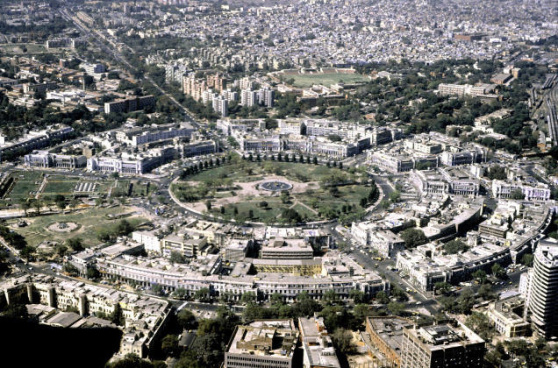
Urban flooding has become an increasing challenge for Indian cities due to intense rainfall, rapid urbanisation, reduced natural drainage areas, and ageing stormwater infrastructure. Conventional flood monitoring systems often rely on weather observations and limited ground-level information, which can make it difficult to accurately predict flooding at a neighbourhood or street level.
The IoT network is intended to address this data gap by providing hyperlocal observations. Continuous monitoring can help identify variations in rainfall and water conditions across different parts of a city, enabling AI models to account for localised flood patterns rather than relying solely on city-wide weather data.
A 48-hour forecasting capability could significantly improve the time available for urban authorities to respond to potential flood events. Warnings could support decisions related to traffic management, emergency response, deployment of pumping equipment, protection of critical infrastructure, and evacuation planning in vulnerable areas.
The initiative also demonstrates the growing role of IoT and AI in building climate-resilient urban infrastructure. Instead of responding to flooding only after water levels rise, cities can increasingly use predictive technologies to anticipate risks and prepare resources in advance. Such systems can become particularly valuable as extreme rainfall events become more difficult to manage in densely built-up urban areas.
For researchers, access to high-frequency and geographically distributed sensor data can also improve the accuracy and reliability of AI models over time. Continuous data collection allows models to be tested against real-world events, refined using new observations, and adapted to the specific characteristics of individual urban environments.
Read more: Andhra Pradesh Set to Turn 10.5 Lakh Streetlights into a Connected Urban Network
The collaboration between Aurassure and IIT Bombay highlights the importance of partnerships between technology companies and academic institutions in developing practical solutions for urban resilience. Combining sensor infrastructure, data analytics, and advanced AI research can help bridge the gap between experimental models and deployable city-scale applications.