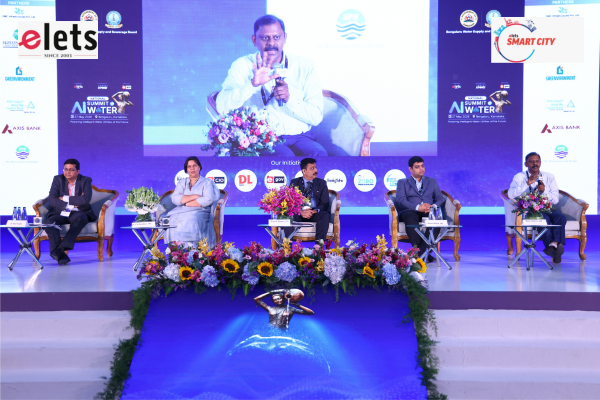
As India faces growing pressures from urbanisation, climate variability, ageing infrastructure and rising expectations for reliable water services, the future of water governance is increasingly tied to the ability of utilities to make faster, more informed and data-driven decisions. The opening session of the National AI Summit on Water 2026, titled “AI for Water Governance – Building Intelligent and Future-Ready Water Utilities,” examined the policy, institutional and technological foundations required to make this transition possible. The discussion focused on how Artificial Intelligence, integrated digital platforms, automation and real-time data can strengthen utility performance while supporting long-term water security and climate resilience.
Across these perspectives, a common concern emerged around persistent non-revenue water, legacy infrastructure, fragmented governance, climate risks and operational inefficiencies. Speakers emphasised that technology adoption must be accompanied by institutional reform, integrated data ecosystems, capacity building and citizen-centric service delivery if AI is to create meaningful and sustainable improvements in water management.
Speaker Perspectives
Dr T. K. Sreedevi, IAS, Secretary, Department of Municipal Administration and Urban Development, Government of Telangana
Dr T. K. Sreedevi emphasised that India’s water-management agenda needs to move beyond drinking-water supply towards wastewater management, reuse and circularity. Drawing on Telangana’s experience, she highlighted the state’s investment of more than ₹9,500 crore in developing a comprehensive water grid and providing household tap-water connections. While these investments have substantially improved water access, she noted that infrastructure expansion alone cannot resolve persistent operational challenges.
A major concern is non-revenue water, which exceeds 40 per cent in several municipalities. Dr Sreedevi argued that reducing these losses must become a strategic priority, particularly as leakages, unauthorised consumption, ageing networks and inadequate monitoring reduce the returns from public investment. AI-enabled monitoring, SCADA, sensor networks and predictive analytics can provide real-time operational visibility, helping utilities detect leaks earlier, optimise networks and strengthen water and wastewater management.
Sri Rajesh Gowda, IAS, Managing Director, Karnataka Rural Infrastructure Development Ltd (KRIDL)
Sri Rajesh Gowda argued that water infrastructure needs to receive the same strategic attention as other major infrastructure sectors. With urbanisation, climate variability and resource constraints increasing pressure on water systems, he highlighted cities such as Bengaluru as potential living laboratories where AI-enabled solutions can be developed, tested and refined before being adapted for smaller cities and towns with more limited resources.
He also identified fragmented institutional responsibilities as a major barrier to effective water governance. Water supply, wastewater, urban planning, environmental regulation and infrastructure development often operate independently, limiting coordination. AI can provide a coordinating layer by integrating information from different systems, improving resource allocation and enabling more coherent planning. He further stressed the importance of treated-water reuse and more efficient allocation of freshwater resources for long-term water security.
Sri Aman Mittal, IAS, Joint Chief Executive Officer, Maharashtra Institution for Transformation (MITRA)
Sri Aman Mittal highlighted integrated data ecosystems as the foundation of intelligent water governance. While utilities already generate substantial information through SCADA systems, customer databases, billing platforms, treatment plants and distribution networks, these systems frequently operate in silos. He argued that utilities need to move towards integrated management frameworks similar to modern power-sector control systems, where information can be brought together for real-time monitoring and decision-making.
He proposed a layered approach connecting physical infrastructure, integrated data systems and an AI-powered intelligence layer. By correlating pressure variations, water-quality indicators, service complaints, billing information and operational data, AI can identify patterns and provide early warnings before failures become larger disruptions. Sri Mittal also stressed that service quality and customer experience must become central to utility management, supported by integrated billing and customer-service platforms that improve reliability, accountability and trust.
Sri Binu Francis, IAS, Joint Managing Director, Kerala Water Authority
Sri Binu Francis highlighted the complexity of managing Kerala’s extensive water network, which serves approximately 48 lakh consumer connections and has achieved nearly universal metering coverage. Despite strong collection efficiency of around 85 per cent, the Kerala Water Authority continues to face challenges from ageing infrastructure, with a substantial portion of its network more than four decades old and some assets approaching a century. Climate variability and limited water-storage capacity further complicate resource management.
Kerala’s experience also demonstrates the operational value of automation and digital services. Automation initiatives have reduced manpower requirements by approximately 800 personnel, while app-based systems allow new water connections to be processed within seven to ten days. WhatsApp-based complaint systems enable citizens to share geotagged leak locations, and nearly 30 digital platforms and software systems collectively monitor services covering around 70 per cent of the state’s population. These initiatives illustrate how digital transformation can improve efficiency while making utility services more responsive to citizens.
Also read: Transforming Water Utilities Through AI: From Data to Predictive and Autonomous Operations
Key Insights
- Water governance must move beyond supply: Utilities need to incorporate wastewater, reuse and circularity into long-term planning.
- Reducing NRW is critical: Persistent water losses can undermine both service efficiency and returns on infrastructure investments.
- AI can strengthen operational visibility: Sensors, SCADA and predictive analytics can help utilities detect problems and intervene earlier.
- Integrated data is essential: Connecting operational, customer, billing and infrastructure information can create a unified intelligence layer.
- Fragmented governance needs integration: AI and digital platforms can support coordination across departments and agencies.
- Cities can become innovation laboratories: Solutions tested in larger cities can potentially be adapted for smaller urban centres.
- Customer experience matters: Reliable digital services, integrated billing and responsive complaint mechanisms can strengthen public trust.
- Automation can improve resource utilisation: Technology can reduce manual workloads while improving operational efficiency.
- Climate resilience must be embedded: Water utilities need to plan for changing rainfall patterns, extreme events and resource constraints.
- Institutional capacity remains fundamental: AI adoption requires governance frameworks, skilled personnel and long-term strategic planning.
Conclusion
The session made clear that building future-ready water utilities is not simply a technology challenge. India’s water systems already represent significant public investment, but ageing networks, NRW, fragmented institutions, climate pressures and operational inefficiencies continue to limit performance. AI can help address these challenges by providing utilities with real-time visibility, predictive intelligence and stronger decision-support capabilities, but its effectiveness will depend on how well it is integrated into existing governance and infrastructure systems.
The experiences shared from Telangana, Karnataka, Maharashtra and Kerala demonstrate that different states are approaching this transformation from different starting points. Telangana’s focus on reducing NRW, Karnataka’s emphasis on integrated planning, Maharashtra’s push for unified data architecture and Kerala’s experience with automation and citizen-facing digital services collectively point towards a broader model of intelligent utility management.
The next phase of water governance will therefore require a shift from isolated technology deployments towards integrated digital utility ecosystems. Physical infrastructure, operational data, customer platforms, institutional processes and AI-based intelligence need to function as connected components rather than independent systems. Such integration can enable utilities to identify problems earlier, allocate resources more efficiently and deliver more responsive services.
Ultimately, the future-ready water utility will combine policy, infrastructure, data, AI and institutional capacity into a coherent governance framework. As water security becomes increasingly intertwined with urban growth and climate resilience, India’s ability to build intelligent and citizen-centric utilities will depend not only on adopting new technologies, but on creating the governance structures and institutional capabilities required to turn those technologies into measurable and sustainable outcomes.