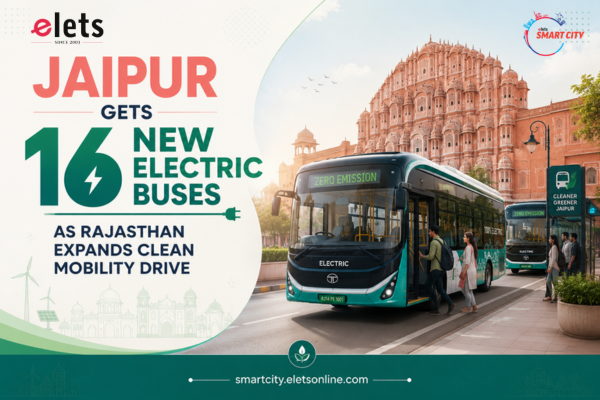
Rajasthan has expanded its electric public transport network with the addition of 16 new PM e-Buses in Jaipur, as the state continues to build out cleaner and more sustainable urban mobility infrastructure. Chief Minister Bhajan Lal Sharma flagged off the buses at the Rajasthan Secretariat on Tuesday after inspecting the vehicles and performing a ceremonial puja.
The latest deployment is part of the PM-eBus Sewa scheme, a Central Government programme aimed at strengthening city bus services through the deployment of electric buses. The scheme envisages the deployment of 10,000 air-conditioned electric buses in eligible urban areas through a public-private partnership model, with support for associated infrastructure and bus operations.
For Rajasthan, the programme represents a significant expansion of electric public transport. According to the latest information shared by the state government, 110 PM e-buses have so far been received across eight cities. Under the first phase, 675 buses have been sanctioned for Jaipur, Jodhpur, Udaipur, Kota, Bikaner, Bhilwara, Alwar and Ajmer. A further 475 buses have been sanctioned, taking Rajasthan’s overall sanctioned allocation to 1,150 electric buses.
The Jaipur rollout comes as the city works to increase the role of electric mobility in its public transport system. The newly introduced buses are intended to provide commuters with a cleaner mode of travel while helping reduce dependence on conventional fuel-powered public transport. Electric buses also operate without tailpipe emissions, making their deployment relevant to efforts aimed at improving urban air quality and reducing transport-related pollution.
However, the expansion of an electric bus fleet requires more than simply adding vehicles to city roads. Charging infrastructure, depot facilities and operational arrangements have to develop alongside the fleet. Rajasthan is therefore working on bus stands, charging points and other supporting infrastructure to facilitate the operation of the growing number of e-buses.
The state’s electric bus programme is also being pursued alongside broader efforts to strengthen public transport. The Chief Minister said 1,000 additional buses are planned for Rajasthan Roadways, while 144 buses had recently been flagged off to improve connectivity in rural areas.
The latest 16-bus addition in Jaipur is consequently part of a much larger transition underway in Rajasthan’s urban transport landscape. With 1,150 PM e-buses sanctioned for the state, the focus will now increasingly be on deploying the approved fleet, developing dependable charging infrastructure and integrating electric buses efficiently into existing city transport networks. If implemented at scale, the programme could give Rajasthan’s major cities a stronger foundation for cleaner, quieter and more sustainable public transportation.