

India’s freight transportation ecosystem is entering a new era of digital transformation. As the backbone of the country’s logistics network, Indian Railways is increasingly integrating advanced technologies such as artificial intelligence (AI), machine learning, natural language processing, and vision-based systems to optimise operational efficiency and improve freight movement reliability.
It makes it all the more pertinent to highlight the evolving technology landscape within the railway network and how data-driven decision-making is enabling the organisation to identify operational bottlenecks and enhance freight management across the country.

Real-Time Data for Smarter Freight Monitoring
One of the key technological interventions currently being implemented involves the use of satellite-enabled real-time locomotive tracking. Through data received at intervals of approximately 30 seconds, railway systems can continuously monitor the position and operational status of locomotives across the network.
This real-time data provides insights into whether locomotives are moving, stationary, or experiencing delays at specific locations. Such visibility is particularly valuable for freight operations, where trains typically operate without fixed schedules and are therefore more susceptible to operational inefficiencies.
To harness the full potential of this data, the technical teams at CRIS have developed an in-house clustering algorithm that analyses locomotive movement patterns and identifies unscheduled detentions. By detecting clusters of stationary locomotives, the system can pinpoint locations where freight trains are being held up for extended periods.
Identifying Operational Bottlenecks Through AI
The clustering model enables railway administrators to identify detention zones across the railway network and categorise delays based on their duration—such as one to two hours or more than two hours.
When visualised on a digital map, these clusters clearly indicate where operational bottlenecks are occurring. This information is then shared with railway management teams, allowing them to investigate the root causes and take targeted remedial action. In many cases, delays may be caused by infrastructure or operational constraints such as level crossings, congestion at major junctions, operational planning, and minimise recurring delays. This approach marks a significant shift from reactive management to predictive and analytics-driven railway operations.
Moving Toward Centralised Network Control
Beyond locomotive tracking and analytics, Indian Railways is also exploring structural reforms in signalling issues, or other system inefficiencies. By analysing these data patterns, management can prioritise infrastructure upgrades, improve operational control systems. At present, the railway network is managed through approximately 70 divisions, each operating four to five control boards responsible for monitoring specific sections of the network.
In total, around 350 control boards manage rail traffic across the country.
While this distributed control model has historically supported operational oversight, it can also contribute to coordination challenges and delays. In comparison, several European railway systems operate through far more centralised control frameworks. Even countries with extensive railway networks, such as Russia, manage operations through a limited number of integrated control modules.
Recognising these global benchmarks, Indian Railways is now working toward a more centralised and technologically enabled control architecture. By integrating advanced analytics, automation, and mathematical optimisation models, the railway network aims to streamline monitoring processes and reduce operational fragmentation.
Enhancing Freight Reliability and Multimodal Integration
The gradual transition toward centralised control, supported by AI-powered analytics, is expected to significantly improve the reliability and efficiency of freight train operations.
Improved visibility, faster decision-making, and predictive insights will enable the railway system to reduce detention times, optimise route planning, and enhance on-time delivery of freight consignments.
These improvements will not only strengthen the performance of the rail freight network but will also support broader multimodal logistics integration across India’s transportation ecosystem.
As India continues to expand its logistics infrastructure and industrial corridors, the integration of AI, satellite data, and advanced operational models within railway systems will play a crucial role in enabling faster, smarter, and more resilient freight transportation.
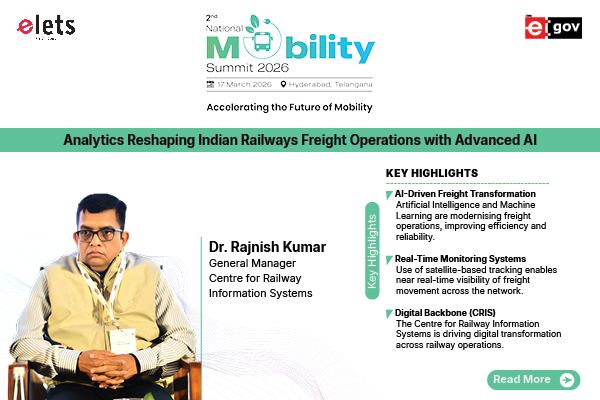
Views expressed by: Dr. Rajnish Kumar, General Manager, Centre for Railway Information Systems, at the National Digital Innovation Summit 2025, in Guwahati.