As one of India’s most vibrant economic hubs, Gurugram has rapidly evolved from a satellite township into a global business destination—home to Fortune 500 companies, tech parks, and bustling residential corridors. Yet, with progress comes the challenge of ensuring seamless, sustainable, and efficient mobility for millions of residents and commuters.
At the heart of this transformation stands the Gurugram Metro Rail Limited. (GMRL), a visionary initiative that reflects Haryana’s strong commitment to creating a modern, green, and people-centric transport ecosystem. Formed as a joint venture between the Government of Haryana and Delhi Metro Rail Limited. (DMRL), GMRL aims to strengthen intra-city connectivity, decongest roads, and enable environmentally responsible urban growth.
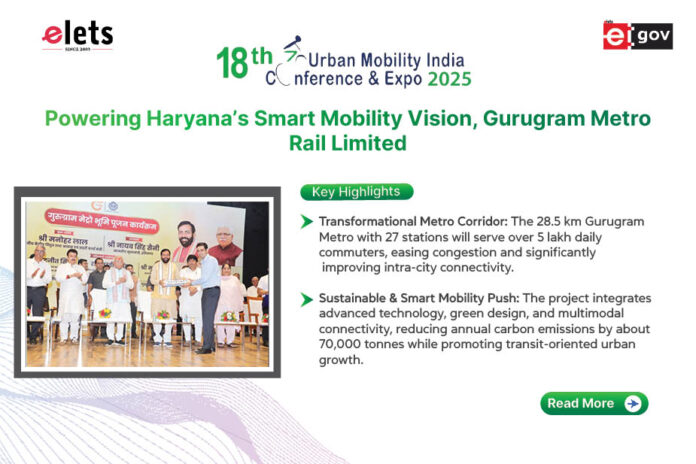
Key highlights
• Total Corridor Length: 28.5 km (fully elevated)
• Number of Stations: 27
• Projected Daily Ridership: Over 5 lakh passengers
• Carbon Emission Reduction: ~70,000 tonnes per year
• Integration: Direct connectivity with Delhi Metro, Dwarka Expressway, and regional mobility hubs
• Focus Areas: Sustainability, Technology Integration, Universal Accessibility, and Upliftment Economic
Redefining urban transit: The Gurugram Metro Expansion Project
The flagship Gurugram Metro extension project—a 28.5 km elevated corridor from Huda City Centre to Cyber City, with a dedicated spur to Dwarka Expressway—is set to redefine how the city moves. Designed to seamlessly integrate with the existing Delhi Metro network, this project will connect major residential, commercial, and industrial zones, including Subhash Chowk, Hero Honda Chowk, Sector 45, Udyog Vihar, and Cyber City.
The corridor will feature 27 elevated stations, each equipped with advanced commuter facilities, modern design aesthetics, and universal accessibility standards. Once operational, it is projected to serve over 5 lakh passengers daily, easing the pressure on road infrastructure, reducing vehicular congestion, and cutting carbon emissions by an estimated 70,000 tonnes annually.
Beyond connectivity, the metro will also drive economic densification along the corridor. By encouraging Transit-Oriented Development (TOD), GMRL is enabling new growth clusters around stations, supporting mixed-use real estate, and boosting local economies—creating a ripple effect that extends well beyond mobility.
Integrating technology, sustainability & design
At every stage of development, GMRL is embedding technology and sustainability into its blueprint. The project incorporates advanced signalling systems, regenerative braking, platform screen doors, and energyefficient station lighting, all designed to reduce operational costs and environmental impact.
The proposed Automatic Fare Collection (AFC) system will enable seamless digital payments and interoperability with other modes of transport, aligning with India’s One Nation, One Card initiative. The stations are also being designed to promote universal accessibility, ensuring that senior citizens, differently-abled commuters, and children can navigate with ease and dignity.
To ensure resilience and future scalability, GMRL’s infrastructure planning adheres to global standards of metro design, ensuring safety, operational efficiency, and low lifecycle maintenance.
Catalysing sustainable economic growth
The Gurugram Metro isn’t just an infrastructure project—it’s a catalyst for sustainable urban transformation. By providing a reliable, time-efficient, and clean mode of transport, the metro will reduce private vehicle dependency and improve the city’s air quality. It will also significantly enhance last-mile connectivity through integration with e-buses, e-rickshaws, and non-motorised transport infrastructure, enabling true multimodal transit.
The project supports Haryana’s broader agenda of sustainable economic development under the Haryana Vision 2047 framework. As mobility improves, so does access to education, employment, and housing, contributing directly to social equity and regional prosperity.
The bigger picture: Haryana’s urban mobility leadership
GMRL’s efforts complement the initiatives led by Haryana Mass Rapid Transport Corporation (HMRTC) and Urban Local Bodies (ULBs), which collectively aim to establish Haryana as a national model for sustainable mobility. Together, these agencies are building a cohesive transport ecosystem—one that prioritises connectivity, technology adoption, environmental stewardship, and citizen well-being.
The project’s emphasis on digital transformation and green engineering aligns with national priorities such as the National Urban Transport Policy (NUTP) and India’s Net Zero 2070 commitment. Gurugram’s evolving metro network is thus a vital component of India’s sustainable urbanisation journey.
Also Read: Pioneering Urban Mobility for Haryana: Haryana Mass Rapid Transport Corporation Ltd.
Shaping the future of smart mobility
GMRL’s vision goes far beyond building tracks and stations—it’s about reshaping the future of urban living. By combining worldclass engineering, sustainability-driven planning, and citizencentric innovation, GMRL is redefining what urban mobility can achieve.
As Haryana’s flagship urban transport initiative, the Gurugram Metro Rail project stands as a testament to how strategic foresight, public-private collaboration, and technological excellence can transform challenges into opportunities. When operational, it will not only improve how Gurugram moves but also inspire how India builds the cities of tomorrow.