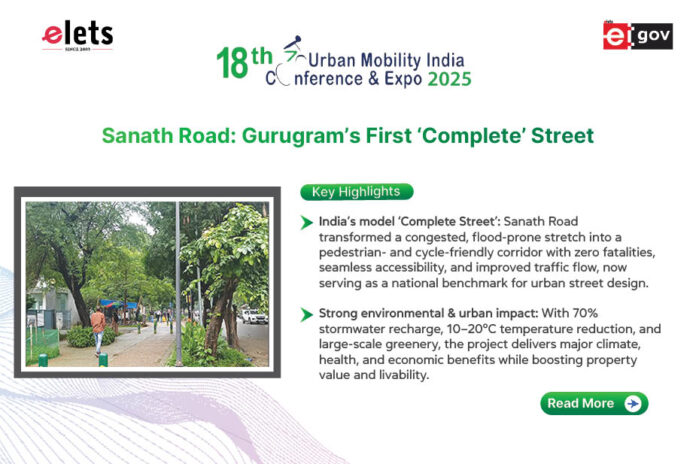
Gurugram, the corporate hub of Haryana, has successfully reimagined urban infrastructure with the transformation of Sanath Road, Udyog Vihar. Once called ‘Anath’ (orphaned) Road due to its chaotic congestion and frequent flooding, the 2.5-kilometre stretch has emerged as Haryana’s first Complete Street, now serving as a national blueprint for sustainable and inclusive urban development, pedestrian-friendly streets, road safety, accessibility and universal design, coordinated services, public amenities with a nature-based approach.
The catalyst for this pivotal change was the Hon’ble Manohar Lal Khattar, then Chief Minister. The road’s story—once called ‘Anath’—became ‘Sanath’, when he approved the streetscape redevelopment to create traffic-conflict-free, accessible and seamless pedestrian and cycle paths, and implement road safety measures and maintain the existing 10m carriageway, instead of cutting existing trees for road widening. This vision was formally realised on April 19, 2025, with the inauguration presided over by the Hon’ble Chief Minister, Shri Nayab Saini, and Cabinet Minister, Shri Rao Narbir Singh. Their participation underscored the government’s unwavering commitment to prioritising the estimated 23,000 pedestrians and cyclists who utilise this road daily, ensuring universal accessibility and safe last-mile connectivity. This strategic intervention has proven that separating traffic modes results in smoother vehicular flow while simultaneously safeguarding public health and safety.
Located in Sector 18, Gurugram, Anath Road/ Sanath Road connects Old Delhi Road to Atlas Chowk at NH8. The 2.5km stretch has a 30m R.O.W./10m carriageway width. Home to a number of offices housing a wide range of companies, some residences, local shops, food outlets and the dense urban village of Sarhaul, it is characterised by mixed land uses. Occupants include corporate offices, including Maruti, Siemens, Ameriprise, PWC, Tupperware, American Tower Corporation, Regus, Munjal Showa, Luma, Motherson Sumi, Safexpress, Nagarro, residences, factories, shops and Sirhaul village.
Sanath Road was not a simple construction project; it was a comprehensive demonstration of effective multidisciplinary coordination. The project’s success is a testament to the coordination of all stakeholders, including the Gurugram Metropolitan Development Authority (GMDA), the Municipal Corporation of Gurugram (MCG), Dakshin Haryana Bijli Vitran Nigam (DHBVN), and the Gurugram Traffic Police. Raahgiri Foundation spearheaded the complex project with its technical team of designers, architects, and landscape experts at Beyond Built Pvt. Ltd., and support and CSR funding provided by Maruti Suzuki and Nagarro. This unique collaboration ensured that the principles of sustainable design could be replicated across the city.
While GMDA constructed the road, kerbs and drains, MCG comprehensively overhauled tangled sewerage and waste management, DHBVN undertook the challenging task of undergrounding the power infrastructure, and Gurugram Traffic Police maintained order, ensuring continuous passage for approximately 30,000 daily commuters. Raahgiri Foundation managed and coordinated all the overlapping service coordination, streetscape planning and design, construction and management, including provision of 5km of shared pathways- for pedestrians and cyclists, pedestrian amenities including lighting, seating, dustbins, signage and traffic calming devices. Collective action enabled the project to transition from a conceptual design to a world-class physical reality.
Design and Material Innovation
The final design and engineering phases delivered extensive benefits. Over 94 disparate entrance conditions were designed to ensure seamless, level, safe pedestrian crossings and universal accessibility. The barrier-free design ensured all transition areas at entrances, abutting roads and pedestrian crossings had warning cues through bollards, material changes and contrasts. Almost 100 vendor spaces are integrated to provide ‘eyes on the street’ and create a ‘sense of place’ for its diverse users.
The project embraced the Circular Economy, through resourceconscious use of materials, minimal introduction of new materials and reuse of significant volumes of construction debris in basework, pavements and seating, and discarded concrete pavers around tree bases. The recycling of approximately 12,000 tons of local construction debris (malba), achieving low use of virgin material and minimising use of non-renewable Materials. The selection of grit finishing for pathways and seating was strategic: its composition ensures less dust accumulation and provides a crucial anti-skid surface with adequate grip, enhancing safety. Furthermore, this durable material, available in various colours, patterns, and compositions, provides seamless access and is remarkably easy to cut and replace, requiring little to no maintenance—critical attributes for long-term municipal assets.
Regarding walkability, the street features well-maintained sidewalks, clearly marked and raised pedestrian crossings, and traffic calming measures, resulting in minimal traffic conflict and congestion. A critical safety outcome is the record of zero road fatalities since construction commenced. The improved street lighting and segregated paths enhance safety and security. And creative graphic signage informs, orients and directs users. This multidisciplinary approach capitalised on domain strength and expertise, allowing for experimentation and validation of innovative approaches, which builds capacity and offers the potential to scale these best practices.
Sanath Road provides a compelling case study in realising multiple dividends from a single investment.
Environmental and Climate Dividends
The design follows a nature-based approach towards ecological development by protecting existing trees, planting native species, decreasing the heat island effect, augmenting natural drainage and infiltration and use of high-albedo materials.
Maximising natural ground for percolation outside of the pathways, and creating natural storm water management solutions wherever possible, has transformed the street, once constantly waterlogged, to one with no waterlogging even during extreme rail events. Grading, bio-swales and rainwater recharge pits ensure maximum groundwater recharge, with only overflow finding its way into drains. Higher moisture content facilitates plant growth that in turn creates thermal comfort and separation of pedestrians from traffic.
The horticulture and structural design provide immediate climate mitigation results. The walking path remains significantly cooler than typical roads, achieving a temperature reduction of 10 to 20 degrees Celsius in summer, drastically reducing the urban heat island effect. The Climate Appropriate planting strategy included the preservation of over 700 existing mature canopy trees and the strategic addition of 540 Native trees, 31,000 Shrubs, and 34,000 Groundcovers. This planting was optimised for nitrogen fixing, pollutant removal, improved air quality, and increased biodiversity, creating an augmented shade structure with minimal maintenance. The groundcover strategy ensures no exposed ground for dust reduction, while the dense foliage provides noise barriers and a buffer from traffic, effectively clearing pollutants. Furthermore, the structural design ensures that approximately 70% of stormwater will be naturally recharged, mitigating flooding.
Economic and Public Health Benefits
The transformation has yielded direct economic benefits, with a noted increase in property rates and a decline in vacancy rates seen as a direct result of the enhanced liveability and connectivity. The street promotes Active Health, and the reduction in congestion and pollution leads to lower emissions, contributing significantly to public well-being. The absence of constant vehicular conflict and traffic danger brings a form of freedom and peace to the daily lives of tens of thousands of commuters.
Also Read: Powering Haryana’s Smart Mobility Vision Gurugram Metro Rail Limited
Capacity building, setting a national standard
The success of Sanath Road has elevated its status to a regional mandate. The Commission for Air Quality Management (CAQM) formally adopted the Sanath Road model, recognising that if all NCR streets were redeveloped to this standard, air pollution would be reduced.
CAQM, with the support of Raahgiri Foundation, has established a dedicated Resources Lab for Streets. This initiative will train and oversee city engineers across all nine major cities of the NCR to replicate this comprehensive ‘complete street’ model.
Sanath Road is the ultimate affirmation of the Haryana Administration’s progressive vision, proving that focused policy, strong political will, and dedicated inter-agency teams can transform legacy liabilities into scalable national models for liveability and sustainability. Based on the model of this street, GMDA has planned to redevelop 100 km of roads in Gurugram in the next two years to make them accessible to walk and cycle on separate, safe footpaths and cycle tracks, a solution that reduces traffic congestion, traffic jams, air pollution, and conflicts on the road, with work already started on 30km as a priority.