India is at a defining moment in the evolution of its mobility ecosystem. Rapid urbanization, expanding logistics networks, and rising vehicle ownership are placing unprecedented demands on roads and transport systems. At the same time, emerging technologies, particularly artificial intelligence and data- driven analytics, are creating new opportunities to rethink how mobility systems are designed, managed, and made safer.
IHub-Data, IIIT Hyderabad, a Technology Innovation Hub established under the Department of Science and Technology’s National Mission on Interdisciplinary Cyber-Physical Systems (NM-ICPS), is working at the intersection of data platforms, artificial intelligence, and applied research to enable such transformation. By developing foundational datasets, research platforms, and deployable solutions, the hub aims to translate cutting-edge research into technologies that address real-world mobility challenges.
The future of mobility will not be defined only by vehicles or infrastructure, but by how effectively we harness data and AI to understand and optimize the movement of people, goods, and vehicles across complex environments.
Across India, cities and transport agencies are increasingly recognizing that mobility challenges, congestion, road safety, infrastructure maintenance, and enforcement, are fundamentally data problems that require intelligent digital solutions.
Data as the Foundation of Intelligent Mobility
Mobility systems generate vast amounts of data every second. Vehicles, cameras, mobile devices, and road infrastructure continuously produce signals that capture traffic patterns, driver behaviour, environmental conditions, and infrastructure health. However, the real opportunity lies not in collecting data, but in transforming it into actionable intelligence.
At IHub-Data, IIIT Hyderabad, significant efforts have been devoted to building foundational datasets and platforms that enable mobility innovation. One such initiative is the India Driving Dataset (IDD), which captures the unique complexity of Indian road environments, ranging from dense urban traffic to semi-structured rural roads. These datasets help researchers develop AI models that can understand mixed traffic environments involving two-wheelers, auto-rickshaws, pedestrians, buses, and heavy vehicles operating simultaneously on shared roads.
Unlike mobility datasets created for highly structured road systems in developed economies, Indian datasets must reflect real-world heterogeneity. AI systems trained on such contextual data are far better equipped to operate effectively under Indian conditions.
Building Platforms for Real-World Mobility Research
Data alone is not enough. Developing practical mobility solutions requires experimental platforms that allow researchers and innovators to capture real-world signals and test emerging technologies. To support this, IHub-Data, IIIT Hyderabad has developed specialized research platforms such as Bodhyaan, an instrumented vehicle equipped with advanced sensors including cameras, LiDAR, and GPS systems to collect high-fidelity road data. These platforms enable experimentation in perception systems, sensor fusion, driver behaviour analysis, and road environment understanding.
Similarly, recognizing the critical role of two-wheelers in India’s mobility ecosystem, researchers have built two-wheeler sensing platforms that capture urban mobility data at scale. These platforms provide valuable insights into rider behaviour, road conditions, traffic interactions, and safety risks in Indian cities. Such platforms bridge the gap between academic research and real-world deployment by enabling experimentation in realistic traffic conditions rather than controlled laboratory environments.
AI for Road Safety and Traffic Intelligence
Road safety continues to be one of India’s most pressing public challenges. With thousands of road accidents occurring every year, improving safety requires proactive, technology-enabled interventions.
AI-powered computer vision systems are increasingly being used to analyse data from CCTV cameras, dashcams, and mobile devices to detect traffic violations such as red-light jumping, speeding, illegal parking, and helmet or seatbelt violations. Automated Number Plate Recognition (ANPR) technologies like VahanEye further enable evidence-based enforcement by linking detected violations with vehicle identities and enabling automated e-challan generation.
Beyond enforcement, AI systems can analyse road imagery and sensor data to detect infrastructure issues such as potholes, missing traffic signs, or visibility hazards. These insights allow city authorities to prioritize maintenance and interventions based on actual risk rather than periodic inspections. In this way, mobility systems are gradually evolving from reactive management to predictive and data-driven decision-making.
Translating Research into Real-World Impact
One of the most important challenges in mobility innovation is translating research outcomes into solutions that can be deployed at scale.
Collaborative initiatives between government, academia, and industry are critical to achieving this transition. A notable example is iRASTE (Intelligent Solutions for Road Safety through Technology and Engineering), a joint initiative aimed at improving road safety through a combination of AI analytics, driver monitoring systems, vehicle-based safety technologies, and infrastructure insights.
Early deployments have demonstrated encouraging results, with ADAS-enabled buses reporting significantly fewer accidents compared to conventional vehicles. Such initiatives demonstrate how data-driven technologies can translate into measurable improvements in road safety outcomes.
Building India’s Mobility Innovation Ecosystem
Solving mobility challenges requires more than technology, it requires an ecosystem. India is uniquely positioned to build such an ecosystem by bringing together research institutions, startups, industry partners, and government agencies. Platforms that provide open datasets, experimental infrastructure, and simulation environments enable startups and innovators to build solutions tailored to India’s mobility realities. Cities like Hyderabad are emerging as important centres of mobility innovation, where academic research, startup ecosystems, and government initiatives converge to create deployable solutions.
Equally important is talent development. Multidisciplinary training programs and collaborative research initiatives are helping build a new generation of engineers, data scientists, and policymakers who understand the intersection of mobility, infrastructure, and artificial intelligence.
The Road Ahead
The convergence of data infrastructure, artificial intelligence, and collaborative innovation ecosystems will define the next phase of mobility transformation in India.
In the coming decade, intelligent mobility systems will increasingly support real-time traffic management, predictive infrastructure maintenance, driver safety monitoring, and urban mobility planning. Data-driven insights will help cities identify risk corridors, optimize traffic flows, and prioritize investments in road infrastructure.
For India, the opportunity is not merely to adopt global mobility technologies but to build solutions tailored to its unique mobility landscape.
By investing in data platforms, AI research, and collaborative deployment models, India can create a mobility ecosystem that is not only smarter and more efficient, but fundamentally safer for every citizen on the road.
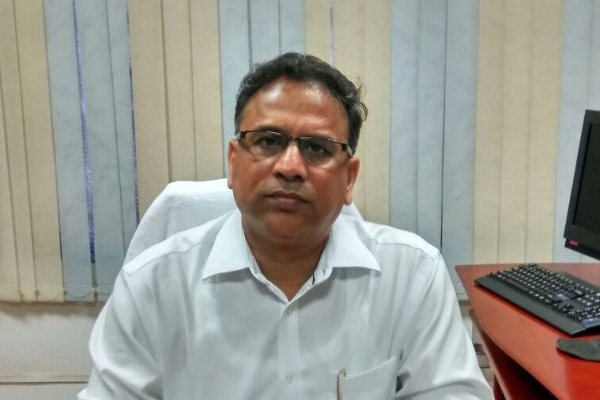
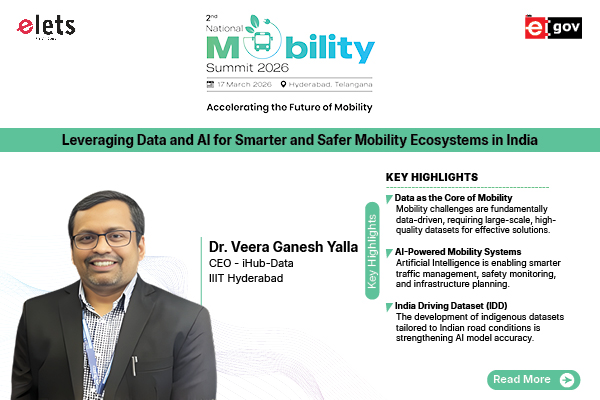
Views expressed by: Dr. Veera Ganesh Yalla, CEO – IHub-Data, IIIT Hyderabad (Technology Innovation Hub under DST’s NM-ICPS mission)