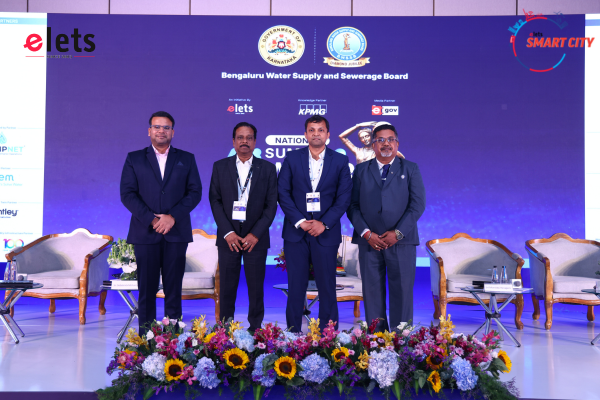
As artificial intelligence moves from being a technology buzzword to becoming an increasingly integrated part of the water sector, its role is expanding across the entire water lifecycle, from treatment and distribution to water-quality monitoring, demand management, wastewater reuse and ecological protection. A dedicated panel on AI-Powered Circular Water Economy at the National AI Summit on Water 2026 in Bengaluru explored how AI and digital governance can help utilities build more predictive, transparent and sustainable systems, while addressing the equally important questions of data reliability, institutional capacity, public trust and economic viability.
The session brought together Sri. Tejas Pol, Director, KPMG, Sri. Ketan Garg, IAS, Commissioner, Greater Visakhapatnam Municipal Corporation, and Sri. Manicka Vasagam, Director, Shriram Research Institute, Bengaluru, offering perspectives spanning consulting, municipal governance, utility operations and research. The discussion moved beyond the capabilities of AI to examine the foundational conditions required to make intelligent water management work on the ground. From wastewater reuse and customer-facing digital tools to Bengaluru’s geospatial and machine-learning research, the panel highlighted how technology, reliable data, human capacity and institutional decision-making must work together to create a genuinely circular water economy.
Speaker Perspectives
Sri. Tejas Pol, Director, KPMG
Moderating the session, Sri. Tejas Pol highlighted how artificial intelligence is becoming increasingly inclusive across the water sector, spanning multiple stages of the water lifecycle and bringing a wider set of decision-makers into the process. He connected the discussion to the growing importance of circularity as cities become more sustainable and data centres expand, emphasising the need to understand how AI and digital governance can strengthen water management across India. His framing positioned AI not merely as a technology layer, but as an increasingly important component of how utilities, institutions and investors approach the water ecosystem.
Sri. Pol also underscored the importance of retaining human judgment alongside AI and large-scale modelling capabilities. While advanced technologies can help integrate vast datasets, identify patterns and model uncertainty, he stressed that humans must continue to determine what is important and what should be prioritised, particularly when decisions have wider social and environmental implications. The effectiveness of AI in water governance, therefore, depends on combining computational intelligence with informed human decision-making.
Sri. Ketan Garg, IAS, Commissioner, Greater Visakhapatnam Municipal Corporation
Sri. Ketan Garg explained that AI and digital technologies are becoming increasingly important across the water and wastewater value chain, from treatment plants and filtration systems to distribution networks and household-level monitoring. Data-driven technologies can improve predictability around pressure, supply, quantity and water-quality parameters, while automated metering and monitoring systems can provide utilities with greater visibility into network performance. He also highlighted a Visakhapatnam pilot that enables consumers to access information on the quantity and quality of water supplied to them through a mobile application, demonstrating how digital tools can improve transparency and customer assurance.
Turning to wastewater reuse, Sri. Garg identified public perception, institutional fragmentation and high technology costs as significant barriers to creating a circular water economy. He argued that citizens need confidence that treated wastewater is safe before reuse can achieve widespread acceptance, while utilities must also find economically viable models for treatment and reuse. Visakhapatnam’s experience demonstrates the potential of this approach: treated wastewater is being supplied to organisations including HPCL, railways, steel plants and the Navy, generating around ₹450 crore in annual revenue. For Sri. Garg, the future of intelligent water systems therefore rests on three outcomes: transparency and assurance for customers, protection of the surrounding ecosystem, and economic efficiency for the utility.
Sri. Manicka Vasagam, Director, Shriram Research Institute, Bengaluru
Sri. Manicka Vasagam focused on the importance of large-scale data, geospatial intelligence and predictive modelling in understanding Bengaluru’s long-term water challenges. He explained that the research undertaken for Bengaluru’s urban water ecosystem draws on data from 1973 to 2026, combining spatial observations with climate, geographical, hydrological and institutional information. Rather than relying on individual variables such as rainfall, the approach seeks to integrate multiple datasets to understand the city’s water sources, water bodies, groundwater conditions and future recharge possibilities. Machine-learning tools, including random forest and long short-term memory models, are being used to analyse these datasets and generate more actionable insights.
He stressed that the ultimate value of AI-led research lies in its ability to inform policy and urban planning. Bengaluru’s position on the Deccan Plateau, groundwater constraints and increasing urbanisation make the protection and restoration of water bodies particularly important, while the conversion of permeable areas into concrete surfaces has affected natural recharge. The research therefore aims to identify future water sources, potential recharge areas and how urban development can be planned around water availability. Sri. Vasagam emphasised that research findings must reach policymakers and be accepted as credible evidence if AI is to contribute meaningfully to long-term water security and climate resilience.
Key Insights
- AI is becoming a water-sector-wide technology: Its applications are expanding across treatment, distribution, monitoring, demand management, water quality, wastewater reuse and ecological management.
- Technology must be grounded in physical infrastructure: Sensors, meters, treatment systems and distribution networks need to function effectively before AI can deliver reliable outcomes.
- Data reliability is fundamental: AI-driven decisions are only as dependable as the data feeding the models, making sensor maintenance, field validation and periodic monitoring essential.
- Public trust will determine wastewater reuse: Advanced treatment alone cannot deliver circularity at scale unless citizens have confidence in the safety and quality of reused water.
- Wastewater can become an economic resource: Visakhapatnam’s experience demonstrates how treated wastewater can generate significant revenue while meeting industrial and institutional demand.
- Large-scale datasets can strengthen water planning: Combining historical, geographical, climate, hydrological and institutional data can help cities understand current constraints and anticipate future water risks.
- Bengaluru requires integrated water intelligence: Groundwater constraints, urbanisation and reduced natural recharge make the protection of lakes and water bodies critical to long-term water security.
- AI can support predictive urban planning: Machine-learning and hydrological models can help identify future water sources, recharge opportunities and areas where urban growth could create additional water stress.
- Field capacity remains indispensable: Engineers and field personnel need to understand sensor operations and data reliability, as weak field-level inputs can undermine sophisticated AI systems.
- Human judgment remains central: AI can strengthen evidence-based decision-making, but questions involving priorities, public interest and environmental trade-offs require human oversight.
Also read: Powering AI in Water: Why Financing Will Define India’s Smart Water Future
Conclusion
Across consulting, municipal governance and research perspectives, the panel converged on a central recognition: India’s transition towards an intelligent and circular water economy will depend on how effectively technology is integrated with physical infrastructure, reliable data, institutional capacity and human decision-making. AI can provide utilities with stronger capabilities to monitor systems, predict demand, assess water quality, optimise operations and model future scenarios, but technology alone cannot resolve the structural challenges facing urban water systems.
The discussion also demonstrated that circularity must be understood through multiple dimensions. For citizens, it requires safe and transparent water services. For the environment, it requires protection of groundwater, lakes, coastal systems and other ecological assets. For utilities, it must create an economically sustainable operating model. Visakhapatnam’s wastewater reuse experience illustrates how environmental objectives can be connected with financial value, while Bengaluru’s research demonstrates how AI can support long-term planning around increasingly constrained water resources.
At the same time, the discussion highlighted the importance of the foundations beneath AI. Reliable sensors, accurate datasets, trained field personnel and credible validation mechanisms must accompany digital transformation. Without these, sophisticated models can produce unreliable insights and potentially flawed decisions. The next phase of India’s water transformation will therefore depend not simply on deploying more AI, but on creating the institutional and operational ecosystem required to use it effectively.
Looking ahead, the truly intelligent water utility will not simply be the one with the most advanced technology. It will be the one that can convert data into reliable intelligence, intelligence into better decisions, and those decisions into measurable outcomes for citizens, ecosystems and the utility itself. By bringing AI together with human expertise, scientific research and accountable governance, India can move towards water systems that are not only smarter, but also more circular, resilient, transparent and economically sustainable.