

By Minal Srinivasan, Managing Director, Kesari Infrabuild Pvt. Ltd
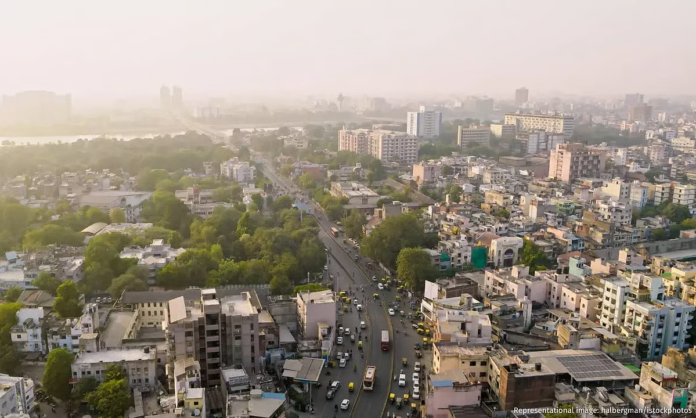
Summers in Indian cities feel harsher than they used to. Nights bring less relief, and afternoon errands have become a test of endurance. Climate change is part of the cause, but the way our cities are built is quietly making things worse. Climate-smart buildings, designed to work with local weather rather than against it, offer one of the most practical ways to bring that heat down.


What Is the Urban Heat Island Effect?
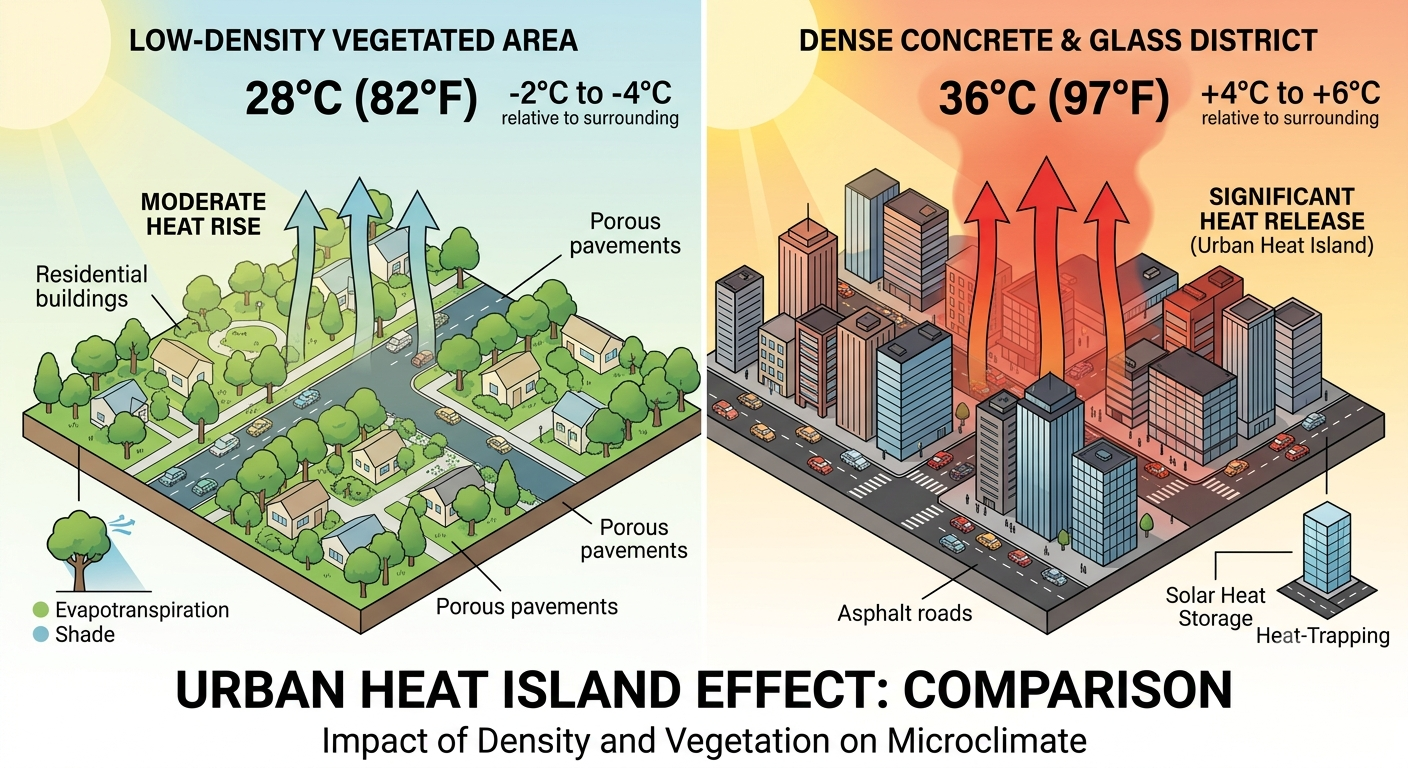
The urban heat island effect is the tendency of cities to run significantly warmer than the surrounding countryside. Concrete, asphalt, and glass absorb heat during the day and release it slowly after dark, while vegetation and open spaces cool more quickly. Because the effect is strongest at night, it removes the relief people usually expect after sunset.
Drive from the outskirts of a city into its commercial core on a summer evening, and the difference is often obvious. The term is technical, but its consequences are personal. A street vendor loses hours of business in an unforgiving afternoon. A traffic police officer works on a busy road in the sun for hours. A construction worker spends most of the day in direct heat. A family in a top-floor flat turns their home into an oven every summer, and many parents now worry about electricity bills because air-conditioning has moved from occasional comfort to daily necessity.
Heat is no longer only a weather issue. It affects health, household finances, workplace productivity, and how liveable our cities are.
Why Are Indian Cities Heating Up?
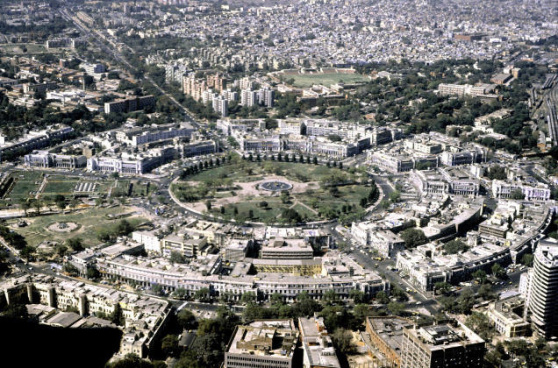
Indian cities are growing, and every new home, school, hospital, office and factory adds to the heat load if it is poorly designed. Projections suggest the country’s urban population could reach around 600 million by 2036. That growth makes climate-responsive planning urgent, and it also creates an opportunity. India is still building much of its urban future, so today’s design choices will shape cities for decades.
Yet many buildings still treat climate as an afterthought. Large expanses of glass have become a symbol of modern architecture, even in regions with intense sun. Dark roofs absorb and hold heat. Dense developments block natural airflow, and green space is often sacrificed to maximise built-up area. The result is a built environment that frequently works against the people inside it.
How Does Building Design Raise Energy Demand?
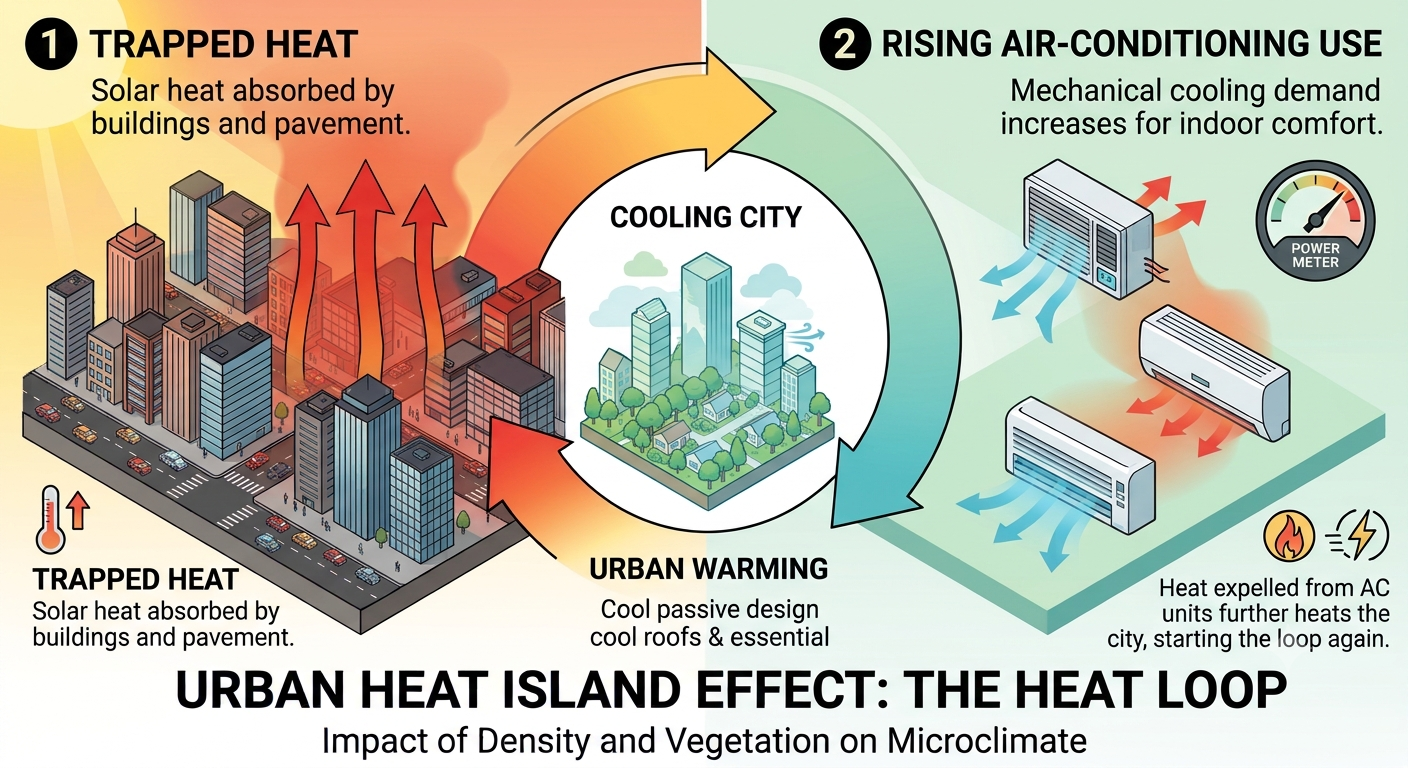
Many people assume the heat problem exists only outdoors, but poorly designed buildings trap heat indoors too. Occupants then depend more on mechanical cooling, which raises household energy bills, operating costs for businesses, and pressure on the electricity grid. The cycle usually runs like this:
- Poorly designed buildings trap heat indoors.
- Occupants rely more on air-conditioning to stay comfortable.
- Higher cooling demand increases energy use, and the heat expelled from cooling systems adds to urban warmth.
Air-conditioners are essential during extreme heat and protect health, so the goal is not to remove them. The goal is to reduce how much cooling buildings need in the first place.
What Are Climate-Smart Buildings?
Climate-smart buildings are designed to respond to local climate conditions. They reduce heat gain and cooling demand through passive design, using measures such as natural ventilation, shading, cool roofs, suitable materials and thoughtful landscaping. Many of these features are inexpensive and effective.
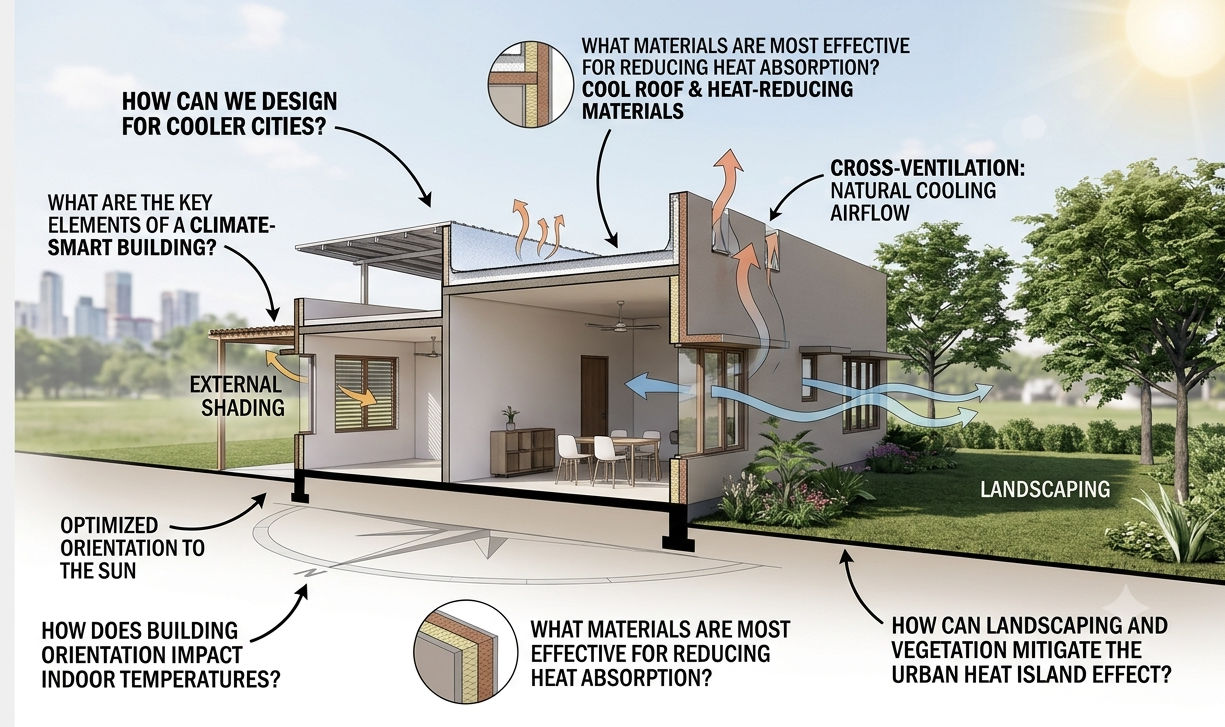
Climate-smart design starts with practical questions:
- How can a building use natural light without adding heat?
- How can ventilation improve comfort?
- Do materials perform well in local conditions, not just on cost?
- Can shading reduce direct exposure to the sun?
- Can landscaping create cooler microclimates?
The answers often lead to solutions that are both effective and achievable.
How Did Traditional Indian Architecture Handle Heat?

Traditional Indian architecture offers proven examples of passive cooling. Courtyards encouraged air circulation. Verandas created shaded transition spaces. Jaali screens filtered sunlight while keeping air moving. Thick walls insulated interiors from extreme temperatures. These were practical responses to climate, not only aesthetic choices. Modern cities cannot simply copy historical forms given higher densities and changing lifestyles, but the principles remain valuable.
Affordable Climate-Smart Design: Passive Measures for All Buildings
No. Improved ventilation, better roofing materials, strategic shading, and careful orientation can significantly improve thermal comfort without dramatically raising costs. The benefits reach many groups. Low-income communities gain relief in daily life, middle-income households can manage energy expenses, and businesses can improve efficiency and employee wellbeing.
Key takeaway: The most effective climate-smart measures are often the simplest, and they are not reserved for premium projects.
Who Benefits From Climate-Smart Buildings?
Buildings that perform efficiently tend to have lower operating costs. Comfortable indoor environments support productivity and occupant satisfaction, and climate-resilient assets are better placed to handle future environmental risks. For developers, resilience is becoming a source of long-term value.
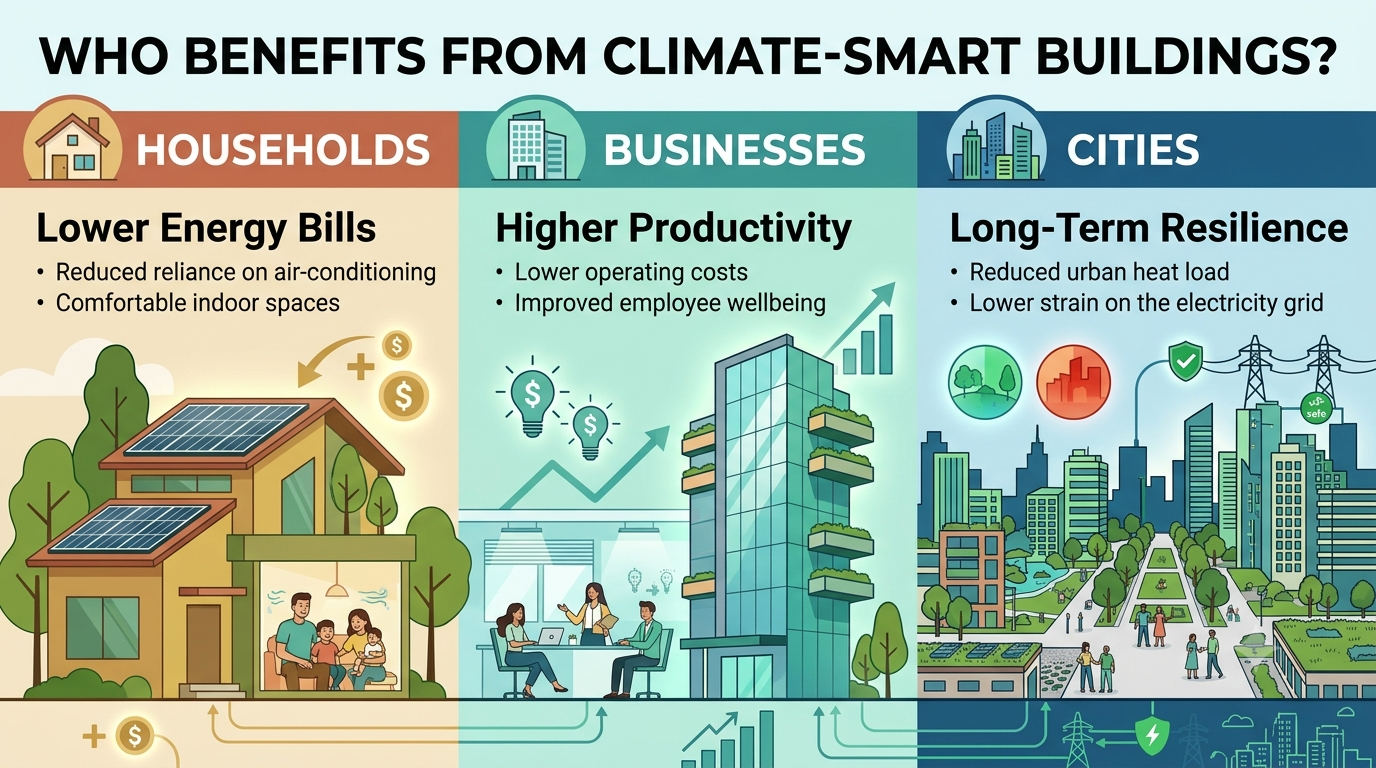
Sustainability, once viewed mainly as a corporate responsibility initiative, is now increasingly recognised as a strategic priority.
Key takeaway: Climate-smart design lowers operating costs, supports people and protects long-term asset value.
What Progress Is Already Visible?
Developers across the country are exploring passive design strategies that reduce energy demand. Some institutions are adopting cool roofing solutions, and corporate campuses are recognising the value of shaded outdoor spaces and landscape planning. Green building certifications have brought sustainability into mainstream conversations about development. These steps matter, but they must move beyond isolated examples.
Which Policies Support Climate-Smart Construction in India?
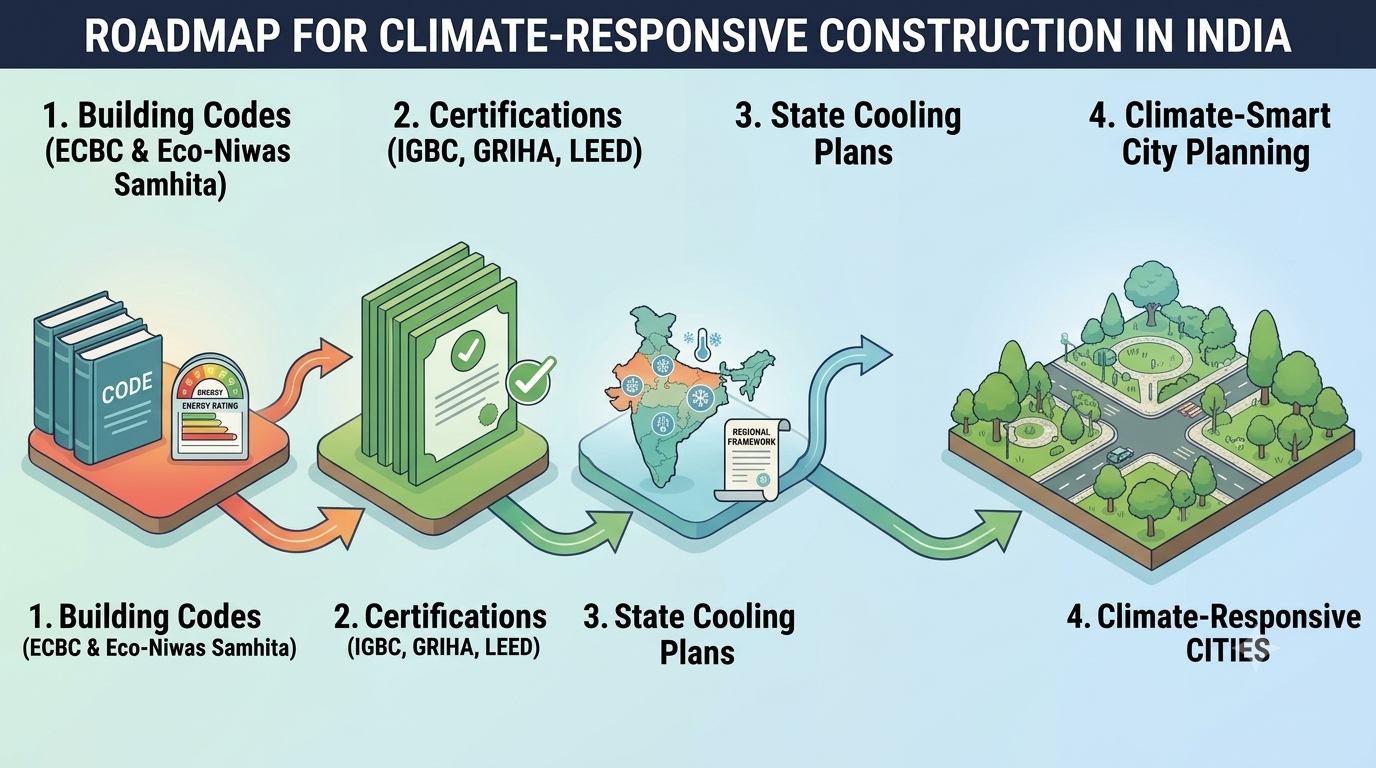
India already has several frameworks that encourage climate-responsive construction:
| Framework | Main focus | Relevant to |
|---|---|---|
| Energy Conservation Building Code (ECBC) | Energy efficiency in commercial buildings | Developers, architects, engineers |
| Eco-Niwas Samhita | Energy efficiency in residential buildings | Residential developers, homeowners |
| IGBC green building certification | Sustainable design and performance ratings | Developers, corporate campuses |
| GRIHA rating system | Green building ratings suited to Indian conditions | Developers, institutions |
| LEED | International green building certification | Multinational and export-oriented projects |
State-level cooling action plans add further support. These frameworks have helped mainstream sustainability, but the next challenge is making climate-responsive design the norm rather than the exception. Urban planners should integrate green infrastructure into city design. Architects and engineers should prioritise climate responsiveness from the earliest stages of a project. Businesses can invest in resilient assets, and communities can share the local knowledge that shows which solutions work best.
Frequently Asked Questions
What is the difference between climate-smart and green buildings?
Green building is a broader term for environmental performance, often verified through certifications such as IGBC, GRIHA or LEED. Climate-smart design focuses on responding to local climate conditions, mainly through passive measures that reduce heat gain and cooling demand. The two overlap, and a building can be both.
Do climate-smart buildings reduce the need for air-conditioning?
They can. Passive measures lower the cooling load, so buildings need less mechanical cooling. Air-conditioning remains important during extreme heat, but it works more efficiently in buildings designed to limit heat gain.
What are the simplest climate-smart measures to start with?
Improved ventilation, cool roofing, shading and building orientation are among the most accessible options. They can improve thermal comfort without major cost increases.
The Mindset Shift
The transition towards climate-smart cities will require collaboration. But perhaps the most important shift is one of mindset. Climate has to move from afterthought to starting point. When architects, developers, policymakers and residents ask how a building will perform in the heat, not only how it will look, Indian cities can become places where people want to live and work.
Views expressed by Minal Srinivasan, Managing Director of Kesari Infrabuild Pvt Ltd.