

India has committed to net zero by 2070, and green buildings and sustainable finance are central to how that goal will be financed. A CFA Society India analysis puts the capital needed at $22.7 trillion by then, with a financing gap of $2.5 trillion by 2050—most of which sits in debt.
India has committed to achieving net zero by 2070. The capital required to deliver on that promise is staggering: $22.7 trillion between now and 2070, with $8.05 trillion needed over the next 25 years, according to a recent CFA Society India analysis.

The same study warns of a financing gap of $2.5 trillion by 2050, growing to $6.5 trillion by 2070. Most of that shortfall sits in debt rather than equity.
The real estate sector cannot afford to watch this from the sidelines. Buildings consume a massive share of India’s energy, and the country is adding commercial, residential, and industrial space faster than anywhere else in the world.
A significant portion of India’s capital will inevitably fund new buildings. The real choice is what kind of assets we build: structures designed to perform for the next 30 years, or buildings that lock in high operating costs and carbon exposure before their useful life is even half over.
Until now, green buildings and sustainable finance have operated as separate conversations in India. That needs to change.
Our sustainable debt market is still young. Cumulative issuance across green, social, and sustainability-linked debt stood at $55.9 billion by the end of 2024, compared to China’s $555.5 billion over the same period.
India’s largest segment, green bonds, reached $32.2 billion in mid-2025 and ranked 28th among 82 nations, accounting for barely 0.9% of the worldwide market. Green loans totalled around $19 billion.
Meanwhile, transition bonds and loans, which are vital to hard-to-abate industries like steel and cement, have not been offered locally. UltraTech Cement, JSW Steel and Adani Electricity Mumbai raised about $1.7 billion through sustainability-linked bonds, although all the issuances were offshore.
Why Green Buildings Earn Higher Returns

Over three decades in the industry, I have watched developers and lenders debate one core question: does green investment actually pay off? Today, the market data gives a clear answer.
-
Higher rents and sale values: JLL’s synthesis of 42 international studies shows that certified green buildings earn an average 6% rental premium and a 7.6% sales premium over uncertified peers.
-
Stronger investor appetite: A 2023 CBRE survey found that 45% of market participants are willing to pay more for certified assets, with investors leading that demand over occupiers.
-
Lower cost of capital: Analyzing transaction cap rates in New York, UBS found that Leadership in Energy and Environmental Design (LEED) Platinum, Gold, and Silver-certified buildings secure a lower cost of capital than uncertified buildings.
This pricing dynamic cuts both ways. High-emission, underperforming buildings increasingly trade at a brown discount. Investors are actively pricing in the risk that stricter climate regulations will render these assets obsolete well before the end of their useful life.
How LEED Bridges Green Buildings and Sustainable Finance
Rating systems like LEED give banks and bond desks a critical tool: they turn a subjective sustainability claim into measurable data that lenders can underwrite.
Both the LEED grading system and PERFORM, the U.S. Green Building Council’s (USGBC) portfolio-level verification tool, are directly mapped to the International Capital Market Association’s (ICMA) Green Bond Principles and Green Loan Principles. These guidelines require issuers to explicitly spell out the use of revenues, whether for energy efficiency, renewable energy, green building, or climate-resilient infrastructure. They also connect perfectly with GRESB, the worldwide benchmark that institutional investors use to assess real estate portfolios.
Globally, more than 40 national and regional sustainable finance taxonomies exist today. Most of them—including the ASEAN Taxonomy and frameworks in Singapore, Hong Kong, and Malaysia—explicitly recognise LEED. That shared benchmark reduces market friction and lowers greenwashing risk for instruments like transition bonds, which India has yet to launch.
Similarly, the Climate Bonds Initiative (CBI) considers certified green buildings as acceptable assets under its construction requirements. Issuers, investors and external assessors use LEED certification as verification that an asset satisfies globally accepted environmental benchmarks across worldwide jurisdictions. For institutional investors, LEED does more than just validate operational efficiency – it gives an accepted framework for assessing environmental risk and asset quality.
Adopting this benchmark can give Indian banks, NBFCs, and institutional lenders much-needed confidence as they scale their sustainable finance portfolios. Financial institutions remain cautious about green claims due to reputational and regulatory greenwashing risks.
By relying on a certification system already embedded in global capital market frameworks, Indian lenders can simplify due diligence and verify measurable environmental outcomes. In practice, LEED acts as an independent bridge connecting capital providers with developers seeking sustainability-linked financing.
What India’s Climate Finance Taxonomy Still Needs
On the regulatory side, India has done real work. The Securities and Exchange Board of India (SEBI) has tightened disclosure for green debt securities. The Reserve Bank of India (RBI) has a framework for green deposits. The International Financial Services Centres Authority (IFSCA) is pushing on transition finance.
But the centrepiece, a nationally notified climate finance taxonomy, is still pending, well over a year after the draft went out for public consultation. That gap is worth closing quickly.
Once notified, the taxonomy should explicitly recognise credible, internationally benchmarked green building certification as evidence for use of proceeds, so banks and non-banking financial companies (NBFCs) can price green and transition loans with confidence instead of defaulting to caution. LEED-certified assets abroad have already unlocked real discounts on financing, from lower interest rates to higher loan proceeds, to reduced mortgage insurance. There is no reason Indian lenders cannot build the same, once the underlying data earns their trust.
The $2.5 to $6.5 trillion gap that CFA Society India has flagged will not close because of policy intent alone. It closes when developers, lenders, regulators, and certification bodies start treating building performance as something you can actually put a number on, not a line in a sustainability report.
Buildings that perform better lower risk and cost of capital for whoever is financing them, and that access to capital, in turn, pushes the market toward more high-performing buildings. India has the ambition. Most of the regulatory scaffolding is there, too. What is missing is finance and green building speaking to each other in the same terms, using the same evidence, at the same pace.
As India seeks to scale green bonds, green loans, and transition finance, internationally recognized certification systems such as LEED can play a role similar to a credit rating, not by assessing financial strength, but by providing trusted, third-party validation of environmental performance. That common language can help unlock larger pools of domestic and international capital for the built environment sector.
—————————————————————————————————————————–
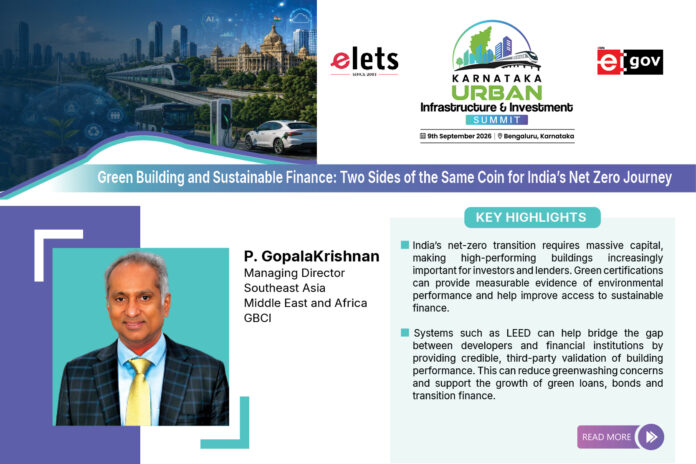
Views expressed by: P. GopalaKrishnan, Managing Director, Southeast Asia, Middle East and Africa, GBCI
About the author: P. GopalaKrishnan is Managing Director, Southeast Asia, Middle East and Africa at Green Business Certification Inc. (GBCI), the certification and credentialing body for LEED and other globally recognized green building rating systems. He has over 30 years of corporate experience across these markets and works closely with developers, investors, policymakers, and industry bodies to advance green building adoption and sustainable finance.
People Also Ask answers:
- What is a brown discount? Use the definition paragraph above.
- Do green buildings earn higher rents? The article cites a study of 42 international studies reporting an average 6% rental premium. Attribute it to JLL.