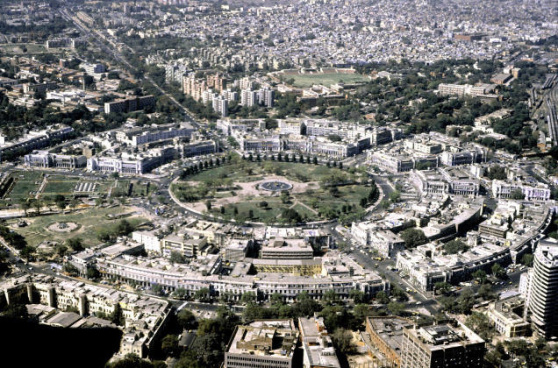
Haryana, as one of India’s fastest-urbanising states, confronts rapidly evolving mobility demands — from expanding residential clusters and tech parks to growing industrial hubs and greater integration with the Delhi NCR. In this dynamic context, HMRTC stands as a key public-institutional instrument in advancing the state’s urban-mobility mission.
Established on 24 March 2012, HMRTC is charged with planning, implementing and operating mass-transit systems (metros, rapid-rail, etc) within the state. Its role dovetails with the broader goal of making cities in Haryana efficient, connected and sustainable.
1. Expanding Metro & Rapid Transit Corridors
• HMRTC has approved two new metro routes in Gurugram: a 17 km route from Bhondsi village to Gurugram Railway Station via Sohna Road, and a 13 km corridor from Golf Course Extension Road to Sector-5.
• A draft corridor linking Palam Vihar to Dwarka Sector-21 (approx. Rs 1,687 crore) underscores HMRTC’s ambition to integrate Delhi & Gurugram mobility.
• HMRTC floated bids for DPRs (Detailed Project Reports) for two corridors: Railway Station to Bhondsi and Sector-5 to Golf Course Extension.
2. Gap-Analysis & Future-Readiness Recognising that mobility needs are changing fast, HMRTC recently initiated a study to map “missing links” in the Gurugram–Manesar urban complex. This will feed decisions on where new corridors, feeder services or intermodal integration is required.
3. Institutional Collaboration & Funding Models
Hmrtc is working in tandem with state agencies and the Centre.
• The metro project between Millennium City Centre and Cyber City (28.5 km, 27 stations, cost ~ ₹5,452.72 crore) is to be undertaken via a joint venture (50:50 between Centre & Haryana) under a new company.
• HMRTC’s funding model for metro projects includes land contribution by the State, central grants (20%), state support and other financial structuring.
Building the blueprint for smart, green mobility
• Alleviating congestion & environmental stress: As mobility shifts from private–vehicle dominance to mass-transit options, corridors planned by HMRTC promise to reduce journey times, emissions and traffic load.
• Economic & spatial integration: With industrial and IT clusters (e.g Manesar, Gurugram) growing, linking them via rapid transit strengthens labour access, boosts productivity and supports mixeduse development.
• Liveable cities & citizen experience: By emphasising last-mile connectivity, station-area planning and feeder systems, HMRTC aligns with the vision of making urban areas accessible and inclusive.
• Future-proofing: The gap-analysis study is a sign HMRTC isn’t just executing yesterday’s plans but preparing for tomorrow’s patterns of travel, lifestyle and land-use.
Strategic enablers for seamless mobility
• Innovative financing models: HMRTC is actively exploring diverse funding mechanisms and land value capture strategies to ensure the long-term financial sustainability of metro corridors. The focus is on creating business models that balance public benefit with operational efficiency.
• Integrated, multimodal connectivity: Recognising that true mobility lies in seamless integration, HMRTC is working closely with state ULBs, bus agencies, and private partners to ensure smooth first- and last-mile connectivity through aligned routes, digital ticketing, and commuterfriendly infrastructure.
• Efficient land management and coordination: HMRTC continues to prioritise proactive planning and inter- agency coordination to streamline project timelines. A structured approach to land management and approvals helps maintain steady progress on major corridor developments.
Also Read: Data is Already in the Ground: Powering the intelligent water utilities of the future
Looking ahead: Key themes for 2025 & beyond
• Station-area development / TransitOriented Development (TOD): HMRTC’s engagement with value capture (as referenced in its “Vision for Value Capture – Financing through TOD – Haryana Model”) shows an advanced understanding of mobility + land-use synergy.
• Digital / Smart mobility integration: Real-time passenger information, mobile ticketing, integrated payment ecosystems and datadriven route-planning will gain greater emphasis.
• Green & clean mobility: As corridors get built, complementing them with electric feeder fleets, cycling infrastructure and pedestrian zones will boost mobility sustainability.
• Regional connectivity: HMRTC’s support for extensions like the Delhi–Alwar rapid rail corridor up to Bawal signifies the shift from city-centric to region-wide perspectives.
HMRTC is emerging as a linchpin in Haryana’s urban mobility transformation. With ambitious plans, strategic corridor creation, and evolving institutional models, it is laying the groundwork for a mobility-rich future. For the state’s cities to truly become liveable, connected and efficient, the success of HMRTC’s initiatives will be one of the most important metrics to watch.
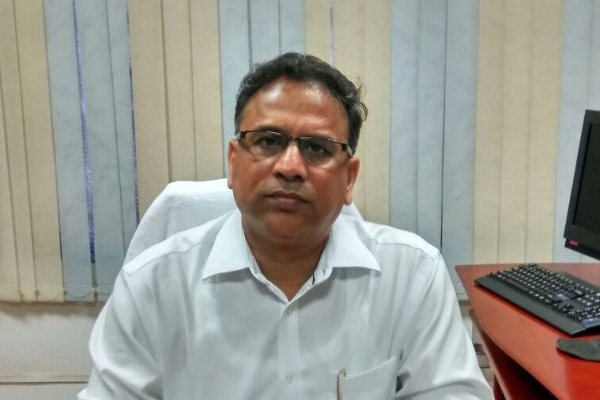
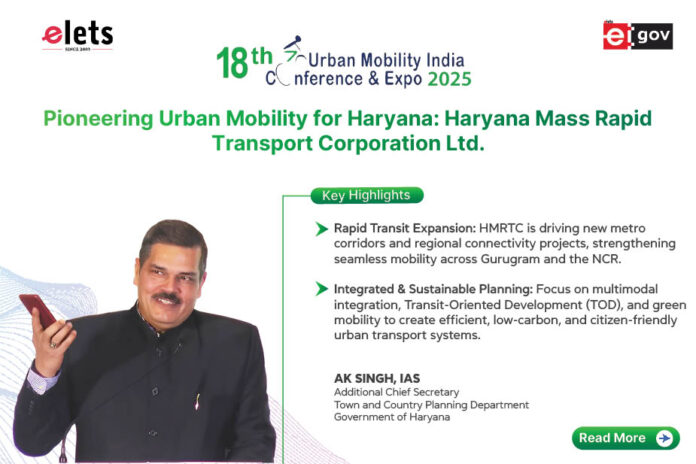
Views expressed by: Shri. AK Singh, IAS Additional Chief Secretary, Town and Country Planning Department Government of Haryana