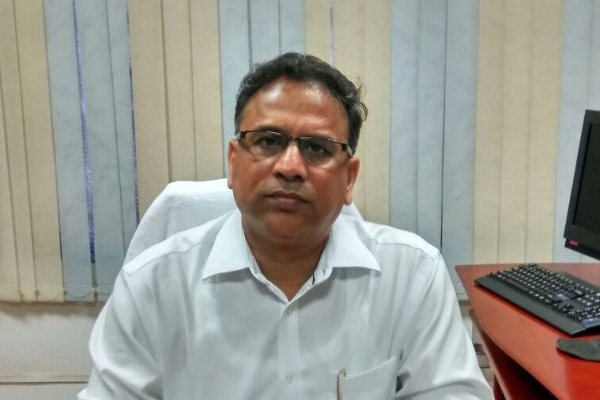
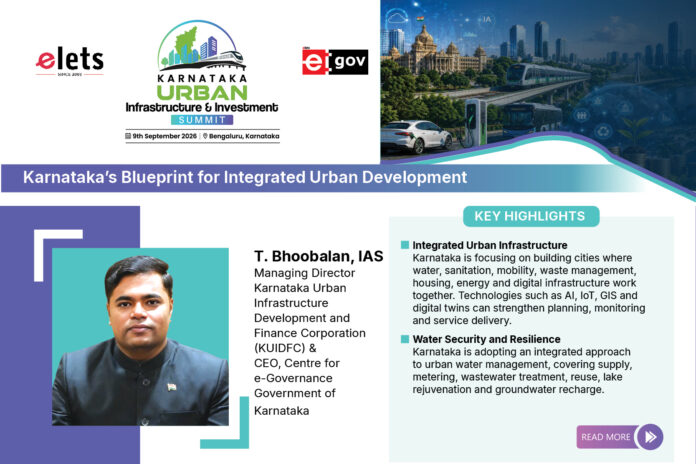
Karnataka is witnessing a significant phase of urban transformation, with growing cities creating new opportunities for integrated infrastructure, technology-led governance and sustainable development. As urbanisation accelerates, the focus is increasingly on strengthening water security, sustainable mobility, innovative financing, climate-resilient infrastructure and efficient public services. T. Bhoobalan, IAS, Managing Director, Karnataka Urban Infrastructure Development & Finance Corporation (KUIDFC) and CEO, Centre for Smart Governance, Government of Karnataka, in conversation with Abhineet Kumar of Elets News Network, shares his perspective on Karnataka’s urban development journey and the strategies shaping smarter, more connected, sustainable and future-ready cities.
Edited Excerpts:
1. Karnataka is emerging as one of India’s leading urbanising states. What is your vision for building smart, resilient and future-ready cities across the State?
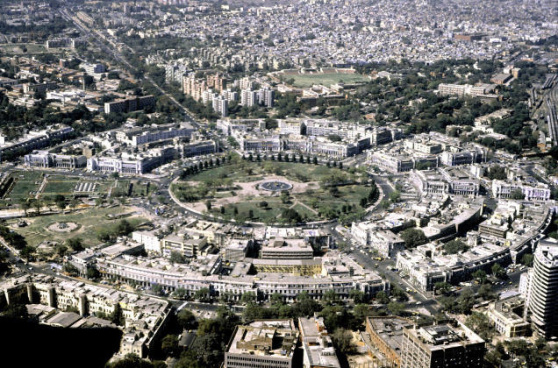
Karnataka’s urban transformation presents a significant opportunity to create cities that are productive, inclusive and future-ready. The State has consistently remained ahead of the national urbanisation trajectory, with its urban population estimated at 44.4 per cent in 2023, compared with 35.1 per cent for India. This growing urban footprint calls for infrastructure planning that is integrated with economic development, technology, sustainability and the evolving needs of citizens.
Our focus has been on developing urban systems where water, sanitation, mobility, waste management, housing, energy and digital infrastructure work together. Technology can play an important role through AI, IoT, integrated command and control centres, digital twins and real-time monitoring, enabling cities to make faster and more informed decisions.
The experience of Bengaluru’s water utility demonstrates how this approach can translate into measurable improvements. BWSSB has been integrating SCADA, GIS, AI-based monitoring and smart metering into water and sewerage operations. Its centralised SCADA system enables real-time monitoring of the water supply and sewerage network, while GIS-based mapping supports better planning and preventive maintenance.
For KUIDFC, the larger opportunity is to support projects that combine strong infrastructure with efficient service delivery and long-term sustainability. The objective is to create cities where infrastructure investments translate into measurable improvements in liveability, economic productivity and citizen experience.
2. Water security is becoming increasingly important for rapidly growing cities. How can Karnataka build sustainable and resilient urban water systems?
Urban water management is moving towards a more integrated approach covering the entire water cycle, from source and transmission to distribution, consumption, wastewater treatment and reuse. Karnataka has already demonstrated the potential of this approach through its 24×7 water supply initiatives. The World Bank-supported programmes in Hubballi-Dharwad, Belagavi and Kalaburagi have provided an important foundation for taking continuous and reliable water supply to a larger urban population.
The Karnataka Urban Water Supply Modernization Project, with an estimated project cost of around ₹2,657 crore, envisages 24×7 water supply across the corporation areas of these three cities. Earlier demonstration projects had already shown the potential of continuous supply, with around 230,000 people benefiting from 24×7 service in selected areas. The programme also introduced water metering and improved billing systems, linking better service delivery with more efficient resource management.
Bengaluru also provides important examples of how water security can be addressed through a combination of augmentation, conservation and reuse. BWSSB currently serves more than 14 million residents, with installed Cauvery water treatment capacity of 2,293 MLD. It operates 34 sewage treatment plants with a combined capacity of 1,348.50 MLD, while treated wastewater is increasingly being reused for environmental and commercial purposes.
Lake rejuvenation and groundwater recharge are equally important. BWSSB has reported the rejuvenation of 274 lakes using treated wastewater, while rainwater recharge pits and water-saving measures such as aerators are being deployed to strengthen demand-side management. These interventions demonstrate that urban water security cannot depend solely on creating additional supply.
Going forward, the focus can expand towards wastewater reuse, scientific stormwater management, lake and catchment rejuvenation, smart metering and technology-enabled monitoring. The objective is to create urban water systems where every component, from supply to treatment and reuse, contributes to long-term water security.
3. Urban infrastructure requires significant and sustained investment. What financing models can help Karnataka create a stronger pipeline of bankable urban projects?
Financing urban transformation requires a diversified ecosystem that brings together government resources, multilateral institutions, institutional finance, PPPs and capital-market instruments. Karnataka has considerable experience in leveraging external assistance for urban infrastructure, with KUIDFC serving as an important institutional platform for project development, financing and implementation.
The State also has a strong track record in innovative municipal finance. The Karnataka Water and Sanitation Pooled Fund previously demonstrated how pooled financing and municipal bonds could bring capital-market resources into urban infrastructure. More recently, the Karnataka Budget for 2026-27 provided for municipal bond-based financing by city corporations under the Greater Bengaluru Authority, while the State’s Bengaluru development allocation was continued at ₹7,000 crore.
There is also scope to build on Karnataka’s experience with multilateral and PPP-based urban infrastructure projects. Bengaluru’s water sector, for instance, has seen JICA- and World Bank-supported programmes as well as private-sector participation in treated wastewater reuse and related infrastructure.
The next phase is about developing a larger pipeline of technically sound, financially structured and investment-ready projects. Strong project preparation, credible revenue models, appropriate risk-sharing mechanisms and transparent governance can help attract institutional and private capital. KUIDFC can play an important role in bringing these elements together and supporting urban local bodies in developing projects that are ready for long-term investment.
Also Read: Bengaluru’s Water Transformation: How BWSSB is Rewriting Urban Water Governance
4. Bengaluru and other cities in Karnataka are expanding public transport and sustainable mobility infrastructure. How can the State build a truly integrated urban mobility ecosystem?
The future of urban mobility will be shaped by integration across different modes of transport. Bengaluru’s growth makes this particularly important, and the city’s mobility ecosystem is evolving through metro expansion, bus-based public transport, suburban rail, electric mobility and improvements in first-mile and last-mile connectivity.
The opportunity is to bring these modes together through integrated planning, intelligent traffic management, transit-oriented development and technology-enabled passenger services. Data can help authorities understand travel patterns in real time and improve route planning, traffic management and network efficiency. Electric mobility can further support the transition towards cleaner urban transportation, particularly in public and shared mobility.
The larger objective is to make public transport the preferred, convenient and efficient choice for citizens. Well-connected mass transit, walkable neighbourhoods, cycling infrastructure, EV charging networks and seamless last-mile connectivity can together create a mobility system that supports economic growth while enhancing the overall quality of urban life.
This integrated approach is also important when planning urban infrastructure more broadly. Mobility, land use, housing, water and other civic systems cannot be planned in isolation. Future urban projects should therefore be evaluated not only in terms of physical infrastructure created, but also in terms of connectivity, accessibility, resource efficiency and the quality of services delivered to citizens.
5. Climate resilience and net-zero development are becoming central to the future of cities. What should Karnataka’s approach be towards creating low-carbon and climate-ready urban centres?
Climate resilience provides an opportunity to rethink how we design and manage urban infrastructure. Karnataka has a diverse climate profile, with around 77 per cent of its land classified as arid or semi-arid, making efficient management of water, energy and natural resources particularly important. Urban infrastructure therefore needs to incorporate resilience and resource efficiency right from the planning and design stage.
Water management will be an important part of this transition. Bengaluru’s experience demonstrates the value of combining lake rejuvenation, wastewater reuse, groundwater recharge, rainwater management and demand-side conservation. Such measures can strengthen resilience against both water scarcity and extreme rainfall. BWSSB’s approach of using rejuvenated lakes as groundwater recharge and runoff-buffering assets illustrates how urban ecological infrastructure can complement conventional infrastructure.
There is significant potential to combine climate resilience with the State’s economic and technological strengths. Renewable energy, energy-efficient buildings, electric mobility, smart grids, energy storage, wastewater reuse, circular waste management and AI-enabled energy management can collectively support lower-carbon urban development. These interventions can also create new opportunities for innovation, investment and green jobs.
For KUIDFC and its urban partners, the long-term vision should be to create infrastructure that remains efficient and adaptable across its entire lifecycle. With Bengaluru’s population projected to grow substantially in the coming decades, planning today with a 2040 and 2050 perspective will be essential. Future-ready cities will be those that combine economic dynamism with resource efficiency, climate resilience, technology and high-quality public services.
6. How can digital governance and emerging technologies strengthen urban service delivery and municipal administration?
Digital technologies are increasingly becoming an integral part of urban governance. The objective should not be technology adoption for its own sake, but the use of technology to improve planning, monitoring, service delivery, transparency and accountability.
Karnataka has significant scope to build an integrated digital urban ecosystem by combining GIS, AI, IoT, digital twins, real-time dashboards and citizen-facing platforms. Bengaluru’s water sector provides an example, with SCADA, GIS, AI-based monitoring, online service platforms and IoT-enabled tanker management being used to improve operational efficiency and citizen services.
At the institutional level, digital systems can help urban local bodies move towards data-driven decision-making, predictive maintenance, better revenue management and faster grievance redressal. Interoperability among different government platforms will also be important so that departments and agencies can work with a common understanding of urban infrastructure and service requirements.
The larger objective is to create a citizen-centric digital governance framework in which technology strengthens institutional capacity and enables urban authorities to respond more efficiently to changing requirements.