In many Indian cities, nearly 40 per cent of treated water never reaches consumers. Although the water passes quality checks and enters the distribution network, it is lost through ageing pipelines, leaks, pressure fluctuations, and poorly monitored supply systems. Officially termed non-revenue water, this problem reflects a deeper issue: utilities often lack real-time visibility into their networks.
For years, the solution has focused on expanding infrastructure through initiatives such as Jal Jeevan Mission, AMRUT 2.0, and the Smart Cities Mission. While these programmes have significantly strengthened urban water infrastructure, new assets alone cannot fix systems that remain largely invisible once water leaves the treatment plant.
Three major challenges persist. First, monitoring usually stops at the treatment facility, leaving distribution networks untracked. Second, utilities face a shortage of technical expertise even as pumping costs account for up to 40 per cent of operational expenses. Third, most cities still rely on intermittent water supply, where water flows only for limited hours each day. This creates negative pressure in pipelines, increases contamination risks, and makes efficient network management far more difficult.
AMRUT 2.0’s push towards 24×7 water supply is both timely and necessary. However, moving towards continuous supply without first understanding where losses occur can lead to costly and inefficient capital investments.
India has overcome such structural gaps before. Rural connectivity did not wait for copper cable. The country leapfrogged the landline era, moved directly to mobile networks, and built a digital economy on new infrastructure. Urban water systems now have a similar opportunity: build the intelligence layer first, identify where losses are concentrated, and direct physical investments where they are truly needed.
The water sector is now entering a stage where artificial intelligence, digital twins, sensors, SCADA integration, and real-time analytics can transform how utilities operate. AI can reduce the dependence on manual analysis and help engineers make faster, more accurate decisions. What earlier required weeks of technical assessment can now be done in hours, with expert oversight focused on validating results and improving outcomes.
This is no longer theoretical. At Rashtrapati Bhavan in New Delhi, integrated treatment and reuse systems have helped increase the share of water reused on the premises. In Karnataka, AIenabled pumping has supported real-time river-to-reservoir transfers during periods of water stress. In Jamnagar, decentralised reuse models are demonstrating how circular water systems can work at a utility scale when digital intelligence is built into the design.
The common factor across these examples is data integration. Platforms such as Xylem Vue connect sensors, SCADA, and business data into a single real-time system. This enables leak localisation, pressure zone optimisation, digital twin modelling, and better planning for the transition from intermittent to continuous supply. In international deployments, such platforms have helped reduce non-revenue water by more than one-third and improve network efficiency significantly.
Of course, technology cannot replace pipes, pumps, or treatment plants. Sensors cannot repair broken pipelines. AI cannot compensate for networks designed for cities much smaller than they are today. Physical infrastructure will still be essential.
But sequencing matters. When utilities deploy intelligence first, they can identify the small parts of the network responsible for the biggest losses. This makes infrastructure investment more targeted, accountable, and defensible. Every smart meter installed, every SCADA upgrade completed, and every distribution network commissioned adds to the data foundation of a future-ready water utility.
The message is clear: understand the system before rebuilding it.
India’s water security is no longer just a policy aspiration. It is being planned, priced, tendered, and built today. The real question is not whether AI will reshape urban water management. The question is whether this transformation will happen with the right domain expertise, accountability, and urgency.
The data is already in the ground. The tools are here. What India’s water utilities need now is the intelligence to listen, act, and deliver reliable water to every citizen.
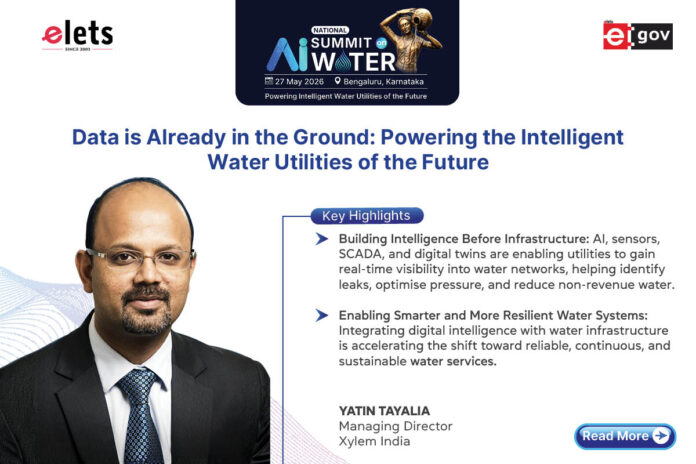
Views Expressed by: Yatin Tayalia, Managing Director, Xylem India