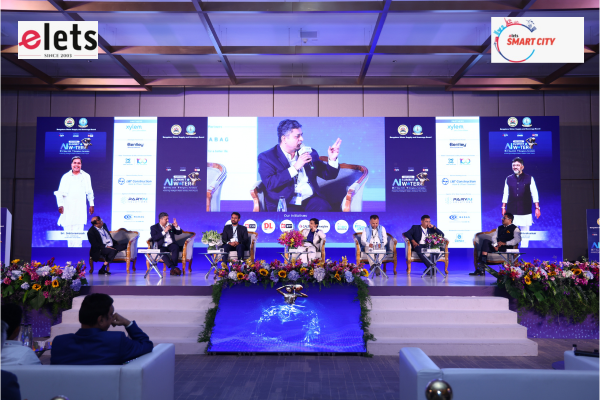
A wide-ranging panel discussion on Building India’s Digital Water Stack brought together policymakers, technologists, academicians and utility leaders to examine how digital and artificial intelligence tools can reshape the way India manages its water resources. The conversation moved across urban and rural contexts, from command-and-control centres in metropolitan corporations to volumetric billing in gram panchayats, and from foundational AI infrastructure to pump-level intelligence, underscoring that the digital water stack is not a single technology but a layered ecosystem of data, infrastructure, people, utilities and solution providers working together.
The session was held during the National AI Summit on Water 2026 in Bengaluru, and it captured the urgency of India’s water challenge alongside the promise of technology to address it. Panellists repeatedly returned to the idea that data already exists across departments and utilities, often trapped in silos, and that the real opportunity lies in integrating this data into intelligent, predictive and even prescriptive systems that can serve citizens, administrators and farmers alike.
Speaker Perspectives
Kumar Saket, Associate Partner, KPMG
The discussion opened with a vision of a country where every household, urban or rural, can rely on clean water whenever needed, and where a water utility can view every pipe, meter, household and asset on a single screen. This framing described systems capable of alerting managers to problems before they occur, giving farmers visibility into borewell levels in advance, and grounding infrastructure decisions such as new dams in real-time, trustworthy data rather than paper records. Collectively, this was presented as the essence of India’s digital water stack and the application of AI to water management.
KN Ramesh, Commissioner, Bengaluru South City Corporation
Digital and e-governance were described as transformative forces for how government functions, particularly in a city facing population growth, illegal tapping of supply and pressure drops in the network. The SMART framework was outlined, standing for simple, moral, accountable, responsible and transparent governance, as a guiding principle for public digital systems. A key challenge highlighted was that departments have historically worked in silos, each building its own IT system, leaving a wealth of data, including satellite imaging of water bodies, remote sensing data, GPS-mapped networks and water quality readings, underutilised. Artificial intelligence was positioned as the means to shift governance from a reactive posture to a proactive one, enabling public grievance systems to categorise complaints and detect duplicates automatically. Reference was made to Karnataka’s digital water stack project, launched around August 2025 and focused on groundwater extraction across 41 talukas, as well as the state’s track record of IT pioneering through systems such as Bhoomi, e-procurement and Kaveri. A stark statistic was shared: one district in Karnataka currently faces severe water shortage, a number projected to rise to eight districts by 2050, reinforcing the message that every drop counts and that digital intervention is essential to averting a deeper water crisis.
Dr Lakshminarayana Rao, Associate Professor, IISc Bengaluru
Building on the idea that what gets measured gets managed, the point was extended to note that what gets measured through an AI system can generate intelligent, actionable decisions. Five foundational layers were laid out for any functioning AI water stack: large volumes of good, well-annotated data; robust infrastructure including high-performance computing and data centres; skilled people to convert data into usable systems, an area where institutions such as IISc and Bengaluru’s academic ecosystem play a strong role; a utility willing to host and apply these systems, with BWSSB cited as an example; and companies capable of propagating the technology to reach the masses. Long-standing experience working with BWSSB and other government agencies was cited to illustrate that data frequently sits unused in silos due to reluctance to share, whether from fear or a perceived loss of relevance, a barrier that needs to be addressed for AI systems to succeed.
Tushar Tyagi, Strategic Manager, Digital & Treatment Solutions, Xylem
AI was described as a journey rather than an instant solution, dependent on historical data and built through multiple modules over time. It was noted that Indian utilities are progressing at very different paces, with some still at the stage of installing SCADA systems or floating tenders for treatment infrastructure, while others are considerably more advanced, meaning implementation approaches must be tailored to each utility’s maturity. An example from Xylem’s management of water systems in Valencia, where a digital twin of the drinking water network enables predictive maintenance, was shared to illustrate how AI can flag pressure anomalies at specific nodes in real time, allowing intervention before a pipe failure occurs, thereby reducing cost, response time and disruption to users.
Anil Sethi, Founder & Chairman, iPUMPNET
A shift in framing was proposed, moving beyond the conventional source-to-tap view of water supply to a closing-the-loop approach that also considers tap-to-source, reflecting a circular use of water. It was emphasised that every rupee saved in operations and maintenance translates into a benefit that can be passed on to consumers. Pumping stations were described as the heartbeat of the water supply system, since their failure collapses the entire network, yet most utilities lack visibility into whether that heartbeat is healthy. Practical examples were shared, including the importance of optimal pump sequencing, since running the same efficient pumps continuously can lead to their premature wear, and the value of moving beyond predictive alerts to prescriptive recommendations rooted in root-cause analysis. It was also pointed out that while pumps receive significant attention, the motors driving them are often neglected, with burnout being common; intelligent tools were said to be able to flag motor failure risks up to six months in advance based on analysis across more than 200 pumping stations nationally.
Narwade Vinayak Karbhari, CEO, Dakshina Kannada Zilla Panchayat
A distinct rural perspective was offered, noting that while much of the discussion around water administration tends to focus on urban utilities, rural governance faces its own constraints, particularly limited financial and human resources, with many zilla and gram panchayats operating with significant staff vacancies. Dakshina Kannada’s recent move to a flat water billing rate was described as creating unintended strain on infrastructure, since planning assumptions such as those used under the Jal Jeevan Mission are based on average per-person consumption projections that do not account for uneven usage. Digital volumetric billing was presented as a response, using an app that records meter readings and generates transparent bills, reducing disputes and encouraging conscious water use as people become more aware of their consumption and its cost. Looking ahead, the ambition articulated was for AI to guide maintenance scheduling for physical infrastructure, identify the most energy-efficient pumps to optimise electricity costs, and support better planning of water sources to reduce dependence on tankers, particularly given the health risks associated with unverified tanker water sources during summer shortages.
Key Insights
- India’s digital water stack is best understood as a layered system, spanning good annotated data, computing infrastructure, skilled people, willing utilities and technology providers, rather than any single tool or platform.
- A recurring barrier across urban and rural contexts is data sitting in departmental silos, often unused due to reluctance to share; unlocking this existing data is as important as generating new data.
- The shift from reactive to proactive, and eventually prescriptive, water management, whether through predictive maintenance of pipes and pumps or preemptive grievance redressal, was framed as the core value proposition of AI in this sector.
- Rural and urban water administrations face different constraints, with rural panchayats particularly limited by staffing and finances, meaning AI applications need to be tailored to local realities such as volumetric billing and tanker source planning.
- Practical, granular interventions, such as optimal pump sequencing and early motor-failure detection, demonstrate that AI’s impact in water management often lies in operational details rather than only in large-scale command centres.
Conclusion
Across urban command centres, rural panchayats, academic research and specialised technology solutions, the panel converged on a shared understanding that India’s water challenges, from urban demand pressures to rural infrastructure gaps, require a coordinated digital and AI-driven response built on trustworthy data and collaborative institutions. The discussion reflected both the scale of the task, evidenced by projections of worsening water scarcity in the coming decades, and the tangible progress already underway, from Karnataka’s digital water stack initiative to utility-level predictive maintenance and rural volumetric billing. The collective message was one of cautious optimism: the foundational pieces- data, infrastructure, talent, willing utilities and capable technology partners- are increasingly falling into place, and the task ahead is to knit them together into a coherent, proactive and citizen-centric water governance system for the whole country.