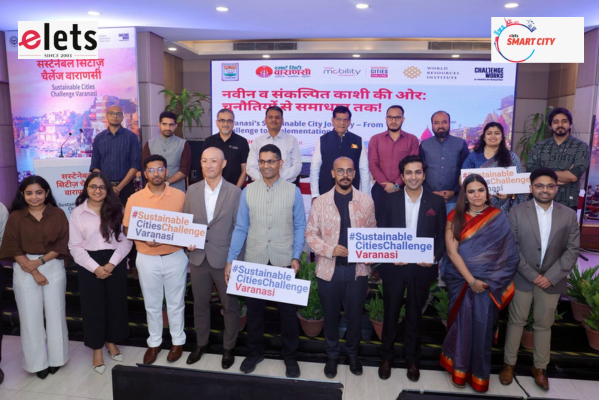
VARANASI, INDIA: Following the announcement of the winners of the Sustainable Cities Challenge (SCC) Varanasi, the city is preparing to scale innovative mobility and crowd-management solutions that will enhance pedestrian movement, accessibility, and the experience of residents and visitors across its historic core, Kashi. The initiative is led by Varanasi Nagar Nigam in collaboration with the Toyota Mobility Foundation (TMF), Challenge Works, and WRI India.
CityFlow by CITYDATA.AI and Nippon Koei, and Janjatra by The Urbanizer were selected as winners and will receive financial and advisory support to scale their solutions across the old city. Behtarway by VOGIC AI and Nayichaal by Prameya Consulting were recognised as Honourable Mentions for their contributions towards more inclusive and efficient mobility in Varanasi.
The event was graced by Shri Arvind Kumar Sharma, Honourable Minister, Ministry of Urban Development, Government of Uttar Pradesh. He expressed his enthusiasm for scaling the innovative solutions emerging from the Challenge and looked forward to their positive impact in Varanasi.
Designed to address the complex movement of millions of pilgrims, tourists, and residents through Varanasi’s dense heritage precincts, the selected solutions combine advanced technology and people-centred design to enhance navigation, improve safety, and support proactive crowd management.
CityFlow, developed by CITYDATA.AI in partnership with Nippon Koei, uses big data, computer vision, and generative AI to analyse and manage crowd movement in real time, helping authorities identify and respond to congestion hotspots. Janjatra, developed by The Urbanizer, combines colour-coded wayfinding, dynamic digital signage, and tactical urban interventions to improve navigation and ease pressure on heavily used pedestrian routes. The Honourable Mention solutions complement these efforts through targeted mobility interventions. Behtarway, developed by VOGIC AI, is an AI-powered hyperlocal pedestrian navigation platform, while Nayichaal, developed by Prameya Consulting, focuses on improving accessibility and navigability for vulnerable populations in the old city of Kashi.
The selected teams emerged from a two-year challenge process that brought together innovators, city authorities, mobility experts, and local stakeholders to develop practical and scalable approaches to crowd and pedestrian management. As implementation moves forward, the winning and Honourable Mention solutions are expected to support a safer, more accessible, and seamless experience for residents and visitors navigating Varanasi’s historic urban core.
Himanshu Nagpal, IAS, Municipal Commissioner, Varanasi Nagar Nigam and CEO, Varanasi Smart City Limited, said:
“Managing the movement of millions of pilgrims, tourists, and residents through a dense and historic urban fabric requires new approaches that balance heritage preservation with modern city management. The solutions emerging from the Toyota Mobility Foundation’s Sustainable Cities Challenge demonstrate how data-driven technologies, wayfinding innovations, and human-centred design can help cities anticipate and respond to crowding challenges more effectively. As Varanasi continues to evolve as a global cultural and spiritual destination, these interventions will support safer, more efficient, and more accessible movement across the city’s historic core.”
Prasanna Ganesh, Executive Program Director, Toyota Mobility Foundation, said:
“The innovators recognised today have successfully transformed the challenges of a historic city into opportunities for innovation. Their solutions have progressed beyond pilot concepts and now help city authorities manage overcrowding while providing residents and visitors with a smoother, safer, and more convenient mobility experience in Varanasi. At Toyota Mobility Foundation, we focus on practical and scalable innovations that combine technology, sustainability, and collaboration. Our goal is to help create mobility ecosystems that improve quality of life and ensure Mobility for All.”
Kathy Nothstine, Director of Cities and Societies at Challenge Works, said:
“By implementing cutting-edge innovations in an immensely historic and spiritual setting, Varanasi is demonstrating its leadership in pairing future-facing technology with human-centred urban design. We look forward to seeing how Varanasi’s winners continue to implement solutions that help people move around the city safely and enjoyably.”
Avinash Dubedi, Head, Sustainable Cities and Transport, WRI India, said:
“Varanasi is showing how historic cities can use innovation to address today’s mobility challenges. The selected solutions combine real-time data, digital technologies, urban design, behavioural insights, and accessibility-focused planning to manage pedestrian movement more effectively. Beyond easing crowd congestion, they offer a framework for creating people-centric public spaces that improve safety, accessibility, and visitor experience while preserving the city’s unique character. As these solutions scale, Varanasi can become a model for heritage and pilgrimage cities worldwide seeking to integrate mobility management with inclusive urban design.”
Supporting the challenge through on-ground engagement and the amplification of its various initiatives in India, Toyota Kirloskar Motor has worked alongside the Toyota Mobility Foundation to advance implementation in the country.
Vikram Gulati, Country Head and Executive Vice President, Corporate Affairs, Toyota Kirloskar Motor, said:
“We are truly inspired by the commitment, creativity, and ingenuity demonstrated by the selected teams in developing innovative solutions that contribute to the sustainable management of India’s historic marvels. Their ideas present exciting opportunities to enhance crowd management in Varanasi while setting new benchmarks in urban mobility and public safety. We commend their efforts in harnessing innovation to address real-world challenges and creating meaningful societal impact.”
As Varanasi moves towards implementation, the Sustainable Cities Challenge marks an important milestone in demonstrating how innovation, collaboration, and technology can address complex urban mobility challenges in heritage cities. By bringing together government, industry, and urban innovators, the initiative not only aims to enhance safety, accessibility, and the visitor experience in Kashi but also establishes a scalable model for other historic and pilgrimage destinations across India and globally seeking sustainable, people-centric mobility solutions.