

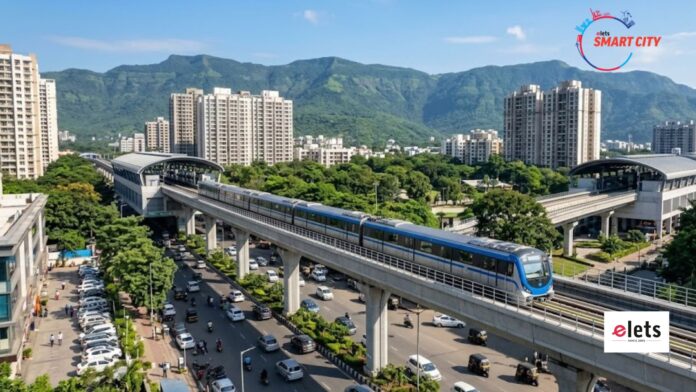
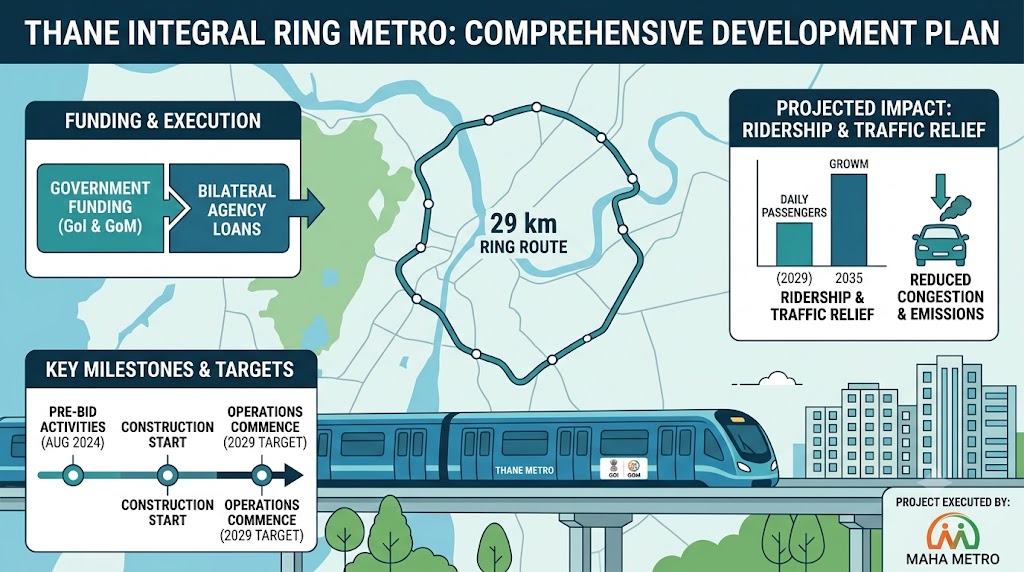
Thane Integral Ring Metro Rail Project in Maharashtra got a nod from the Union Cabinet on 16 August 2024. The 29 km corridor is expected to cost ₹12,200.10 crore. Operations are expected to start in 2029. The metro line will be operated on the western periphery of Thane city, bounded by the Ulhas River and Sanjay Gandhi National Park. It will serve Kolshet, Hiranandani Estate, Dongripada, Wagle Estate, Saket and Naupada. Out of the total 29 km, 26 km will be elevated and 3 km underground. The route will stop at 22 stations.
Funding and Finance

The project will be jointly funded equally by the Government of India and the Government of Maharashtra. Part-funding will be provided by bilateral agencies. Additional financing will be through the sale of station naming and access rights, monetizing project assets and Value Capture Financing. The release did not say what each funding source will contribute. Maha Metro will execute the project comprising civil, electromechanical and other associated works. Pre-bid activities have commenced and tender documents are being prepared. “contracts will be floated for bidding simultaneously,” the release says.
Impact and Ride Count
The government estimates that the metro will carry 6.47 lakh passengers daily by 2029, which will go up to 7.61 lakh in 2035 and 8.72 lakh in 2045. The corridor is expected to improve transportation efficiency, relieve traffic congestion, spur economic growth and reduce greenhouse gas emissions. The release notes details benefits for students and daily commuters. No details on individual contract timelines and the breakdown of bilateral funding are provided in the release. Issued in August 2024. Current tender status or applicability of the 2029 target has not been independently verified. Readers should check with Maha Metro or Ministry of Housing and Urban Affairs for the latest updates.
Read More: Srinagar Smart City awards
Maintenance directions of Qayoom emphasized that the long-term success of Srinagar Smart City projects depends not just on timely construction, but on continuous maintenance and active public use.