


Karnataka is growing fast, and its cities are changing with it. New neighbourhoods are coming up, infrastructure is expanding, and economic activity is reaching new parts of the state. But this growth is also bringing a question that cities can no longer ignore: Are we building cities that can cope with a changing climate?
Heavy rain can quickly put pressure on roads and drainage systems. Longer dry periods can make water harder to manage, while rising temperatures can affect everyday life, public health and energy use. These are not problems for the distant future. They are already becoming part of the way cities have to plan and operate.

Karnataka also faces a unique challenge because of its varied geography. The state stretches from the Western Ghats and the semi-arid Deccan Plateau to the coastal belt, with each region facing its own climate pressures. Some areas are more vulnerable to drought and water shortages, while others face intense rainfall, flooding, heat, and coastal risks.
This makes climate resilience an important part of Karnataka’s urban future. The focus cannot be only on dealing with problems after they happen. Cities need to plan, protect their natural systems, and build infrastructure that can handle changing conditions.
The goal is not to stop growth. It is to make sure that growth is safer, smarter, and prepared for the years ahead.
From Responding to Risks to Planning for Them
Urban flooding offers one of the clearest examples.
Rapid urbanisation, changes in natural drainage, encroachment of water channels and increasing paved surfaces can intensify the impact of heavy rainfall. Karnataka’s disaster-management framework recognises urban flooding as an important challenge, alongside heat, drainage and runoff management, wetlands, rainwater harvesting and early-warning systems.
The implication is simple: a city’s resilience is often determined long before the rain arrives.
A stormwater drain is not simply a drainage asset. A lake is not merely a waterbody. A park is not just an amenity. A tree canopy is not only landscaping. Together, they form part of the infrastructure that helps a city absorb climate shocks.
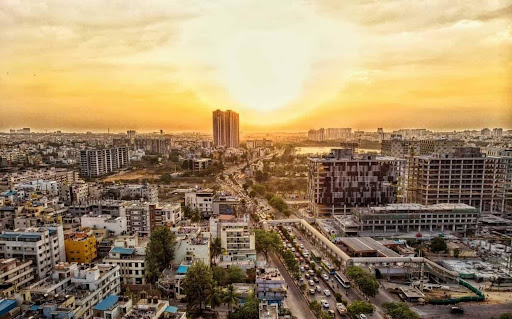
Bengaluru provides a powerful example. Its interconnected lakes and drainage systems historically played an important role in storing and moving rainwater. Protecting these ecological systems is therefore not just about conservation; it is also about protecting urban infrastructure and reducing vulnerability.
This thinking needs to extend to Karnataka’s emerging cities, where urban expansion still offers an opportunity to protect natural drainage channels, wetlands and open spaces before development makes them difficult and expensive to recover.
The Resilience Checklist
- Protect natural drainage and floodplains
- Restore lakes, wetlands and recharge zones
- Integrate climate risk into master plans
- Use GIS and real-time data for risk mapping
- Design infrastructure for future climate conditions
Bengaluru’s Climate Roadmap: A Model for Urban Transformation
Bengaluru has begun moving towards a more structured approach through the Bengaluru Climate Action and Resilience Plan (BCAP).
The plan takes an integrated view of water, waste, mobility, energy, buildings and green spaces, recognising that these systems are closely connected.
Its water strategy calls for greater conservation, wastewater reuse and restoration of “sponge spaces”, areas capable of absorbing and retaining rainwater. The plan targets 40 per cent of the city’s surface area becoming permeable by 2040 through ecological restoration and nature-based solutions. It also targets treated wastewater reuse of at least 50% by 2030 and 90% by 2050.
These targets represent an important change in urban thinking.
Instead of relying exclusively on larger drains and other hard infrastructure, cities can work with natural systems. Rain gardens, permeable surfaces, restored wetlands, urban forests, rejuvenated lakes and decentralised water systems can reduce runoff, support groundwater recharge, moderate local temperatures and improve public spaces.
The greenest infrastructure can also be some of the most practical infrastructure.
Water Security Will Define Urban Resilience
For Karnataka, climate resilience is inseparable from water security.
The state’s geography creates sharp variations in water availability. Parts of northern and central Karnataka face recurring drought and water stress, while the Western Ghats and coastal regions experience intense rainfall and flood-related risks. Future climate variability makes managing these extremes even more important.
Urban planning must consequently move beyond the traditional model of simply bringing more water into cities. The future lies in a combination of conservation, rainwater harvesting, wastewater treatment and reuse, groundwater recharge, and protection of urban water bodies.
Cities also need a better understanding of their complete water cycle, where water comes from, where it is consumed, how much is lost, and how much can be recovered and reused.
Initiatives under AMRUT 2.0, including shallow aquifer management, are encouraging cities to integrate groundwater mapping and recharge into urban planning. Bengaluru was among the cities covered under the initial pilot.
As Karnataka’s urban population and economic activity expand, water resilience should become a basic consideration in housing, industrial areas, commercial developments, and new urban extensions.
Designing Cities for Heat
Flooding may be the most visible climate risk, but extreme heat is becoming equally important. Dense construction, extensive paved surfaces, traffic and limited vegetation can contribute to urban heat-island effects, making neighbourhoods less comfortable during hot periods.
Heat resilience therefore needs to enter the design of everyday infrastructure.
More trees along streets can provide shade. Cool roofs can reduce heat entering buildings. Better ventilation can reduce dependence on mechanical cooling. Public transport stops can incorporate shade and drinking-water facilities, while parks and open spaces can be distributed strategically across neighbourhoods.
Karnataka’s Heat Wave Action Plan highlights preparedness measures including drinking-water availability, functioning urban water infrastructure and coordination across departments.
But preparedness alone is not enough.
The better question is: Can neighbourhoods be designed so that extreme heat has less impact in the first place?
Climate-Ready Streets and Mobility
A city cannot be truly resilient if people cannot move safely during extreme weather.
Flooded roads, unusable footpaths, exposed bus stops and poorly drained streets can turn a weather event into a mobility crisis. For Karnataka’s emerging cities, this presents an opportunity to get the basics right from the beginning. New roads can integrate drainage, pedestrian infrastructure, shade, trees and cycling facilities. Public transport can be planned alongside land use rather than introduced after urban form has already been established.
A resilient street should work on an ordinary day, and remain functional on an extraordinary one.
This approach also makes streets more inclusive, particularly for children, older citizens, pedestrians, cyclists and people with disabilities.
The Coast Needs a Different Kind of Resilience
Karnataka’s climate strategy cannot overlook its coastal cities. The state has a coastline of around 320 kilometres, and its climate planning recognises risks associated with sea-level rise and impacts on coastal infrastructure and livelihoods.
For Mangaluru, Udupi and other coastal settlements, resilience will require careful land-use planning, protection of wetlands and natural buffers, climate-sensitive infrastructure and stronger preparedness. The answer is not necessarily to build harder barriers everywhere. Mangroves, dunes, wetlands and other coastal ecosystems can act as natural buffers while supporting biodiversity and local livelihoods.
This is where nature-based resilience becomes particularly relevant: cities can strengthen the ecosystems that already provide protection rather than relying entirely on concrete solutions.
Resilience Must Become an Investment Strategy

Climate resilience should not be viewed as an additional cost attached to an infrastructure project. It should be understood as an investment in that infrastructure’s long-term performance.
A road designed without considering future rainfall may require repeated repairs. A housing project designed without heat considerations can increase cooling demand. A city that allows lakes and wetlands to disappear may eventually spend far more on flood management and water supply.
The cost of resilience must be measured against the cost of not being resilient.
CITIIS 2.0 is one example of the wider national shift towards climate-sensitive planning, evidence-based decision-making, climate governance and investment in urban climate action.
For Karnataka, this creates opportunities for green finance, public-private partnerships, technology-led infrastructure management and climate-linked investment.
Where Investment Can Make a Difference
- Water: Conservation, reuse, recharge and resilient supply systems
- Infrastructure: Climate-proof roads, drainage and public facilities
- Nature: Lakes, wetlands, forests and green corridors
- Technology: GIS, sensors, early-warning systems and climate data
- People: Heat preparedness, inclusive spaces and community participation
Building Resilience Beyond Bengaluru
The future of climate-resilient Karnataka cannot be built around Bengaluru alone.
Mysuru, Hubballi-Dharwad, Belagavi, Tumakuru, Mangaluru, Udupi and other growing urban centres are becoming increasingly important engines of economic activity. Their expansion presents something Bengaluru no longer has in the same measure: the opportunity to build resilience into urban growth from the start.
Climate-risk maps should inform master plans. Natural drainage networks should be treated as strategic infrastructure. New development should consider water availability and heat exposure. Early-warning systems should be strengthened, while municipal bodies need the skills and data required to manage climate risks.
Resilience must also be local. The challenges faced by a coastal city will not be identical to those of a dryland city in northern Karnataka. City-level climate planning must reflect local geography, economic activity, infrastructure capacity, and community needs.
A Future That Is Designed, Not Predicted
Karnataka does not have to choose between economic growth and climate resilience. Increasingly, the two depend on each other.
The cities that attract businesses, talent and investment in the coming decades will be those that can offer reliable water, efficient mobility, dependable infrastructure, healthier public spaces and the ability to withstand climate shocks. The task ahead is larger than building stronger drains or planting more trees. It is about changing how urban development itself is imagined, from short-term expansion to long-term preparedness.
Karnataka already has many of the ingredients required for this transition: strong institutions, a technology ecosystem, scientific expertise, urban programmes and an increasingly sophisticated infrastructure sector. The next step is to connect these strengths. A climate-resilient city is not one where climate risks disappear. It can absorb a shock, recover quickly, and continue to provide a good quality of life.
For Karnataka’s next generation of cities, that should not be an aspiration for tomorrow. It should be the foundation of development today.
Written by: Sahaj Anand | Elets News Network (ENN)