

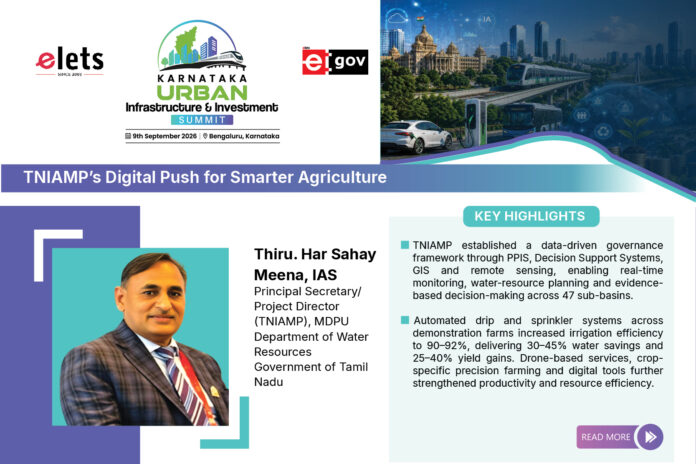
The Tamil Nadu Irrigated Agriculture Modernisation Project (TNIAMP), implemented from 2018 to 2025, was designed to enhance the productivity and climate resilience of irrigated agriculture, strengthen water management, and expand market access for farming communities across 47 sub-basins in 34 districts of Tamil Nadu. Jointly financed by the World Bank (US$318 million) and the Government of Tamil Nadu (US$136 million), the project built on the foundation of the earlier IAMWARM project and adopted a multi-sectoral, sub-basin-based development approach spanning irrigation, agriculture, horticulture, livestock, fisheries and agricultural marketing.
Implementation was coordinated by the Water Resources Department (WRD) through a Multi-Disciplinary Project Unit (MDPU), working with seven line departments and three universities. The project benefited more than 6.56 lakh farmers, including 1.37 lakh women — 131% of the 5 lakh target. Across its components, TNIAMP embedded two distinct but complementary streams of IT-enabled interventions: an institutional monitoring and decision-support stream, and an agriculture-side precision-farming and automation stream.

Institutional Side: Monitoring, Governance and Decision-Support
At the heart of TNIAMP’s governance architecture is the Project Performance Information System (PPIS), a web-based platform enabling real-time tracking of Project Progress, Project Development Objective (PDO), and Intermediate Result Indicators across all implementing departments. PPIS-based progress reporting was submitted to the World Bank in March 2025 and has been cited in the project’s Lessons Learned as a model for transparent, data-driven decision-making for future Government of Tamil Nadu programmes.
Complementing this, a Decision Support System (DSS) was developed, which equips WRD and allied departments with advanced analytical tools for water-resources planning and season-based crop planning and decision-making, institutionalising evidence-based irrigation management well beyond project closure. The GIS-based Tamil Nadu Water Resources Information System (TNWRIS), supported by hydrological models such as SWAT, MIKE SHE and MIKE HYDRO BASIN, has strengthened basin-level planning, including flood and groundwater assessment for the Chennai Basin. In all, 1,414 WRD engineers were trained under this stream, out of 2,304 participants across 71 capacity-building programmes.
GIS and hydrological data platforms now underpin real-time basin-level planning and reservoir operations.
Independent validation is built into the system through Remote Sensing (NDVI and water-spread analysis) across all 47 project sub-basins, which confirmed an improved irrigation area of 94,063 ha, with stabilisation projected to reach 1.31 lakh ha. A digitally-supported quasi-experimental study conducted with the Centre for Agriculture and Rural Development Studies (CARDS)–Tamil Nadu Agricultural University (TNAU), drawing on data from 14,001 beneficiary households across 118 project tanks, 35 anicuts and 12 control tanks, statistically validated productivity gains — rice +13%, pulses +17%, maize/vegetables +19%, banana +20% — and farm-income increases of 22–28%.
Agriculture Side: Precision Farming and Automation
On the farmer-facing side, TNIAMP drove a decisive shift from traditional surface irrigation to automated drip and sprinkler systems. Across 3,947 demonstration farmers covering 2,757 ha, efficiency rose from around 60% to 90–92%, delivering 30–45% water savings and 25–40% yield increases. Every one of the 3,947 demo farmers continued the practice after project closure — a 100% retention rate that speaks to the economic, self-sustaining logic of the technology rather than dependence on subsidy. At the wider component level, micro-irrigation coverage reached 22,985 ha against a 12,000 ha target.
Precision drip and fertigation systems delivered 30–45% water savings across demonstration farms.
Crop-specific precision-farming packages were extended to castor hybrids, watermelon, grafted brinjal, high-density mango, pomegranate, papaya and jasmine, while a mobile application for crop- and water-data capture supported a low-emission rice pilot across 5,549 farmers on 5,000 ha, underpinning an Alternate Wetting and Drying / System of Rice Intensification (SRI) carbon-credit proof-of-concept with an estimated reduction of 4–6 tCO2e/ha. Drone-based application for pest and nutrient management, and drone-based custom hiring, proved highly effective for rice-fallow pulse farmers, cutting input wastage and labour costs while creating a new farm-gate service model.
| TNIAMP’s digital and IT interventions are strengthening institutional monitoring and enabling precision agriculture across Tamil Nadu
6.56 Lakh 30–45% 25–40% ₹34.83 Crore |
Digital market linkages closed the loop: through e-NAM (Electronic National Agricultural Market), 38,061 farmers and 3,706 traders transacted 11,103 MT of produce during the project period across three TNIAMP hubs, inclusive of 8,986 farmers and 6,711 MT worth ₹34.83 crore transacted in FY2025–26 alone — evidence of continued post-project growth in digital-trading uptake.
Drone-based pest and nutrient management proved highly effective for rice-fallow pulse farmers.
The Road Ahead
TNIAMP’s IT interventions operated as two mutually reinforcing streams. On the institutional side, PPIS, DSS, remote sensing and the CARDS–TNAU digital indicator study created a real-time, evidence-based governance architecture — now flagged in the project’s Lessons Learned as a replicable template for future Government of Tamil Nadu agriculture and water-sector programmes. On the agriculture side, the demonstrated economic viability of precision irrigation and drone-based services, combined with TNAU’s ongoing engagement with carbon-exchange platforms for the AWDI carbon-credit model, positions these interventions for scale-up financing through follow-on schemes such as PMKSY, RKVY-RAFTAAR and SMAM Custom Hiring Centres — extending TNIAMP’s digital and precision-farming gains to a wider farmer base across Tamil Nadu.
——————————————————————————————————
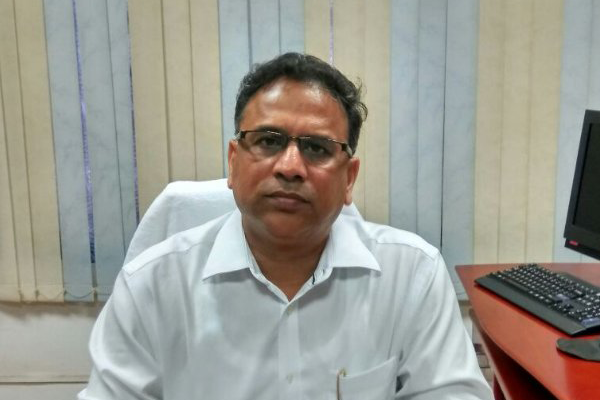
Views expressed by: Thiru. Har Sahay Meena, IAS, Tamil Nadu Irrigated Agriculture Modernisation Project (TNIAMP), MDPU, Department of Water Resources, Government of Tamil Nadu