
ABSTRACT
Rapid urbanisation, climate variability, population growth, and increasing pressure on freshwater resources are reshaping the global water sector. Traditional approaches to urban water management are no longer sufficient to address the complexities of modern metropolitan regions. In this context, Artificial Intelligence is emerging as a transformative force, enabling water utilities to improve operations, optimise resources, manage infrastructure more efficiently, and strengthen citizen service delivery.

The Bengaluru Water Supply and Sewerage Board, one of India’s largest urban water utilities, has initiated a comprehensive digital transformation journey by integrating AI, IoT, SCADA, GIS, predictive analytics, and intelligent automation into water and wastewater management. This article explores how AI is helping BWSSB build a more resilient, sustainable, and future-ready urban water governance model.
INTRODUCTION
Cities across the world are facing growing water challenges due to rapid urban expansion, climate change, groundwater depletion, ageing infrastructure, and rising demand for reliable water and sanitation services. Urban water utilities are under increasing pressure to reduce losses, optimise energy consumption, improve sustainability, and deliver better services to citizens.
Artificial Intelligence has become one of the most promising tools in this transformation. AI-powered systems can process large volumes of real-time data, predict failures, improve network performance, optimise resource allocation, and support faster decision-making.
For a rapidly growing city like Bengaluru, AI is not just a futuristic idea. It is becoming a strategic necessity for long-term water security and urban resilience.
BENGALURU’S COMPLEX WATER ECOSYSTEM
Bengaluru represents one of India’s most dynamic and complex urban water ecosystems. BWSSB serves over 14 million residents across nearly 800 square kilometres through an extensive network of water supply and sewerage infrastructure. The utility manages more than 14,000 kilometres of water pipelines and over 12,000 kilometres of sewer lines, along with multiple largescale treatment facilities.
The city’s dependence on the Cauvery Water Supply Scheme, combined with rapid peripheral growth, groundwater stress, climate variability, and increasing water demand, makes advanced digital management essential. Recognising these challenges, BWSSB has adopted a strategic vision to position Bengaluru as a model for AIenabled urban water governance.
AI AS A STRATEGIC ENABLER
AI has the potential to transform how water utilities operate and manage infrastructure. By combining machine learning, IoT sensors, digital twins, automation, and advanced analytics, utilities can shift from reactive management to predictive and proactive operations.
At BWSSB, AI is being explored and integrated across key areas such as smart water distribution, non-revenue water reduction, predictive maintenance, energy optimisation, wastewater reuse, smart metering, citizen engagement, groundwater analytics, and intelligent command-and-control systems.
This marks a broader transition from conventional infrastructure management to intelligent, adaptive, and data-driven utility systems.
AI-DRIVEN SMART WATER INFRASTRUCTURE
One of the major applications of AI at BWSSB is the development of advanced command-and-control systems powered by SCADA, IoT, and real-time analytics. These platforms allow continuous monitoring of water supply and sewerage networks and enable faster operational decisions.
AI-powered systems can support realtime leak detection, intelligent pressure management, demand forecasting, predictive contamination analysis, automated compliance monitoring, and dynamic optimisation of operations. These capabilities help improve service reliability, operational transparency, and infrastructure resilience.
REDUCING NON-REVENUE WATER THROUGH AI
Non-Revenue Water remains one of the biggest challenges for water utilities across the world. Through digital monitoring, AI-based analytics, and infrastructure modernisation, BWSSB has made significant progress in reducing NRW levels.
AI-enabled acoustic sensors, district metering analytics, and predictive leak detection systems help identify leakages, inefficiencies, and abnormal consumption patterns at an early stage. This supports better water balancing, reduces losses, improves efficiency, and strengthens the financial sustainability of the utility.
DIGITAL TWINS AND INTELLIGENT ASSET MANAGEMENT
BWSSB has also implemented GISbased digital mapping of water and wastewater assets. The integration of GIS with SCADA, IoT, and AI is enabling the development of a city-scale digital twin of Bengaluru’s water infrastructure. Digital twins can support predictive infrastructure simulations, asset lifecycle management, flood-risk assessment, groundwater monitoring, climate resilience planning, and preventive maintenance scheduling. These systems enhance longterm planning and help utilities make more informed infrastructure decisions.
AI AND ENERGY OPTIMISATION
Water and wastewater systems are among the most energy-intensive public utility operations. BWSSB has implemented AI and Industrial IoTenabled Integrated Pumping Performance Management Systems across major pumping stations.
With predictive analytics and AI driven optimisation, the utility can improve pump efficiency, reduce downtime, forecast seasonal energy needs, lower energy consumption, and support the integration of renewable energy. These initiatives contribute to cost reduction as well as sustainability and decarbonisation goals.
AI FOR WASTEWATER REUSE AND CIRCULAR WATER ECONOMY
Future urban water systems must move beyond linear consumption models and embrace circular water economies. BWSSB is advancing wastewater reuse and resource recovery through intelligent treatment and monitoring systems.
AI-enabled wastewater systems can support real-time treatment monitoring, automated regulatory compliance, sludge and biogas forecasting, reuse market optimisation, and resource recovery.
These initiatives help promote industrial reuse, lake rejuvenation, environmental sustainability, and renewable energy generation through biogas recovery. This positions wastewater not as a liability, but as a valuable resource within a sustainable urban ecosystem.
CITIZEN-CENTRIC DIGITAL GOVERNANCE
AI and digital technologies are also transforming citizen engagement and service delivery. BWSSB has introduced several technology-enabled platforms to improve transparency, accessibility, and efficiency.
These include intelligent grievance management systems, online connection platforms, digital billing and collection systems, IoT-enabled smart tanker management, and mobile applications for citizen participation. The “Sanchari Kaveri” smart tanker system is an important example of AIand IoT-enabled urban water distribution.
It supports real-time monitoring, automated allocation, and transparent delivery management, especially during periods of water scarcity.
BWSSB VISION 2030: TOWARDS INTELLIGENT WATER UTILITIES
BWSSB’s Vision 2030 aims to position Bengaluru as a globally recognised model for intelligent and sustainable urban water management. The roadmap focuses on integrating AI across critical utility functions such as smart metering, predictive maintenance, intelligent distribution management, NRW reduction, wastewater systems, groundwater analytics, climateresilient planning, and equitable 24×7 water supply.
The long-term objective is to build an integrated, adaptive, resilient, and data driven urban water ecosystem that can support Bengaluru’s sustainable growth.
CHALLENGES AND THE WAY FORWARD
Despite its potential, AI adoption in the water sector comes with several challenges. These include integration with legacy infrastructure, data quality, cybersecurity, institutional capacity, regulatory adaptation, and investment requirements.
Successful implementation will require strong government support, policy reforms, technology partnerships, research collaboration, skilled human resources, and sustainable financing models. Collaboration between utilities, academia, industry, and policymakers will be essential to accelerate AI-led transformation in the water sector.
CONCLUSION
Artificial Intelligence is redefining the future of urban water management. For rapidly growing cities facing increasing pressure on water resources, AI offers a powerful opportunity to improve efficiency, sustainability, resilience, and service delivery.
BWSSB’s digital transformation journey demonstrates how intelligent technologies can help conventional water utilities evolve into future-ready, citizen-centric, and climate-resilient systems. As cities across the world search for sustainable solutions to water security, Bengaluru’s experience highlights the transformative potential of combining AI, digital infrastructure, and datadriven governance.
The future of water utilities will not be defined only by pipelines, pumps, and treatment plants. It will be shaped by intelligent systems that can learn, predict, adapt, and manage water more sustainably.
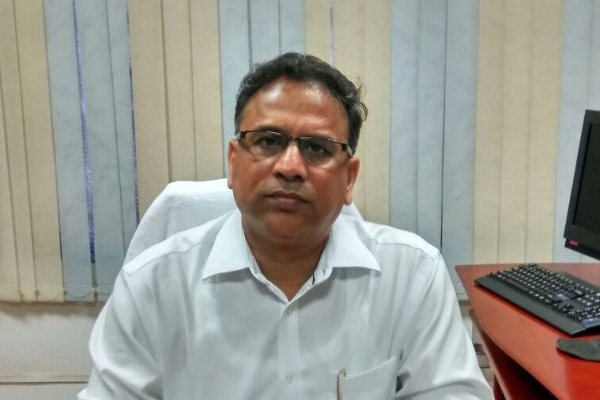
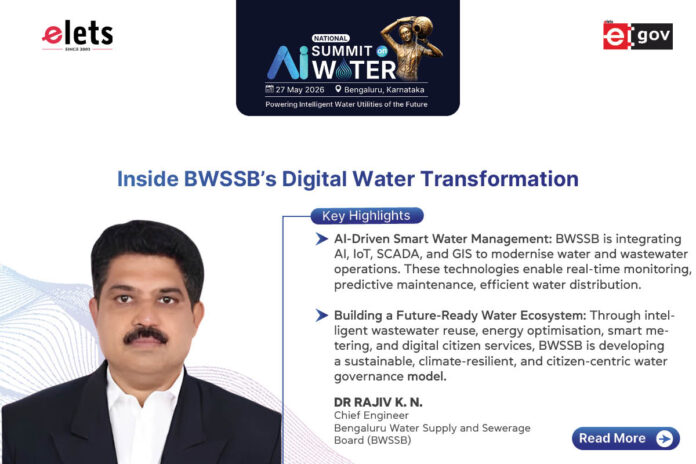
Views Expressed by: Dr. Rajiv K N, Chief Engineer, Bengaluru Water Supply and Sewerage Board (BWSSB)