

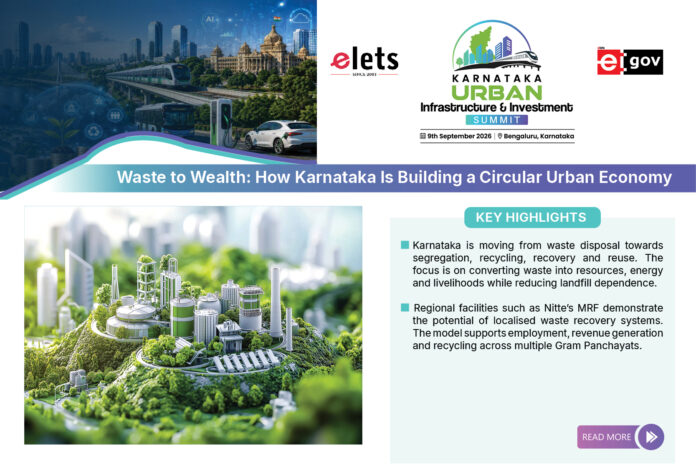
Karnataka’s approach to waste management is gradually moving beyond simply collecting and disposing of waste. The focus is increasingly on segregation, recycling, recovery, and finding productive uses for materials that would otherwise end up in landfills. The Solid Waste Management Rules, 2026, which came into effect on April 1, 2026, add further weight to this approach by requiring segregation at source into four streams: wet waste, dry waste, sanitary waste and special-care waste. The rules also place greater emphasis on resource recovery, Extended Producer Responsibility and the polluter-pays principle.
For Karnataka, this builds on waste management efforts already underway in Bengaluru, Mysuru and several rural local bodies. The next challenge is to bring these efforts together and build a stronger circular economy, where waste can become a source of recyclable materials, compost, energy and livelihoods rather than ending its journey at a landfill.

Karnataka’s Circular Economy Push
Karnataka’s circular-economy transition extends beyond its major cities. Rural local bodies are increasingly experimenting with decentralised systems that collect, segregate and recover dry waste closer to where it is generated.
A notable example is the Material Recovery Facility at Nitte Gram Panchayat in Udupi district, which serves 45 Gram Panchayats; the facility collects dry waste from 45 Gram Panchayats. The system processes nearly 7 tonnes of dry waste a day, with recyclable materials recovered and non-recyclable fractions channelled for appropriate processing, including co-processing. The facility also generates approximately ₹15 lakh in monthly turnover, demonstrating how material recovery can support a financially viable local waste-management model.
The Nitte model is significant because it links waste management with local economic activity. It creates employment, generates revenue from recovered materials and reduces the amount of dry waste requiring disposal.
For Karnataka’s smaller towns and rural settlements, such decentralised models can complement the larger infrastructure required in cities such as Bengaluru.
Bengaluru: Karnataka’s Scale Test
Bengaluru represents the largest and most complex component of Karnataka’s waste-management challenge.
The Bruhat Bengaluru Mahanagara Palike (BBMP) covers 713 sq km and has more than 29 lakh households across 8 zones, 27 divisions and 198 wards. BBMP’s published data puts per-capita waste generation at 309 grams per day for regular households, compared with 300 grams for households in slum areas.
The scale of the collection network is substantial. BBMP reports 4,646 auto tippers supporting door-to-door primary collection, alongside its wider fleet for secondary transportation.
BBMP’s system is structured around segregated collection. Wet waste, along with domestic hazardous waste including sanitary waste, is collected daily, while dry waste is collected at least twice or thrice a week depending on requirements. The city’s dry-waste stream can move through Dry Waste Collection Centres and Material Recovery Facilities, where recyclable material is sorted and prepared for recycling. Suitable non-recyclable material can also be channelled towards resource and energy-recovery applications.
One BBMP statistic requires careful interpretation. Its published dataset separately reports 58.5 per cent from households, 49.7 per cent from commercial establishments and 6.8 per cent from street sweeping. These figures total more than 100 per cent and therefore should not be presented as mutually exclusive shares of Bengaluru’s total waste generation. The figures are retained here only as separately reported BBMP data, rather than being used to describe the city’s waste composition.
The larger significance of Bengaluru is its existing recovery infrastructure. The city has the collection network, processing facilities, and access to industrial markets needed to support a circular system. The next challenge is ensuring that the material entering this system is properly segregated and consistently recoverable.
Mysuru: A Decentralised Pathway
If Bengaluru represents the scale challenge, Mysuru demonstrates the potential of decentralised processing. Mysuru has been recognised for its emphasis on source segregation, door-to-door collection and decentralised waste management. A NITI Aayog case study documented seven zero-waste management plants and one centralised compost unit as part of the city’s system. It also recorded a 200-tonne-per-day centralised biodegradable-waste processing plant and 43 collection centres for non-biodegradable waste.
These figures come from the NITI Aayog case study and should be understood as documented infrastructure from the period covered by the study, rather than current 2026 capacity figures. The broader lesson remains highly relevant for Karnataka. Smaller cities do not necessarily need Bengaluru-scale facilities. They can combine local segregation, composting and dry-waste sorting with regional recycling networks.
This creates a hybrid model: waste can be processed locally wherever economically and technically feasible, while higher-value recyclable materials can be aggregated and moved into larger recycling markets.
Bengaluru’s E-Waste Opportunity
Karnataka’s circular-economy opportunity extends beyond municipal waste. Bengaluru’s technology and electronics ecosystem gives the state a particularly important opportunity in e-waste recovery. Discarded computers, servers, networking equipment, mobile devices and other electronic products contain valuable materials and components that can be recovered through formal recycling and refurbishment systems.
The E-Waste (Management) Rules, 2022 have established an Extended Producer Responsibility framework for e-waste, creating greater responsibility for producers and other stakeholders to support collection and environmentally sound recycling.
For Karnataka, the challenge is to ensure that more electronic waste generated by businesses, institutions and households reaches authorised processing channels rather than informal or unregulated handling. The opportunity is therefore both environmental and economic. Formal e-waste recycling can recover valuable materials while ensuring that hazardous components are handled under regulated conditions. Bengaluru’s technology ecosystem can also support a broader market for repair, refurbishment, reuse and resource recovery.
Bringing Rural Karnataka Into the Circular Economy
A circular economy for Karnataka cannot be built around Bengaluru and Mysuru alone. The state’s smaller municipalities and Gram Panchayats require systems that match their waste volumes, financial capacity and access to recycling markets. The Nitte MRF demonstrates how such a model can work at the rural level.
The facility’s operations across 45 Gram Panchayats show the potential of regional aggregation. Instead of every Gram Panchayat attempting to establish a separate large processing facility, dry waste can be collected across multiple local bodies, brought to a common MRF, segregated and then channelled into recycling and co-processing streams.
The model also demonstrates the employment potential of circularity. The Nitte facility employs local workers and generates revenue through the sale of recyclable material, creating a direct connection between resource recovery and rural livelihoods. This approach could be particularly relevant for other rural and semi-urban parts of Karnataka where large centralised waste-processing plants may not be economically viable.
The Segregation Gap
Karnataka’s biggest challenge is increasingly not the absence of infrastructure but the quality and consistency of material entering that infrastructure. A Material Recovery Facility cannot recover maximum value from mixed waste. Composting systems cannot operate efficiently when organic waste is contaminated with plastics and other materials. Recycling markets also lose value when recyclable material is diverted into uncontrolled disposal or informal channels.
This makes source segregation the critical link between Karnataka’s waste infrastructure and its circular-economy ambitions. The new national rules strengthen this link by making four-stream segregation mandatory and introducing stronger compliance mechanisms. For Karnataka’s urban local bodies and Gram Panchayats, the opportunity is to translate this regulatory requirement into measurable improvements in collection quality, recovery rates and processing efficiency.
From Waste Management to Resource Management
Karnataka already has several of the building blocks required for a circular economy: Bengaluru’s large-scale collection network, Mysuru’s decentralised waste-management experience, rural MRF models such as Nitte, and an expanding formal recycling ecosystem.
The next stage is integration. Bengaluru needs stronger source segregation to ensure that its processing infrastructure receives usable material. Mysuru and other urban local bodies can continue developing decentralised processing systems. Rural Karnataka can build regional MRF networks that aggregate recyclable material across Gram Panchayats. Bengaluru’s technology ecosystem can support formal e-waste recovery, refurbishment and recycling.
At the same time, the informal workforce that has historically played a major role in India’s material-recovery economy needs to be integrated into formal and regulated systems.
For Karnataka, circularity is therefore not simply about reducing landfill dependence. It is about creating a system in which one sector’s waste becomes another sector’s resource. The state has a strong foundation: a major technology economy, large urban waste-management systems, established municipal experience and emerging rural recovery models. The next step is to connect these assets into a state-wide resource-recovery ecosystem. The real measure of Karnataka’s circular economy will not be simply how much waste the state collects. It will be how much of that waste it can recover, recycle, reuse, compost or convert into productive resources.
———————————————————————–
Written by: Divya Tyagi | Elets News Network (ENN)