

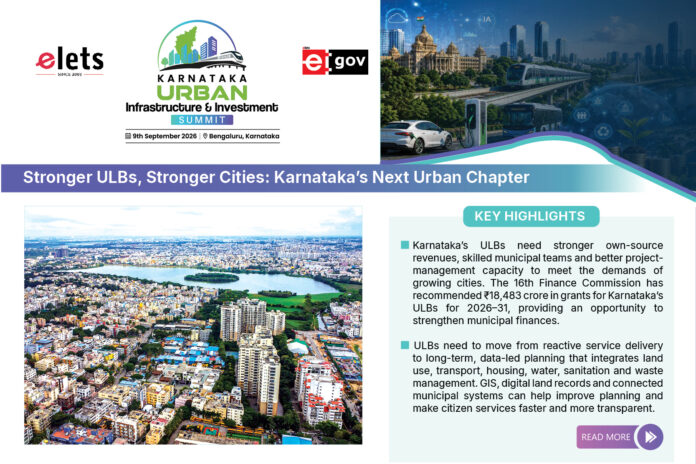
A city can grow quickly, but its local administration cannot afford to work at the same pace without the right systems in place. When new neighbourhoods come up, roads become busier, water demand rises, and more waste has to be managed; the pressure is felt most directly at the municipal level.
This is an important point for Karnataka. The state has some of India’s fastest-growing urban centres, along with a large number of smaller cities and towns that are gradually expanding. Bengaluru is the most visible example, but urban activity is also increasing in cities such as Mysuru, Mangaluru, Hubballi-Dharwad, Belagavi and Tumakuru. Their needs are different, but the basic challenge is similar: how to manage growth while keeping cities functional and liveable.

Much of this responsibility rests with Urban Local Bodies. Municipal corporations, municipal councils and town panchayats deal with a wide range of issues, from local roads and drainage to water supply, sanitation, waste management, public spaces and building-related services. As urban areas become larger and more complex, these institutions will have to do more than simply manage routine civic work.
They will need to plan, manage larger budgets, work with different agencies, and respond to problems much faster.
Karnataka’s Urban Growth Is Taking a Wider Shape
Bengaluru will remain central to Karnataka’s economy, but the state has an opportunity to build a stronger network of regional cities around it.
The expansion of manufacturing, IT and services, logistics, tourism and other sectors is creating new opportunities outside Bengaluru. Better connectivity is also making it easier for businesses and people to look beyond the capital.
This wider growth can help Karnataka create more balanced economic development. But it also puts pressure on local infrastructure.
A city that attracts new investment needs more than industrial land and roads. It needs housing, water supply, drainage, sanitation, public transport, waste management, healthcare, public spaces, and reliable civic administration.
This is where Urban Local Bodies become critical. They are closest to citizens and are responsible for many of the services that determine whether a city is comfortable and efficient to live in.
What Growing Cities Will Need from Their ULBs
As Karnataka’s urban centres expand, municipal governments will have to handle a much broader set of responsibilities.
Some of the immediate priorities include:
- Better municipal finances to maintain existing infrastructure and fund new projects.
- Skilled municipal teams with expertise in planning, finance, technology and project management.
- Integrated urban planning that connects land use, housing, transport, water and waste.
- Digital municipal systems for faster and more transparent citizen services.
- Stronger climate preparedness for flooding, heat and water stress.
- Better coordination between ULBs, development authorities and state agencies.
- Greater citizen participation in local planning and decision-making.
The important shift is from simply managing existing services to preparing for what the city will need five, ten, or twenty years from now.
Municipal Finance: The Foundation of Better Services
Good urban services require steady funding. Municipalities have to maintain roads, drainage networks, streetlights, water infrastructure, and public facilities while also investing in new projects.
The 16th Finance Commission has recommended ₹18,483 crore in grants for Karnataka’s Urban Local Bodies for 2026–31. This provides an important opportunity to strengthen municipal finances and improve the delivery of basic services.
However, grants alone cannot provide a long-term solution. ULBs also need stronger own-source revenues.
Property tax remains one of the most important sources of municipal income. Better property databases, GIS mapping, regular assessments and simple online payment systems can help municipalities improve collections while making the process easier for citizens.
User charges and better management of municipal assets can also contribute to financial sustainability. The larger goal should be to give municipalities enough financial certainty to plan beyond individual projects or financial years.
A Snapshot of What Stronger ULBs Should Deliver
| Area | What needs to improve | Expected outcome |
| Finance | Stronger own-source revenue | More predictable municipal spending |
| Planning | Integrated, data-led plans | Better managed urban expansion |
| Manpower | Skilled technical teams | Faster and better project delivery |
| Technology | Connected digital systems | Easier citizen services |
| Infrastructure | Focus on maintenance | Longer-lasting public assets |
| Climate | Local resilience measures | Safer and more prepared cities |
People and Skills Will Shape Municipal Performance
Urban problems are becoming more specialized. A municipality now needs people who understand not only civil engineering and administration, but also GIS, data, mobility, urban finance, waste processing, climate resilience and digital governance.
This is particularly important for smaller ULBs, where access to specialised professionals can be limited.
Karnataka can strengthen this capacity through regular training, shared technical resource centres and partnerships with universities, professional bodies and technology institutions. A pool of specialists that can support multiple smaller municipalities could also help cities prepare better projects and manage large contracts.
Elected representatives also need access to better information and training. Stronger municipal governance is not only about officials; it also depends on informed local leadership.
Plan the City Before the City Outgrows the Plan
Many urban problems become difficult and expensive because they are addressed too late.
If housing expands without drainage, flooding becomes a recurring problem. If commercial activity grows without mobility planning, congestion follows. If development moves into peripheral areas without basic services, municipalities eventually have to spend much more to provide them.
Karnataka’s emerging cities have an opportunity to avoid this cycle.
Master plans should connect land use with transport, housing, water, sanitation, waste management, and environmental protection. Planning should also extend beyond the existing municipal boundary and consider the wider urban region where development is actually taking place.
Technology can support this shift. GIS-based mapping, digital land records, updated property databases, and infrastructure inventories can help ULBs understand how their cities are changing and where investment will be needed next.
The idea is simple: plan instead of constantly playing catch-up.
Technology Should Make Municipal Services Simpler
Karnataka has one of India’s strongest technology ecosystems, and there is an opportunity to bring more of that capability into everyday urban governance.
Digital property tax systems, online building permissions, grievance platforms and citizen-service portals are already changing how people interact with municipalities. The next step is to connect these systems so that information does not remain locked within individual departments.
A municipality should gradually be able to build a digital picture of its properties, roads, water networks, public assets, waste facilities and other infrastructure.
But technology should always have a clear purpose.
The success of a digital municipal system should not be measured by the number of applications or portals created. It should be measured by whether a resident can access a service more quickly, track a complaint more easily, and receive a transparent response.
Climate Resilience Needs to Start at the Local Level
Climate-related challenges are becoming part of everyday urban planning.
Heavy rainfall, flooding, heat, and water stress can quickly disrupt city life. For ULBs, preparing for these risks means looking at both large infrastructure and small local interventions.
Protecting lakes and wetlands, maintaining storm-water drains, improving rainwater management, increasing green spaces and promoting wastewater reuse can all contribute to more resilient cities.
For cities that are still growing, there is a major advantage: they can build these considerations into new development instead of having to retrofit infrastructure later.
Climate resilience should therefore become part of normal municipal planning rather than a separate project.
Bengaluru’s Transformation Offers Lessons for Other Cities
Bengaluru’s size has made urban governance particularly complex. The creation of the Greater Bengaluru Authority (GBA) and the move towards a multi-corporation structure represent an important change in the way the metropolitan region is being governed.
Other Karnataka cities may not need the same institutional model. Their scale, resources and challenges are different.
But Bengaluru’s experience offers a broader lesson: governance structures need to keep changing as cities change.
As regional cities become larger, municipalities and development authorities will need clearer roles, better coordination and stronger mechanisms for planning across administrative boundaries.
Giving Local Governments a Stronger Voice
ULBs are closest to the communities they serve. They understand local roads, neighbourhood-level infrastructure gaps and everyday service issues better than institutions operating farther away from the ground.
This makes greater local decision-making important.
At the same time, more responsibility must come with accountability. Municipalities need transparent budgets, regular performance reporting, open procurement processes and clear service standards.
Citizens should also have better opportunities to participate in decisions about their neighbourhoods. Public consultations, digital feedback systems and accessible municipal data can make local governance more open and responsive.
The aim should be to create ULBs that are empowered to take decisions, equipped to implement them and accountable for the results.
The Real Test Will Be Everyday Urban Life
Karnataka has a strong economic base and a growing network of cities. The next challenge is to make sure that urban governance keeps pace with this growth.
This will require investment in infrastructure, but it will also require investment in the institutions managing that infrastructure.
Stronger municipal finances, better-trained staff, integrated planning, useful technology and greater local decision-making can help Karnataka’s ULBs become more capable of dealing with the demands ahead.
Ultimately, the success of urban development will not be measured only by the number of projects completed or the amount of money invested. It will be visible in everyday life, a road that is maintained, a drain that works during heavy rain, regular waste collection, reliable water supply, and a municipal service that does not require citizens to make repeated visits to an office.
Karnataka has an opportunity to build cities that are not only bigger and more economically productive, but also easier and better places to live.
That journey will begin at the local level, with stronger Urban Local Bodies capable of taking Karnataka’s cities into their next phase of growth.
Written By: Sahaj Anand | Elets News Network (ENN)