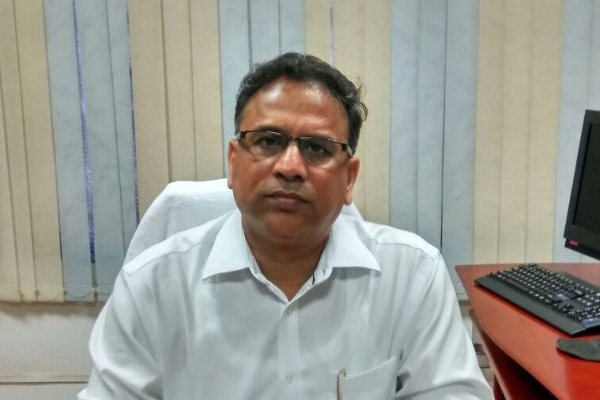
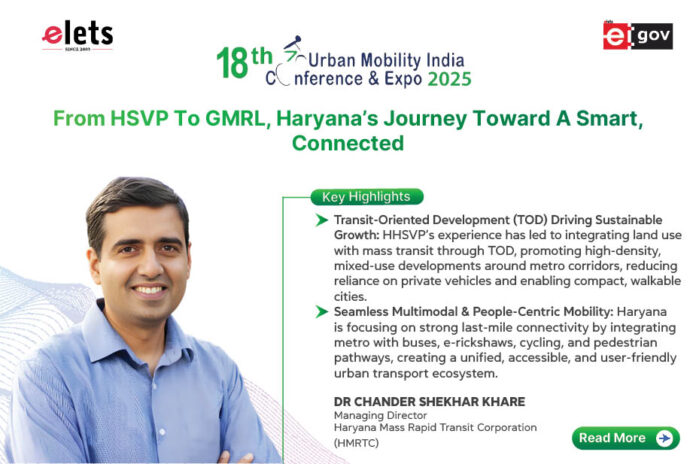
Dr. Chander Shekhar Khare, Managing Director, Haryana Mass Rapid Transit Corporation (HMRTC),in an exclusive conversation with Nandini Jha, from Elets News Network (ENN), Dr. Khare shared insights into Haryana’s transformative vision for integrated urban mobility. From land-use planning and mass transit integration to last-mile connectivity and regional rapid corridors, he outlined how Haryana is building a future-ready, sustainable, and inclusive transport ecosystem.
Haryana Shehri Vikas Pradhikaran (HSVP) has played a key role in shaping planned urban growth across the state. How has your experience with HSVP influenced your approach to integrating land use planning with mass transit development, and how does this synergy contribute to creating more sustainable and accessible urban centres?
Haryana Shehri Vikas Pradhikaran (HSVP), formerly HUDA, has played a pivotal role in shaping planned urban growth across the state through the development of well-conceived sectors and modern planning parameters.
With over three lakh allottees across various towns, HSVP has ensured that urban expansion is systematic, infrastructure-ready, and inclusive.
My experience with HSVP has deeply influenced my perspective on the integration of land use planning with mass transit systems. I see this synergy as central to building sustainable and accessible urban centres. The arrival of Mass Rapid Transit Systems (MRTS) in Gurugram, Faridabad, and Bahadurgarh has transformed how we plan urban growth — shifting from static zoning models to Transit-Oriented Development (TOD) frameworks.
We are now incorporating land value capture mechanisms, higher-density nodes, and mixed-use development around metro corridors. The experience in Gurugram demonstrates this clearly — areas surrounding the Rapid Metro and upcoming metro extension have seen a rise in high-rise residential and commercial developments where people prefer to walk to metro stations, reducing dependence on private vehicles.
This approach aligns with our vision of promoting compact, connected, and low-carbon urban growth, where transport and land planning work handin-hand to make cities more livable and economically vibrant.
Gurugram Metro Rail Limited (GMRL) has been instrumental in transforming urban mobility in one of India’s fastest-growing cities. What are the key achievements and learnings from the Gurugram Metro project, and how is this experience shaping the expansion of metro services to other parts of the National Capital Region?
Gurugram Metro Rail Limited (GMRL) is a newly formed Special Purpose Vehicle (SPV) jointly promoted by the Government of India and the Government of Haryana to implement the Gurugram Metro Extension Project. From inception, GMRL has been envisioned as a futuristic, technologydriven organisation, integrating the best global practices in planning, sustainability, and governance.
While GMRL is a young company, it benefits from the extensive experience of Haryana Mass Rapid Transport Corporation (HMRTC), which has long partnered with DMRC, MoHUA, and NCRTC in expanding Haryana’s mass transit network. The state already enjoys seamless connectivity through the Yellow Line to Gurugram, Violet Line to Faridabad and Ballabgarh, and Green Line to Bahadurgarh, while Rapid Metro Gurugram efficiently serves the city’s core business districts.
The new Gurugram Metro corridor, extending from Millennium City Centre to Cyber City with a spur to Dwarka Expressway, represents a significant leap forward. It emphasises multi-modal integration, Transit-Oriented Development (TOD), and land value capture mechanisms, ensuring long-term financial and environmental sustainability.
In parallel, HMRTC is helping in two major Regional Rapid Transit System (RRTS) corridors under the NaMo Bharat initiative — the Delhi–Gurugram–Bawal line and the Delhi–Panipat – Karnal line. In addition, the proposed RRTS corridor connecting Gurugram–Faridabad–Noida–Jewar Airport will be a true game-changer for regional connectivity. This vertical alignment will allow direct high-speed travel between Gurugram and NoidaJewar Airport without entering Delhi, drastically reducing travel time and congestion while strengthening NCR’s economic and mobility linkages.
Collectively, these initiatives mark a transformative phase in Haryana’s urban mobility landscape — one that blends strategic foresight, sustainable design, and inter-agency collaboration to create a truly integrated and future-ready transport network across the National Capital Region.
With the rapid expansion of metro networks, last-mile connectivity remains a critical challenge. How is GMRL addressing this through multimodal integration, and what innovative solutions are being explored to ensure seamless connectivity between metro stations and residential or commercial hubs?
Last-mile and first-mile connectivity are often the make-or-break factors for the success of any metro system. While the Gurugram Metro Rail Limited (GMRL) project is still in the planning and design phase, we have accorded top priority to accessibility and seamless multimodal integration from the very beginning.
Our Detailed Design Consultant (DDC), Systra, has been given a clear mandate to ensure that each station is designed with integrated pedestrian pathways, cycling tracks, feeder bus bays, and shared mobility interfaces. We believe that a new metro line will only be as effective as the ease with which people can reach and depart from its stations.
To strengthen this focus, we have constituted a dedicated team led by Shri Ashok Bansal, retired HCS officer, who brings valuable experience from his tenure as JT CEO, GMCBL when I served as the first CEO of Gurugram Metropolitan City Bus Limited (GMCBL). This team is working to synchronise metro stations with bus routes, e-rickshaw stands, and other public transport modes, ensuring a comfortable and convenient transfer experience for commuters.
We are also exploring innovative stationspecific access models. For instance, the upcoming Sector-47 Metro Station will feature direct entry from the new IKEA Centre, allowing commuters to move seamlessly between the retail hub and the metro platform — a small but meaningful example of how we envision walkable, integrated, and user-centric transit environments.
In addition, we are exploring special use provisions in metro design and operations — including the possibility of using metro coaches for emergency medical transport (ambulance use) when required. The new system is also being designed with a strong emphasis on universal accessibility and comfort — with dedicated facilities and safety features for women, senior citizens, and children, ensuring inclusivity and dignity for every commuter.
Our ultimate vision is to make Gurugram’s metro network not only a symbol of modern mobility but also a people-centric system — our logo speaks the same – Swift safe and sustainable. We strive to make Gurugram metro accessible, safe, and responsive to the diverse needs of its citizens.
The Urban Mobility India (UMI) Conference provides a platform to showcase innovative models and best practices. What message or vision would you like to share from Haryana’s perspective as the host state, and how do you see HMRTC and metro projects contributing to the state’s larger mobility transformation and economic growth goals?
The Urban Mobility India (UMI) Conference is truly the ‘Kumbh’ of urban mobility in India — a confluence where national and international experts, policymakers, and innovators come together to share experiences, best transformative ideas.
We are deeply thankful to the Hon’ble Minister of Housing and Urban Affairs and Hon’ble Chief Minister, Shri Manohar Lal, for choosing Gurugram as the venue for this year’s UMI Conference. It is both an honour and an opportunity for Haryana to showcase its integrated mobility vision.
Our participation goes beyond the Gurugram Metro Rail Limited (GMRL) project. We will also highlight the role of Unified Metropolitan Transport Authorities (UMTAs) such as the Gurugram Metropolitan Development Authority (GMDA) and Faridabad Metropolitan Development Authority (FMDA). These institutions embody the Haryana model of decentralised decision-making, where local transport challenges are addressed at the local level through empowered planning and coordinated action.
Through initiatives like the Gurugram Metropolitan City Bus Limited (GMCBL), intelligent traffic management systems, and transit-oriented development policies, Haryana is building a multi-layered mobility ecosystem — one that integrates metro, bus, cycling, walking, and shared transport into a seamless experience.
Gurugram’s economic success story is well known, but our focus now is on making that growth sustainable, inclusive, and people-centric. As hosts of UMI 2025, we aim to showcase our achievements, acknowledge our challenges, and learn with humility from the experiences and wisdom of other states and international delegates.
Our vision is clear — to make Haryana a leader in integrated, sustainable, and technology-driven mobility, where every journey contributes to the state’s broader goals of economic growth, environmental resilience, and quality of life.