Few Indian cities carry a water burden as structurally complex as Bengaluru’s. The city draws its lifeline from the Kaveri River, 140 kilometres away, lifted to a height of 450 metres through decades of engineering effort. Roughly 80 per cent of that water returns as sewage, which cannot be discharged into a sea or a major river as in most metropolitan systems. Instead, it moves through a cascading chain of lakes, each vulnerable to degradation. This is the operating reality that any technology intervention for Bengaluru’s water utility must be built around.
A City That Demands Technological Vigilance
Bengaluru’s population is engaged, informed and often critical of civic service delivery. That scrutiny, far from being a burden, is a democratic asset: an attentive citizenry pushes government utilities to improve. Given the scale and visibility of the city’s water challenges, there is little choice but to stay at the forefront of technology adoption, from SCADA-based monitoring of the Kaveri pumping system to the next generation of AI-driven tools now under discussion.
From Data Collection to Real-Time Decisions
Extensive data already exists on how much water is pumped from the source, how much is lost in transmission, and how much is pilfered during distribution. The gap has never been in data availability but in the speed of decision-making. Water systems move with a dynamic, fast-changing character that current institutional processes are not built to match. This is precisely where predictive analysis and preventive maintenance powered by AI can close the loop, turning existing SCADA, GIS and IoT streams into timely, actionable decisions rather than static dashboards.
Turning Grievances Into Actionable Intelligence
Grievance redressal remains one of the most manpower-intensive functions in urban water management, with complaints often getting lost between call centres and last-mile field staff, and with little visibility into resolution quality. An AI agent capable of interpreting a citizen’s complaint and converting it into a precise, trackable action point would represent a major efficiency gain. Plotted systematically, grievance data can also reveal:
- Critical and endemic areas where pipelines fail repeatedly
- Localities where water supply shows recurring contamination
- Causal linkages with public health data, enabling analysis of the roots of disease outbreaks when cross-referenced with health department records
This convergence of civic and health datasets is one of the most promising frontiers for AI in the water sector, offering results with immediate public value.
Computer Vision and the Future of Pipeline Health
Robotic inspection of pipelines, sending a camera-equipped device through underground infrastructure, is not new; Bengaluru’s civic bodies have already experimented with such inspection. What has changed is the ability to interpret the resulting imagery. Earlier, analysing this data was prohibitively costly. With computer vision, machine learning and large language models now maturing, it has become feasible to assess pipe conditions at scale: identifying safe stretches, estimating years to failure, and prioritising maintenance. This replaces the blunt practice of replacing pipes purely by age, which risks removing infrastructure that was never the actual cause of a leak, while leaving the true weak points unaddressed.
Workforce Efficiency Amid Staffing Constraints
Urban water utilities in Karnataka, as elsewhere, operate under persistent staff shortages, with fiscal constraints limiting how much manpower can be added. The only sustainable path forward is equipping existing staff with advanced technological tools. AI’s ability to demystify coding, allowing systems to be built and reports generated through natural language, offers a genuine efficiency boon for government institutions operating well below their required capacity.
The Way Forward: Building Homegrown Capability
Building large foundation models independently is costly, and app-based adoption alone will not be sufficient. Model distillation, where a smaller, trainable model learns from a larger teacher model, offers a more affordable route to specific, high-performance applications, and deserves serious exploration within legal and ethical bounds. Structured hackathons focused on real civic processes, for urban local bodies and water utilities alike, can accelerate this shift from pilot to practice. India’s shortage of dedicated AI researchers remains a genuine constraint, but a stronger institutional emphasis on research, paired with the intelligence already present in the system, can close that gap.
Read more: Building India’s AI-Powered Digital Water Stack for a Smarter Water Future
Conclusion: An Era That Cannot Be Missed
This is a defining moment in the evolution of artificial intelligence, and government utilities that delay adoption risk falling behind rather than displacing jobs. For the water sector, AI’s promise lies not in replacing the workforce but in multiplying its productivity, sharpening decisions, and protecting public health. Karnataka’s urban water institutions are positioned to lead this transition, provided dialogue now translates into deployment.
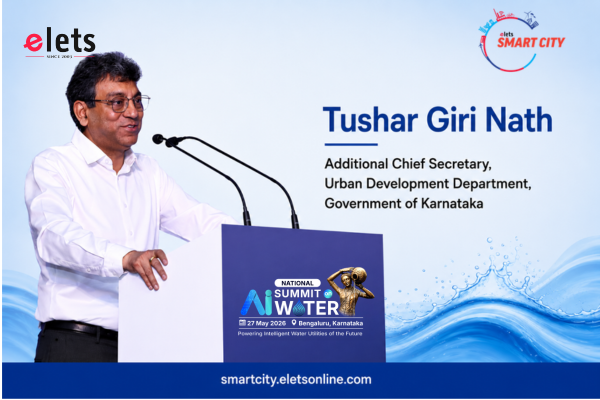
Insights shared by Tushar Giri Nath, Additional Chief Secretary, Urban Development Department, Government of Karnataka, at National AI Summit on Water 2026, in Bengaluru.