Transport ecosystem is undergoing a significant transformation as states explore multimodal mobility solutions to address growing urbanisation and connectivity demands. In this context, Inland Water Transport (IWT) is emerging as a strategic mode for sustainable and efficient passenger and cargo movement, particularly in riverine states.
Assam, with its extensive river network, is taking a structured approach to modernising this sector through regulatory reforms, technological upgrades and private sector participation. The state government is leveraging a multi-year development programme supported by the World Bank to transform its inland water transport ecosystem.
Strengthening the Regulatory and Institutional Framework
Assam is currently implementing a five-year programme aimed at strengthening the operational and institutional capacity of the inland water transport sector. The initiative focuses on a combination of regulatory reforms, legislative improvements, and infrastructure development to enhance passenger mobility and improve service quality.
A key objective of the programme is to introduce modern technological systems that enable greater precision in vessel operations. This includes better calibration of vessel sizes, passenger capacity planning, and operational monitoring to ensure safer and more efficient ferry services across the state’s waterways.
Equally important is the creation of a robust regulatory framework that ensures strict enforcement of safety standards while facilitating technological adoption by both public and private operators.
Addressing Structural Challenges in the Sector
Transport modes such as inland waterways and railways have historically been dominated by public sector operators. While this has ensured basic connectivity, it has also meant that expansion in these sectors has often been constrained by budgetary allocations.
Assam’s strategy seeks to address this structural limitation by creating an enabling ecosystem for private sector participation. By introducing private ferry services and encouraging private operators in both passenger and cargo transport segments, the state aims to expand service capacity and improve operational efficiency.
This approach is expected to reduce dependency on public funding while accelerating the deployment of modern vessels, improved infrastructure, and technology-enabled services.
Expanding a High-Usage Ferry Network Inland waterways play a critical role in everyday mobility across Assam. The state currently operates more than 200 ferry routes, collectively serving over six million passengers annually.
Given this scale of usage, upgrading ferry infrastructure and service standards has become a key priority. The introduction of private ferries on several routes is expected to improve frequency, reliability, and passenger comfort while also supporting economic activity along the river corridors.
The initiative also aims to modernise vessel fleets and operational processes to meet evolving safety and efficiency requirements. Conceptualising Water Metro Systems In a forward-looking step toward urban water mobility, the state has also conceptualised water metro systems in major cities such as Guwahati, Dibrugarh, and Sonitpur. These systems are envisioned as integrated urban transport solutions that combine modern vessels, improved terminal infrastructure, and technology-enabled passenger services.
The goal is to position Assam not only as a regulatory leader in inland water transport but also as a frontrunner in infrastructure deployment, vessel modernisation, and passenger traffic growth. Water metro networks can play a particularly important role in riverine cities, offering faster, environmentally sustainable alternatives to road-based transport while reducing congestion in urban corridors.
Building a Multimodal Mobility Ecosystem
Another important pillar of Assam’s strategy is the integration of inland water transport with other modes of mobility. The long-term vision is to create a seamless transport network that connects ferry services with road transport systems and future rail-based infrastructure.
Initial integration efforts include coordination with state transport bus services and private mobility aggregators such as Uber and Ola. Over time, the framework could also integrate suburban rail or metro systems to enable seamless passenger transfers across different transport modes.
The aim is to create a unified mobility ecosystem where passengers can move across transport modes with simplified check-in and check-out processes.
Advancing Integrated Urban Transport Governance
This broader mobility vision is aligned with the Unified Metropolitan Transport Authority (UMTA) framework, which promotes coordinated planning and management of urban transport systems.
The model has already been implemented in Guwahati in 2023, creating a platform for integrating transport planning across different agencies and mobility services.
By aligning inland water transport with urban mobility planning, Assam aims to unlock the full potential of its river systems while ensuring efficient, safe, and scalable passenger mobility solutions.
A Strategic Shift in India’s Water-Based Mobility
Assam’s approach reflects a broader shift in how inland waterways are being positioned within India’s transport landscape. By combining regulatory reform, private sector participation, technological upgrades, and multimodal integration, the state is building a framework that could serve as a model for other riverine regions across the country.
As inland waterways gain greater prominence in national mobility planning, Assam’s initiatives demonstrate how technology-driven policy reforms and infrastructure investments can revitalise a historically underutilised transport mode and turn it into a critical component of future mobility systems.
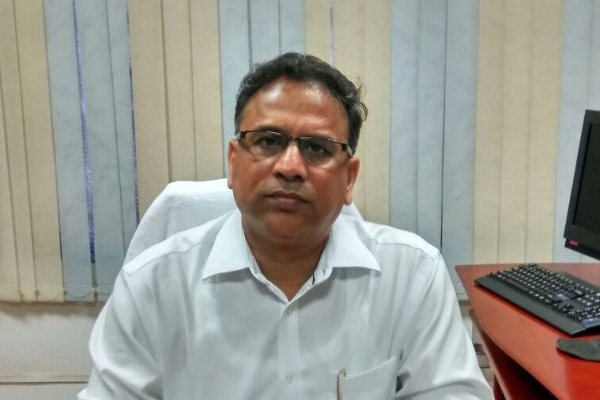
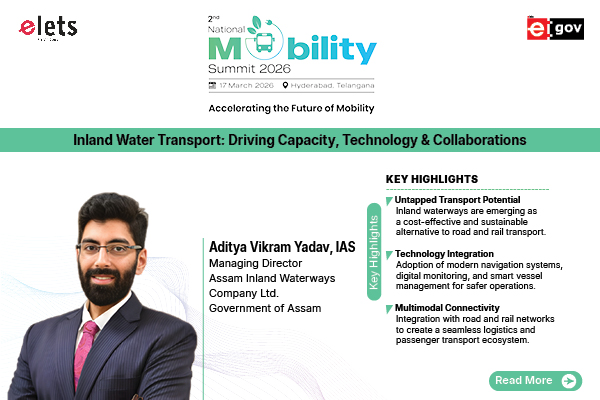
Views expressed by: Shri Aditya Vikram Yadav, Managing Director, Assam Inland Waterways Company Ltd. (AIWCL), Government of Assam, at the National Digital Innovation Summit 2025, in Guwahati.