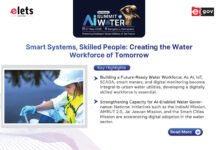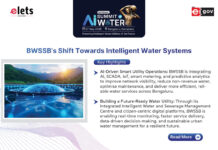
Water governance sits at the intersection of public health, urban development, environmental sustainability and economic productivity, making it one of the most consequential challenges facing any state government today. As India’s cities grow denser and climate variability intensifies pressure on supply systems, the question confronting policymakers is no longer whether to invest in digital and intelligent systems, but how to do so in a way that produces lasting institutional change and measurable improvement in public service delivery.
Bengaluru’s Growth and the Governance Challenge
Bengaluru’s expanding population continues to add complexity to managing water supply, wastewater treatment, groundwater and stormwater systems. The challenge extends well beyond the capital, with cities such as Hubballi-Dharwad, Mangaluru, Belagavi and Mysuru also navigating rapid urban growth against infrastructure that must evolve quickly. At the state level, this translates into pressure on municipal finances, gaps in institutional capacity, and a growing citizen expectation for transparent, responsive governance. Against this backdrop, integrating artificial intelligence and digital intelligence into water utilities has moved from aspiration to a strategic priority for the Government of Karnataka, reinforced by the recent establishment of AI Centres of Excellence in e-governance and the IT-BT sector across the state.
Defining Intelligent Water Governance
Intelligent water governance means a utility that knows in real time where water is being lost and can act before that loss becomes a crisis. It means demand forecasting that moves beyond seasonal averages to incorporate actual consumption patterns, population movement and climate data. It means wastewater systems monitored continuously rather than inspected periodically, and citizen complaints tracked with time-bound responses rather than disappearing into an administrative queue. Karnataka’s status as the first state to evolve and implement an Integrated Climate Change Action Plan provides an institutional foundation for this approach, enabling utility leadership to see the operational health of an entire system and move toward preventive, sustainable solutions rather than isolated fixes.
Building the Enabling Ecosystem
Transformation of this scale depends on the government creating the conditions for success rather than mandating outcomes alone. That requires several coordinated interventions:
- Policy frameworks that support digital procurement, data sharing and performance-based contracts with technology partners
- Investment in capacity building so that personnel operating intelligent systems can use them effectively
- A regulatory environment that rewards efficiency, not merely compliance
- Cross-departmental coordination among urban development, water resources, environment, finance and technology, anchored by a steering committee under the Chief Secretary
From Bengaluru to a National Model
Karnataka aims to document and share what works, with the experience of BWSSB and other local bodies offering potential models for utilities across the country. The responsibility extends beyond solving the state’s own challenges to contributing meaningfully to the broader national learning on intelligent urban water management. Yet technology transforms governance only if accountability follows; data without accountability produces reports, not results. Performance dashboards must be tied to accountability frameworks, predictive alerts must trigger response protocols, and smart meters must connect directly to revenue recovery.
Conclusion: Digital in Service of Reliability
The transformation sought is not digital for its own sake, but digital in the service of a water system every citizen can rely on. As utilities across India weigh similar investments, Karnataka’s emerging framework, spanning policy, capacity, coordination and accountability, offers a template worth close attention: intelligence that translates into decisions, and decisions that translate into measurable outcomes for citizens.
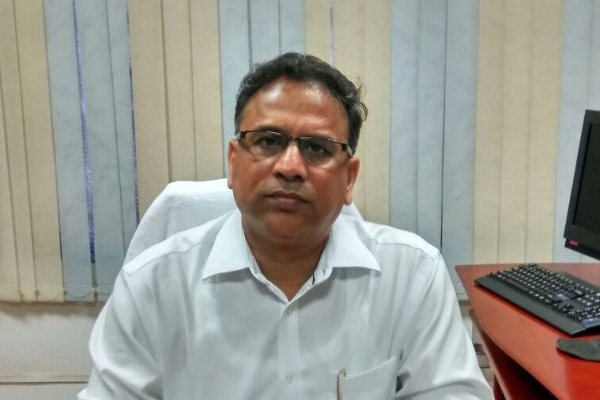
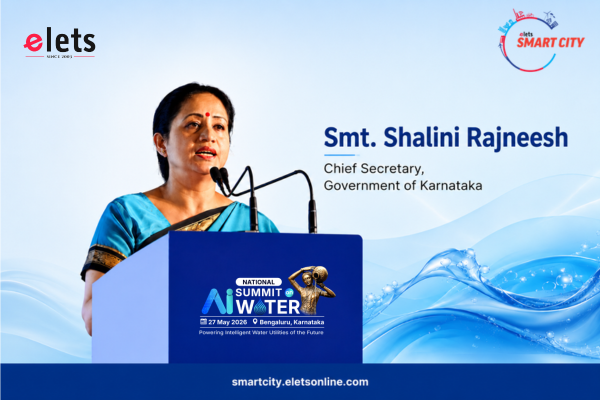
Insights shared by Smt. Shalini Rajneesh, Chief Secretary, Government of Karnataka, at National AI Summit on Water 2026, in Bengaluru.