As Indian cities confront mounting pressure on water resources, utilities are being asked to do more with less: less water, less time, and less tolerance for service failures. The Bengaluru Water Supply and Sewerage Board has responded not with incremental fixes but with a series of connected, technology-driven interventions that together sketch a template for the utility of the future. Four such initiatives illustrate how sensors, GPS tracking and data analytics are being woven into the daily business of moving, monitoring and delivering water across the city.
Energy Efficiency at the Pumping Stations
At the heart of Bengaluru’s water supply lies the Cauvery pumping system, comprising 78 pumping machineries across three-stage pumps. The introduction of the iPUMPNET system has brought predictive maintenance and energy optimisation to this critical infrastructure, delivering an estimated 25 per cent improvement in energy efficiency. Just as significant is the shift from reactive to predictive operations: analytics generated by the system now help anticipate faults before they cause the breakdowns that once disrupted supply to residents. This combination of energy savings and reliability makes the pumping system a strong candidate for replication in other Indian utilities.
Forecasting Groundwater with IISc
A second initiative, developed in collaboration with the Indian Institute of Science, addresses a problem that intensified during Bengaluru’s water crisis: the unpredictability of groundwater. Traditionally, borewell monitoring relied on manual visits and quarterly data, a pace far too slow for a resource that fluctuates continuously. IoT-based sensors installed on groundwater borewells now generate real-time data, enabling a forecasting model that predicts depletion patterns ward by ward. This capability has already proven useful through the 2025 and 2026 summer seasons, allowing precise, localised redressal instead of citywide guesswork. The approach, rare even by global standards, positions Bengaluru’s groundwater forecasting work as a potential reference model internationally.
Sanchari Cauvery: Doorstep Delivery, Digitally Tracked
When private tanker operators drew criticism during the 2024 crisis for exploiting scarcity, the response was not prohibition but disruption through technology. Sanchari Cauvery, described as the nation’s first system of its kind, uses app-enabled sensors and GPS tracking to deliver Cauvery water directly to consumers’ doorsteps at the click of a button. Rather than banning the private tanker market, the system introduced transparent, tech-enabled competition. The effect has been tangible: throughout the summer of 2026, tanker rates have declined, and citizen groups, including apartment federations, have reported satisfaction with the change, even amid ongoing groundwater stress.
Standardising Quality Across RO Plants
Bengaluru’s water ecosystem includes more than 1,026 RO plants, which have historically been managed with little uniformity. IoT sensors now embedded in both the membrane systems and the payment mechanisms feed data to a central command system, enabling real-time monitoring of water quality delivered through these plants. QR code-based payments close the loop on financial leakages, marking a shift toward a fully digital, accountable RO ecosystem.
Also Read: Harnessing Space Technology and AI for Water Resource Management
Conclusion: Toward an AI-Enabled Command System
The next phase envisions a SCADA-based central command system, elevated with AI-enabled action capabilities, under a JICA-supported project spanning both water and used water management. The underlying premise is straightforward: utilities have long generated volumes of operational data without fully using it. Converting that data into predictive, actionable intelligence is now the defining task, and Bengaluru’s experience suggests the direction other Indian cities may soon follow.
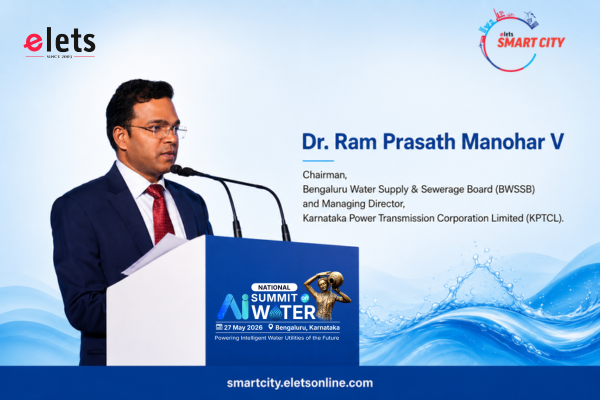
Insights shared by Dr. Ram Prasath Manohar V, Chairman, Bengaluru Water Supply & Sewerage Board (BWSSB) and Managing Director, Karnataka Power Transmission Corporation Limited (KPTCL), at the National AI Summit on Water 2026, in Bengaluru.