Hyderabad has emerged as one of India’s fastest-growing metropolitan regions, driven by a strong technology ecosystem, expanding economic corridors, and sustained population growth. Over the past two decades, the city has also witnessed rapid spatial expansion.
This rapid urbanisation has inevitably placed increasing pressure on urban mobility systems. Hyderabad today hosts a vehicle population exceeding 75 lakh vehicles, with thousands of new vehicles being added every day. Rising vehicle ownership, expanding suburban development, and increasing economic activity have significantly increased travel demand across the metropolitan area. Ensuring that mobility systems keep pace with this growth is therefore a central challenge for urban governance.
Recognizing this transformation, the municipal governance framework has also evolved. 27 surrounding Urban Local Bodies have been merged into GHMC, reflecting the reality that Hyderabad’s growth extends far beyond its historic core. Subsequently, the metropolitan region is administratively structured across three municipal corporations, Greater Hyderabad Municipal Corporation (GHMC), Cyberabad Municipal Corporation (CMC), and Malkajgiri Municipal Corporation (MMC), organized into twelve zones. This restructuring acknowledges Hyderabad as a polycentric metropolitan region, where multiple economic centres and residential clusters are interconnected through a growing mobility network.
In this evolving urban landscape, Urban Local Bodies play a crucial enabling role. While large transport systems such as metro rail and highways provide regional connectivity, municipal administrations shape the everyday mobility experience through roads, junction management, pedestrian infrastructure, and parking management.
Over the past several years, Hyderabad has undertaken a range of initiatives to strengthen this enabling infrastructure. Under the H-CITI Programme, 45 structures (flyovers/underpasses) and 10 road widenings, have been taken up to enhance major corridors. Also, several key infrastructure projects were completed under the earlier “Stratergic Road Development Programme” (SRDP). Apart from raw infrastructure, around 150 electric vehicle charging stations have also been established across the city, in collaboration with TGREDCO, to support the transition toward cleaner mobility.
To address the growing demand for parking in dense commercial areas, the municipal administration has initiated the development of Multi-Level Car Parking (MLCP) facilities at key locations. These facilities help reduce roadside parking, optimise land use in high-demand areas, and improve traffic circulation. In addition, junction improvements and traffic engineering interventions are being implemented across major corridors to enhance connectivity and reduce congestion. These measures form an important foundation for improving mobility across the metropolitan region.
However, as Hyderabad continues to expand, mobility planning must increasingly move beyond infrastructure creation toward building an integrated and sustainable urban mobility ecosystem.
Vision for Hyderabad’s Future Mobility As Hyderabad continues to expand as a major metropolitan region, urban mobility planning must increasingly focus on strengthening the city-level infrastructure that enables efficient daily movement within the urban environment. Urban Local Bodies play a crucial role in shaping this mobility ecosystem through street design, parking management, junction improvements, and the creation of accessible public spaces.
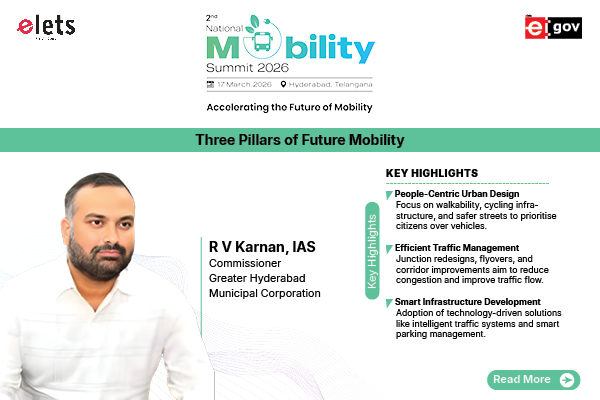
1. People-Centric Streets and Public Spaces
Streets are the most important public spaces in any city and must be designed to accommodate all users. The municipal administration will continue to focus on developing pedestrian-friendly streets with continuous footpaths, safe crossings, improved street lighting, and universal accessibility features.
Special emphasis will be placed on improving walkability in commercial districts, institutional areas, and transit corridors with the inclusion of dedicated cycle-lanes and fast over-bridges for conflict-free movement. Area-based street improvements and redesign of key public spaces will help create vibrant, accessible, and safe urban environments that encourage walking and support last-mile connectivity.
2. Efficient Road Network and Traffic Flow Management
Improving the efficiency of the urban road network is central to managing mobility in a rapidly growing city. The municipal administration will continue to undertake scientific junction redesign, traffic circulation improvements, and corridor-level interventions to address congestion bottlenecks. Infrastructure such as flyovers and underpasses, along with engineering improvements at critical intersections, will support smoother traffic flow across major corridors. These interventions aim to optimise the existing road network and reduce delays while improving road safety.
3. Smart and Sustainable Urban Mobility Infrastructure
Managing mobility in a large metropolitan city also requires smarter use of urban space and infrastructure. Expansion of Multi-Level Car Parking facilities will help address parking demand in dense commercial areas and reduce roadside congestion. At the same time, the city will continue to support the transition toward sustainable mobility through initiatives such as expansion of electric vehicle charging infrastructure.
Technology-enabled systems, including integrated parking management and data-driven mobility planning, will further strengthen the city’s ability to manage traffic and mobility patterns efficiently.
Through these initiatives, Hyderabad aims to build a people-centric and future-ready mobility ecosystem, where safer streets, efficient traffic systems, and well-planned urban infrastructure support the city’s continued economic and spatial growth. The vision is to create a mobility system that not only enables movement but also enhances livability, sustainability, and the overall quality of urban life.
Views expressed by: Shri. R.V. Karnan, IAS, Commissioner, Greater Hyderabad Municipal Corporation (GHMC)