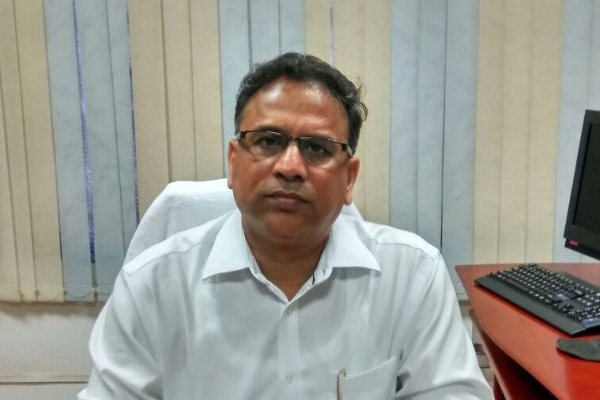
In an exclusive interview, Dr. K. Ilambarithi, IAS, Transport Commissioner, Government of Telangana, shares with Rose Jaiswal from Elets News Network (ENN) insights into the state’s efforts to build a safer, smarter, and more sustainable mobility ecosystem. He discusses key policy initiatives, digital transformation in transport services, and Telangana’s vision for future-ready mobility.
How is Telangana leveraging technology and digital platforms to improve transport services and regulatory efficiency?
Telangana is leveraging digital technologies to enhance transport services, improve regulatory efficiency, and ensure greater transparency. The state has integrated its transport services with national platforms such as VAHAN and SARATHI, enabling online vehicle registration, driving licence services, permits, and tax payments. The Sarathi platform was launched as a pilot in April 2025 and has now been rolled out across the state, while the Vahan system is expected to be fully implemented by July 2026, allowing citizens to access most services digitally without visiting RTO offices.
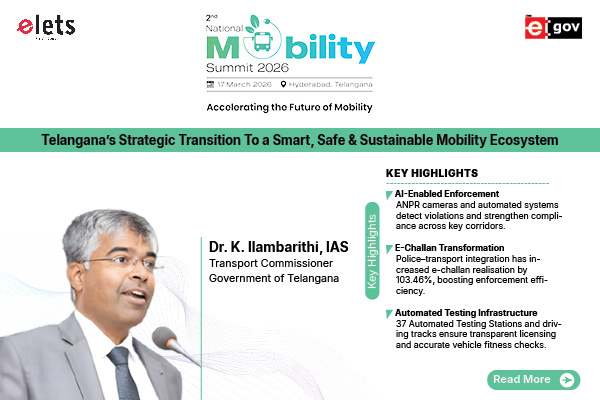
Technology is also strengthening enforcement and compliance. Integration of police e-challans with transport databases has increased e-challan realisation by 103.46%, raising average monthly collections from ₹12.42 crore to ₹25.57 crore. Additionally, 60 ANPR cameras have been approved at 30 locations to automatically detect violations such as helmet and seatbelt non-compliance and over-speeding.
Further, Telangana has approved 37 Automated Testing Stations to ensure accurate vehicle fitness checks and has introduced QR-based monitoring for reflective safety tapes to maintain regulatory standards. Together, these digital and AI-enabled initiatives are improving service delivery, strengthening compliance, and making transport governance more efficient and citizen-friendly.
Road safety remains a critical concern across India. What major initiatives has Telangana implemented to reduce crash and promote responsible driving?
Road safety is a top priority for the Telangana government, which has adopted a comprehensive “4E” strategy—Education, Enforcement, Engineering, and Emergency response—to reduce accidentFs and promote responsible driving.
The state has strengthened enforcement through technology-driven systems. Integration of police e-challans with the Transport Department database has led to a 103.46% increase in e-challan realisation, with average monthly collections rising from ₹12.42 crore to ₹25.57 crore. Additionally, the government has approved installation of 60 Automated Number Plate Recognition (ANPR) cameras at 30 locations to automatically detect violations such as driving without helmets, not wearing seatbelts, and over-speeding, improving compliance with traffic rules.
Telangana has also implemented large-scale awareness and education initiatives. Road safety campaigns in 2025 and 2026 sensitised nearly 2 million citizens, including drivers, students, and vehicle users. The government has also launched Traffic Awareness Parks for children, with a plan to establish at least one park in every district by 2026, and has already formed 57 Road Safety Clubs in schools, colleges, and universities to promote responsible road behaviour among young citizens. In addition, the state is strengthening emergency response through initiatives such as the cashless treatment scheme for road accident victims during the golden hour and the Rah-Veer Scheme, which provides
₹25,000 to citizens who help accident victims within the first hour and national awards for outstanding lifesavers.
Together, these enforcement, awareness, and emergency response measures are helping Telangana build a safer road ecosystem and encourage responsible driving behaviour.
With respect to road safety, we are focusing on all four—E’s: engineering, emergency, enforcement, as well as education. In the aspect of engineering, we are tying up with IIT Madras and their “Center for Excellence in Road Safety” in order to provide a road safety audit on all our road networks, to find out the black spots as well as the spots where frequent crashes are happening, and then to have an engineering solution. This will also help us identify what the issues are in those places and how to resolve those problems.
IIT Madras, as well as the Center for Excellence in Road Safety, will deploy its people—all the engineers at the headquarters in Hyderabad as well as at the district level—in order to complete these road safety audits with all the District Road Safety Committees, and we will take the rectifications from it.
Telangana also has a Road Safety Cess, and that will bring about a substantial amount of resources for us to utilize in changing all these engineering aspects.
In addition to it, we are also focusing on enforcement, and we are making the enforcement electronic. Electronic enforcement, with speed cameras, will be installed on all major highways, high-density corridors, as well as high-risk corridors, and across all city and urban areas so that the complete traffic challan aspect and other aspects will be fully automated.
With respect to emergency response, in addition to the “Rahvee” and cashless treatment of road safety victims, we are also strengthening our emergency network—hospitals, ambulances, and also enabling those primary hospitals along the highways to have active bleeding control as well as life-saving equipment.
Together with all of this, we will be able to make substantial progress in the reduction of fatalities. We are also activating the District Road Safety Committees, headed by the District Collectors, so that crashes and deaths can be significantly reduced.
We are also pioneering and piloting an online road safety awareness module and digital education platforms, which will be made mandatory before applying for an LLR, so that driver education—especially the various aspects of road safety and responsible driving—is digitally imparted to applicants before they apply for it.
Driver awareness and driver education will play a huge role in reducing road crashes. Therefore, this is an aspect we are focusing on. What we are going to do is tie up with TG Online, and we are preparing content to be played before the applicants. This will be camera-enforced content, so they will have to view it and then answer the questions.
This has been made mandatory, and it will be required for applicants before they can proceed with their applications. Additionally, we are in the process of modernising our testing stations—automated testing stations as well as automated driving tracks—without any manual interference. This is also going to substantially improve the process through which people are issued driving licences.
This is the next aspect we are focusing on in order to professionally enhance the standards of people who hold driving licences.
We are also tying up with the Indian Institute of Public Health and the Injury Research Unit there in order for us to evaluate all the hospitals and also to provide public health data about the deaths that are happening. This is also aimed at understanding how to strengthen emergency care and crash victim care.
All these aspects are being planned comprehensively so that there is a complete revamp of the system, ultimately helping to reduce road traffic crash deaths to a minimum across the state.
With the rise of electric vehicles and clean mobility solutions, how is Telangana preparing its transport ecosystem for a sustainable future?
Telangana is actively preparing its transport ecosystem for a sustainable future by promoting electric mobility and clean transportation policies. The state has introduced incentives under its EV policy, including 100% exemption from road tax and registration fees for eligible electric vehicles until 31 December 2026. As a result, 1,15,551 electric vehicles have been registered between November 2024 and February 2026, with ₹925.94 crore provided as tax exemptions, increasing EV penetration in the state from 0.60% in December 2023 to 1.50% in February 2026.
To accelerate the transition to cleaner mobility, the government has also approved 20,000 new electric three-wheeler auto-rickshaw permits and 25,000 retrofitted electric autos within the Outer Ring Road limits of Hyderabad, promoting eco-friendly last-mile transport while restricting new petrol and diesel auto permits.
In parallel, Telangana is encouraging the development of EV manufacturing, battery production, and charging infrastructure across the state, while working with urban local bodies and private stakeholders to expand EV charging networks in cities and along highways. These initiatives, combined with policies such as the vehicle scrappage program to phase out older polluting vehicles, are helping Telangana reduce emissions, improve air quality, and build a cleaner and more sustainable transport ecosystem.
How is the Transport Department collaborating with other government agencies and industry stakeholders to strengthen the state’s mobility infrastructure?
The Transport Department of Telangana works closely with multiple government agencies and industry stakeholders to strengthen the state’s mobility infrastructure. It coordinates with departments such as Police, Health, urban local bodies, and other regulatory authorities to ensure integrated mobility planning, effective enforcement, and improved public safety.
Inter-departmental collaboration has been particularly important in initiatives such as the cashless treatment scheme for road accident victims, where the Transport Department works with Police, Health, EMRI services, insurance companies, and other stakeholders to ensure timely medical assistance during the golden hour. Similarly, enforcement systems integrate transport databases with police e-challan systems, which has helped increase e-challan realisation by 103.46%, improving compliance with traffic regulations.
The department also partners with technology providers and industry players to deploy advanced solutions such as 60 AI-enabled ANPR cameras across 30 locations, digital transport platforms like VAHAN and SARATHI, and automated testing infrastructure, including 37 Automated Testing Stations across the state.
Through these collaborations with government agencies, technology partners, and industry stakeholders, Telangana is building a more integrated, technology-driven, and future-ready mobility ecosystem.
What is your long-term vision for transforming Telangana into a model state for smart and sustainable mobility?
Our long-term vision is to transform Telangana into a national leader in smart, safe, and sustainable mobility by building a transport ecosystem that is technology-driven, environmentally responsible, and citizen-centric. The state aims to expand digital governance in transport services through platforms such as VAHAN and SARATHI, enabling seamless access to vehicle registration, licensing, and regulatory services across the state.
A key focus area is sustainable mobility, with policies promoting electric vehicles through incentives such as 100% exemption from road tax and registration fees until December 2026, which has already supported the registration of over 1.15 lakh EVs in the state. Alongside this, Telangana is strengthening **road safety through its “4E” approach—Education, Enforcement, Engineering, and Emergency response—while deploying technology-enabledW enforcement systems and expanding awareness programmes across the state. The vision also includes building a future-ready mobility ecosystem by encouraging innovation, attracting investments in EV manufacturing and mobility technologies, expanding charging infrastructure, and integrating multiple transport systems for seamless travel. Through these initiatives, Telangana aims to emerge as a model state for intelligent, sustainable, and technology-enabled mobility in India.
What are the key priorities of the Transport Department in Telangana to build a safe, efficient, and citizen-centric mobility ecosystem?
The Transport Department of Telangana is focused on several key priorities to build a safe, efficient, and citizen-centric mobility ecosystem. A major focus is digital transformation of transport services, enabling citizens to access services such as vehicle registration, driving licences, permits, and tax payments online through national platforms like VAHAN and SARATHI. Initiatives such as dealer-point vehicle registration introduced in January 2026 further reduce the need for physical visits to RTO offices and improve service convenience.
Another key priority is strengthening road safety and regulatory enforcement through technology-enabled systems. Integration of police e-challans with the transport database has led to a 103.46% increase in e-challan realisation, with average monthly collections rising from ₹12.42 crore to ₹25.57 crore. The state has also approved 60 AI-enabled ANPR cameras at 30 locations to automatically detect violations such as driving without helmets, not wearing seatbelts, and over-speeding.
The department is also prioritising sustainable and clean mobility. Telangana has introduced incentives for electric vehicles, including 100% exemption from road tax and registration fees until December 2026, supporting the registration of over 1.15 lakh EVs in the state.
By combining digital governance, technology-driven enforcement, and promotion of green mobility, the Transport Department aims to create a transport ecosystem that is safer, more efficient, and responsive to the evolving needs of citizens.
Views expressed by: Dr. K. Ilambarithi, IAS, Transport Commissioner Government of Telangana