
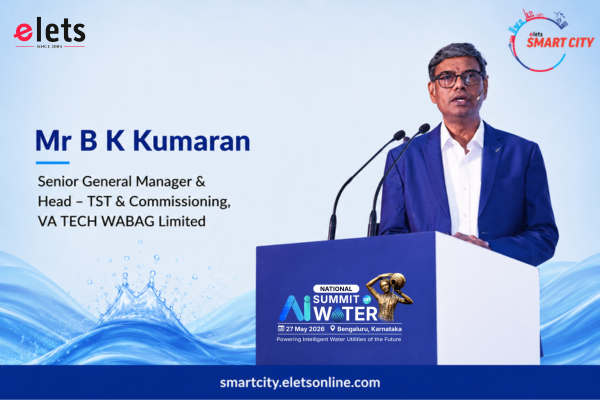
As water utilities and treatment facilities increasingly adopt digital technologies, the focus is shifting from collecting operational data to using it for faster, more informed decision-making. At the National AI Summit on Water 2026, Mr B K Kumaran, Senior General Manager & Head – TST & Commissioning, VA TECH WABAG Limited, presented a case study on the 45 MLD Koyambedu Tertiary Treatment Reverse Osmosis (RO) Plant, operated by the Chennai Metropolitan Water Supply and Sewerage Board (CMWSSB), demonstrating how AI can transform operational intelligence in advanced water-reuse facilities.
The Koyambedu facility recycles treated wastewater to produce high-quality industrial water supplied to nearly 300 industries, including Hyundai, Saint-Gobain, Renault-Nissan, TVS Motor Company and Apollo Tyres. Initially commissioned with a conventional automation architecture comprising sensors, PLCs, SCADA systems and cloud-based monitoring, the plant introduced an AI-driven intelligence layer approximately 18 months into operations. The platform analyses operational data to generate actionable insights and support more timely and informed decisions by plant operators.

From Automation to AI-Driven Intelligence
The introduction of AI marked a shift from conventional plant monitoring towards a more predictive approach to operations. The platform analyses variables including differential pressure, conductivity, flow, pressure and energy consumption, enabling operators to identify emerging performance issues and intervene before they affect plant efficiency.
Key AI applications include membrane-health monitoring, predictive maintenance of high-pressure pumps and other critical rotating equipment, optimisation of chemical-cleaning schedules for UF and RO systems, pump-efficiency assessment, and forecasting of membrane life, water losses and energy-consumption trends.
Rather than relying only on predefined thresholds, the system can examine relationships and trends across multiple operational parameters. This allows plant teams to better understand changing conditions and anticipate potential issues before they translate into equipment deterioration, higher operating costs or reduced treatment performance.
Optimising Membrane Performance and Maintenance
Membrane performance is central to the efficiency of a tertiary treatment RO facility, making timely monitoring and cleaning critical to plant operations. The case study highlighted how AI can support operators in determining when intervention is required rather than relying solely on fixed or routine maintenance schedules.
Delayed membrane cleaning can have a cascading impact on plant performance. It can lead to a 5–8% reduction in membrane life, an 8–10% increase in chemical consumption, a 3–5% rise in specific energy consumption, and 3–5% higher water losses. AI-based monitoring can help identify deterioration in membrane performance at an earlier stage, enabling operators to take corrective action and optimise cleaning cycles. This can help balance maintenance requirements against operational efficiency while protecting the useful life of critical treatment assets.
Predictive Maintenance for Critical Equipment
The AI deployment also extends beyond membranes to critical rotating equipment, particularly high-pressure pumps. By analysing operational parameters and equipment behaviour, predictive models can support early identification of potential performance deterioration.
Pump-efficiency assessment is another important application. Since high-pressure pumping is a significant component of RO operations and energy consumption, understanding changes in pump performance can help operators identify inefficiencies and take corrective action.
This represents a broader transition from reactive maintenance to predictive asset management. Instead of waiting for equipment to fail or performance to deteriorate significantly, utilities can use operational data to identify potential risks and plan interventions more effectively.
Preserving Operational Knowledge with “Ask Z”
A distinctive element of the deployment was “Ask Z”, an AI-powered operator-assistance chatbot designed to bring operational knowledge into a single decision-support platform.
The system integrates equipment documentation, standard operating procedures (SOPs), historical operational records and institutional knowledge, allowing operators to access relevant information through a conversational interface. This can reduce dependence on external experts while making accumulated operational knowledge more accessible within the organisation.
For complex treatment facilities, this capability can be particularly valuable because plant performance depends not only on automated systems but also on the experience of personnel who understand equipment behaviour, operating conditions and historical interventions. By bringing this knowledge into an AI-enabled interface, the system can support knowledge continuity and make operational expertise easier to access. The value of the chatbot is also expected to increase as it continues learning from operational experience. Over time, this can create a more comprehensive knowledge base that supports both day-to-day operations and the development of institutional expertise.
Data Quality as the Foundation
Despite the range of AI applications, the presentation identified establishing reliable, high-quality data streams as the most challenging aspect of implementation. Treatment plants generate information through multiple sensors, control systems and operational processes, and inconsistencies in these data streams can directly affect the quality of AI-generated insights.
The experience therefore reinforces a fundamental principle of industrial AI: the effectiveness of advanced analytics depends on the reliability, continuity and context of the underlying data. AI deployment cannot be treated as a standalone technology intervention; it requires robust instrumentation, dependable data collection, integration of historical information and a clear understanding of the operational processes being modelled.
For water utilities, this makes data governance and data quality critical components of AI readiness. The better the operational foundation, the greater the potential for AI to move beyond monitoring towards meaningful prediction and decision support.
From Data to Actionable Decisions
The Koyambedu case ultimately demonstrates that the value of AI lies not simply in generating or analysing more data, but in converting operational information into timely and actionable decisions.
For a complex RO facility, this means using data to understand membrane health, anticipate equipment deterioration, optimise chemical-cleaning schedules, assess pump efficiency and forecast changes in energy consumption and water losses. Each of these applications connects AI analysis directly to an operational decision.
This creates a more integrated approach to plant management, where AI complements existing sensors, PLCs, SCADA systems and cloud-based monitoring rather than replacing them. The intelligence layer adds the ability to interpret operational patterns, identify emerging risks and provide operators with information that can support faster intervention.
Also read: Xylem Vue: Building a Unified Digital Intelligence Layer for Water Utilities
Conclusion
The Koyambedu case demonstrates how AI can add an intelligence layer to existing automation infrastructure, turning operational data into actionable insights for predictive maintenance, process optimisation and resource efficiency. The deployment shows that the real value of AI lies not in generating more data, but in helping operators interpret existing information and make faster, better-informed decisions.
The measurable operational implications are significant. Delayed membrane cleaning alone can affect membrane life, chemical consumption, energy use and water losses, while predictive monitoring can help operators intervene before these impacts escalate. At the same time, applications such as pump-efficiency assessment and equipment monitoring demonstrate how AI can support a broader shift from reactive maintenance towards predictive and condition-based operations.
The introduction of “Ask Z” further expands AI’s role from equipment and process analytics to organisational knowledge management. By combining operational records, SOPs, equipment documentation and institutional knowledge, the system demonstrates how AI can help preserve expertise and make it accessible to plant personnel. As water reuse becomes increasingly important for meeting industrial and urban water requirements, integrating reliable data, predictive analytics and accessible operational intelligence could help utilities improve efficiency, extend asset life and build more resilient and knowledge-driven water infrastructure.