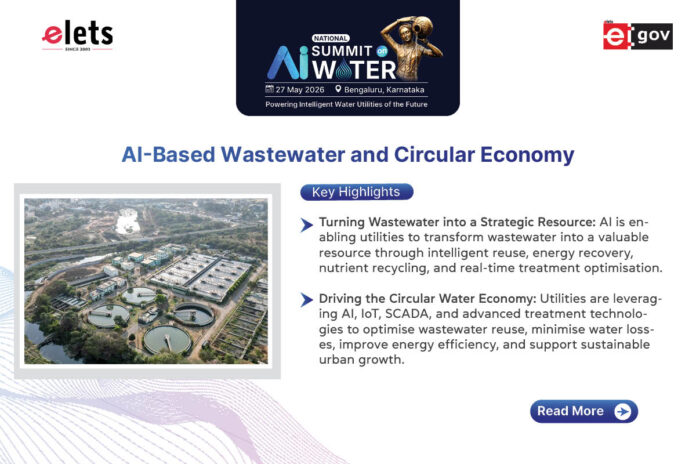
For decades, wastewater was treated as a disposal challenge. Today, it is increasingly being recognised as a strategic resource, capable of supplying recycled water, generating renewable energy, recovering nutrients, and strban utilities. It signals the end of the “infrastructure provider” era and the dawn of the data-driven public service system.
India stands at a critical juncture. Rapid urbanisation, rising industrial demand, groundwater depletion, and climate variability are widening the gap between water availability and demand. Conventional approaches focused solely on sourcing more freshwater are becoming economically and environmentally unsustainable. The future lies in intelligent water reuse and resource recovery.
WASTEWATER – AN ECONOMIC RESOURCE
The circular water economy rests on a simple principle: water should remain in productive use for as long as possible. The modern wastewater systems no longer merely remove contaminants, they recover:
- Recycled water for industrial, agricultural, and urban use
- Energy through sludge digestion and biogas production
- Nutrients such as phosphorus and nitrogen
- Environmental value through reduced freshwater extraction and lake restoration
Globally, advanced wastewater reuse has become mainstream. Singapore’s NEWater model, Israel’s agricultural reuse systems, and industrial water recycling in Europe and Australia demonstrate how treated wastewater can reduce dependence on freshwater sources.
AI is emerging as the digital layer that makes these systems more adaptive, efficient, and financially viable.
NEW AGE WATER INTELLIGENCE WITH AI
Water networks generate enormous volumes of operational data, from pumps and pipelines to treatment plants and customer usage. Historically, much of this data remained underutilised. AI changes this equation.
Machine learning and predictive analytics can now enable:
- Leak detection and NRW reduction
- Predictive maintenance
- Smart metering and demand forecasting
- Real-time water quality prediction
- Energy optimisation in treatment plants
- Automated chemical dosing
- Flood and drought preparedness
- Digital twins for utility planning
Instead of reacting to breakdowns, utilities can predict and prevent them. A recent study published by the Cornell University, titled, “Predictive control of wastewater treatment plants as energy-autonomous water resource recovery facilities” (https://doi.org/10.48550/arXiv.2506.1049) demonstrates how predictive control can operate wastewater plants as energy-autonomous resource recovery facilities, simultaneously achieving treated-water quality targets and biogas generation while minimising energy costs.
This transformation is increasingly visible across Indian water utilities and reuse projects, where digital monitoring, wastewater recycling, SCADA systems and advanced treatment technologies are laying the foundation for AI-enabled and circular water management.
BWSSB: BUILDING THE FOUNDATIONS OF CIRCULAR WATER MANAGEMENT
The Bangalore Water Supply and Sewerage Board manages one of India’s most complex urban water systems. Serving Bengaluru’s expanding metropolitan region, BWSSB oversees:
- Extensive water distribution networks
- Large-scale sewage collection
- Multiple sewage treatment plants
- Treated wastewater reuse and lake rejuvenation initiatives
- Leakage reduction and digital monitoring programmes
BWSSB has increasingly moved beyond a “supply-and-disposal” model toward Total Water Management. The utility has articulated a goal of capturing and treating wastewater comprehensively for reuse and circular urban water management.
AI-DRIVEN NRW REDUCTION AND SMART LEAKAGE MANAGEMENT
One of the largest challenges for utilities worldwide is Non-Revenue Water (NRW), water lost through leakages, theft, or illegal connections. Water loss directly affects utility finances, pumping energy, and freshwater security. BWSSB has undertaken:
- Japanese leak detection systems
- Pressure management
- Water accounting
- District monitoring
- SCADA-linked supervision
- Hidden-leak identification technologies
The next step is AI-enabled network intelligence.
BWSSB’s recent initiatives include robotic and AI-assisted leakage identification and pipeline inspection under its “Blue Force” programme, aimed at reducing illegal connections and physical losses. Bengaluru currently loses significant water through leakages and unauthorised use, making predictive monitoring increasingly important.
The utility has also begun AI-assisted groundwater analytics in partnership with research institutions, using IoT and predictive models to identify vulnerable wards and anticipate scarcity risks.
BWSSB VISION 2030: BUILDING AN AI-NATIVE WATER UTILITY
BWSSB’s ongoing investments in leak detection, SCADA systems, water accounting and treatment infrastructure point toward a larger transformation, one where utilities evolve from operating physical assets to managing intelligent, self-learning water ecosystems.
The next phase of Bengaluru’s water journey could be defined by AI-native wastewater and resource recovery systems. BWSSB’s Vision 2030 framework includes:
- Real-time treatment monitoring across STPs
- Automated CPCB compliance monitoring for key indicators such as BOD, COD and TSS
- AI-based forecasting of sludge and biogas generation using influent quality and flow data
- Predictive optimisation of aeration, pumping and chemical dosing
- Dynamic reuse planning through identification of treated-water demand clusters and industrial reuse marketplaces
- Intelligent decision-support dashboards for utility managers and policymakers.
Such systems would move wastewater treatment from a compliance-driven activity to a resource recovery platform, enabling Bengaluru to accelerate its transition toward a circular water economy. This shift is particularly significant because wastewater contains not only reusable water, but also embedded energy and nutrient value. AI-enabled forecasting and marketplace mapping can help match treated-water supply with industrial, landscaping and non-potable urban demand, transforming wastewater into an economically productive asset.
MAKING SEWAGE TREATMENT PLANTS ENERGY OPTIMISED
Sewage Treatment Plants (STPs) are among the most energy-intensive municipal assets. Aeration systems, pumping stations, sludge handling, and chemical treatment consume large amounts of electricity, often accounting for 30–60% of operating expenditure. AI can dramatically improve this equation.
Machine-learning systems can optimise:
- Aeration rates
- Pump operations
- Oxygen dosing
- Energy scheduling
- Predictive equipment maintenance
- Hydraulic load balancing
Instead of fixed operating cycles, AI allows treatment plants to adapt continuously to inflow patterns and wastewater characteristics. The result is lower electricity consumption, reduced emissions, higher treatment efficiency and lower operating costs. This creates the foundation for energy-aware and eventually energy-neutral treatment systems.
MAKING SEWAGE TREATMENT PLANTS ENERGY OPTIMISED
Sewage Treatment Plants (STPs) are among the most energy-intensive municipal assets. Aeration systems, pumping stations, sludge handling, and chemical treatment consume large amounts of electricity, often accounting for 30–60% of operating expenditure. AI can dramatically improve this equation.
Machine-learning systems can optimise:
- Aeration rates
- Pump operations
- Oxygen dosing
- Energy scheduling
- Predictive equipment maintenance
- Hydraulic load balancing
Instead of fixed operating cycles, AI allows treatment plants to adapt continuously to inflow patterns and wastewater characteristics. The result is lower electricity consumption, reduced emissions, higher treatment efficiency and lower operating costs. This creates the foundation for energy-aware and eventually energy-neutral treatment systems.
SLUDGE-TO-BIOGAS: TURNING WASTE INTO ENERGY
The most visible symbol of the circular water economy is the transformation of sludge from waste into fuel. Traditionally, sewage sludge disposal represented a
major cost burden. Advanced systems now recover value through:
- Anaerobic digestion
- Methane capture
- Biogas generation
- Electricity production
- Biosolids and nutrient recovery
This shift reduces landfill dependence and improves utility economics.
STATE CASE STUDIES ON ADVANCING INDIA’S CIRCULAR WATER ECONOMY
Case Study 1: Kerala Water Authority: The Muttathara Model and Smart Water Management Systems
The Kerala Water Authority has introduced advanced Omni Processor technology at the Muttathara STP in Thiruvananthapuram. The system processes treated sludge to generate electricity; recovered water and reusable ash products. Supported through a multi-stakeholder model, the facility represents a major step toward energy-positive wastewater treatment and circular resource recovery Kerala Water Authority has also institutionalised GIS-enabled Smart Water Management. Its platform supports:
- Water demand forecasting
- Utility analytics
- Outage monitoring
- Decision support
- Water quality and conservation planning
This is an important precursor to AI-enabled utility management. Such projects illustrate how sewage can evolve into an energy and resource stream.
Case Study 2: Odisha: WATCO and Smart Utility Governance
In Odisha, urban water reforms led by utilities and state agencies are increasingly incorporating digital governance and infrastructure monitoring. Utility reforms through WATCO show movement toward digitised utility operations and service management. WATCO focuses on: urban water and sewerage management; sustainability; improved service delivery and utility modernisation.
- Odisha’s emphasis is shifting toward:
- Smart utility operations
- Integrated sewerage systems
- Reuse-ready infrastructure
- Data-enabled management
- Public-private operational models
Circularity is not solely a technological challenge, it is equally a governance and institutional transformation.
Case Study 3: Ghaziabad: Smart Industrial Reuse Model
The Ghaziabad TTRO project demonstrates digital and circular water management at scale. Features include:
- 40 MLD TTRO
- Smart metering
- Industrial reuse network
- Real-time monitoring
- Water supplied to 1,500+ industries
Case Study 4: Tamil Nadu: Chennai’s Koyambedu TTRO Model
Tamil Nadu has emerged as one of India’s leading states in advancing wastewater reuse and circular water management. Faced with recurring droughts, rapid urbanisation and mounting pressure on freshwater resources, Chennai has adopted an increasingly forward-looking approach that treats wastewater not as waste, but as a strategic resource. A defining example of this transition is the Koyambedu Tertiary Treatment Reverse Osmosis (TTRO) Plant, implemented as part of Chennai’s broader wastewater recycling and industrial water security strategy. Developed through the collaborative efforts of city utilities and technology partners, the 45 MLD Koyambedu TTRO facility represents one of India’s most advanced municipal wastewater reuse projects. Designed to convert treated sewage into high-quality industrial-grade water, the project demonstrates how urban wastewater can be integrated into a circular economy framework. The treatment system combines multiple stages of advanced purification, including:
- Tertiary filtration
- Ultra-filtration (UF)
- Reverse Osmosis (RO)
- Advanced polishing and quality assurance systems
- Dedicated transmission infrastructure for industrial supply.
The Koyambedu model estimates indicate that the facility conserves more than 16 million cubic metres of freshwater annually, highlighting the large-scale potential of municipal-industrial water recycling.
PREDICTIVE WATER QUALITY: AI AS ENVIRONMENTAL SENTINEL
Water quality is traditionally assessed through periodic laboratory testing. AI introduces continuous predictive monitoring. Using IoT sensors, machine learning, cloud analytics, digital dashboards, the utilities can predict:
- BOD and COD variations
- Treatment performance
- Contamination risks
- Lake pollution events
- Process failure likelihood
This has major implications for public health, regulatory compliance, environmental protection and urban resilience. AI becomes an environmental early-warning system.
THE ROAD AHEAD
India’s water future cannot depend solely on new reservoirs, deeper borewells, or longer pipelines. The next gateway lies in resource recovery and intelligence-led water management. Utilities such as BWSSB, initiatives in Kerala, digital reforms in Odisha, Ghaziabad TTRO project and industrial reuse models like Koyambedu show that this transition is already underway. The circular water economy is not merely about treating wastewater. It is about redesigning urban systems so that every litre is measured, monitored, reused, and valued. The future of water security will belong to cities that treat wastewater not as an endpoint, but as the beginning of a new resource cycle powered by technology, sustainability, and intelligent governance.
Written by: Dr. Asawari Savant | Elets News Network (ENN)