

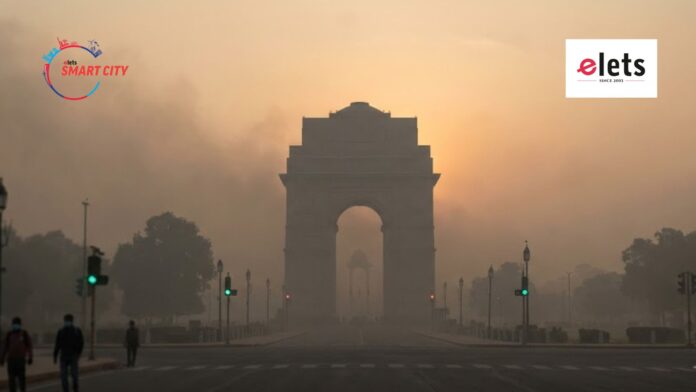
NEW DELHI — Delhi’s air quality reached the “very poor” category Monday for the first time this season, with an overall air quality index reading of 307 at 7:05 a.m., according to the Hindustan Times, citing data from the Central Pollution Control Board.
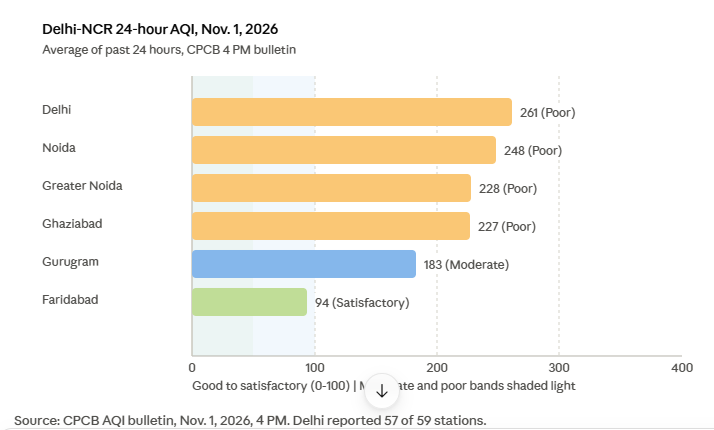
The city had already slipped into the “poor” category over the weekend. The board’s 4 p.m. bulletin for Nov. 1 listed Delhi at 261 on a 24-hour average, with 57 of 59 monitoring stations reporting.

Of the 58 stations that had data Monday, 36 recorded very poor air, the Hindustan Times reported. Jahangirpuri was the only station in the “severe” category, at 417.
The rain on Friday had cleared pollution from the city’s air, but that northwesterly winds and calm conditions have since allowed emissions to build up. Meteorologist Navdeep Dahiya said no favorable weather was expected for seven to 10 days and warned that smog would worsen across the region.
READ MORE: National Capital Region Air Pollution
The Commission for Air Quality Management ordered precautionary measures in an Oct. 30 order covering Nov. 5 to 20. The measures restrict dust-generating demolition and outdoor construction across the National Capital Region, with exceptions for railways, metro services, airports, hospitals, water supply and defence projects.
The order also directs state government and private offices in Delhi and in the districts of Gurugram, Faridabad, Sonipat, Ghaziabad and Gautam Buddha Nagar to operate with up to 50% of staff attending in person. Exceptions apply to industrial establishments and essential services where that arrangement is not feasible.
The commission said historical data from November 2018 to 2025 show a recurring pattern of elevated pollution in early to mid-November. It cited local emissions, crop residue and biomass burning, and low wind speeds as contributing factors.
READ MORE: Pollution Control
Satellite data from NASA detected 1,394 farm fires in Punjab and Haryana between Oct. 1 and Nov. 1, compared with 1,861 in the same period last year, the Hindustan Times reported. The newspaper noted that the figures may not be directly comparable because burning has increasingly shifted to later in the day.