
“India had navigated the shocks of the past four years with its fundamentals intact.” That was Nirmala Sitharaman’s assessment as Union Finance Minister at the 5th Kautilya Economic Conclave in New Delhi on October 3, 2026, delivered against the backdrop of 7.8% real GDP growth in Q1 FY2026-27 and a capital expenditure outlay of ₹12.22 lakh crore for the current fiscal year.
Reform Frameworks and Economic Outcomes
The context for the structural reforms cited by Sitharaman stems from a series of economic challenges such as inefficiencies in tax collection, a fragmented regulatory environment, and a banking sector burdened by non-performing assets. In response to these issues, the government initiated a comprehensive overhaul of the regulatory framework, beginning with the introduction of the Goods and Services Tax (GST) in 2017, aimed at simplifying the tax structure and enhancing compliance.
READ MORE: India’s Infrastructure Growth Needs Stronger Risk Architecture
The Insolvency and Bankruptcy Code was introduced to tackle the growing problem of stressed banks and corporate debt, providing a structured approach to resolving insolvencies. Additionally, the consolidation of 29 central labour laws into four codes was intended to clarify and formalise employment relations and to address long-standing regulatory ambiguities.
Fiscal and Growth Indicators
India’s financial condition is exceptionally strong, with real GDP growing by 7.8% in the first quarter of FY2026-27. The International Monetary Fund predicts a substantial decrease in India’s government debt, from 83.4% of GDP in 2026 to 77.7% by 2031, countering the global trend of rising sovereign debt levels. The Union Budget for FY2026-27 commits a significant ₹12.22 lakh crore for capital expenditure, the largest allocation in the nation’s fiscal history. This is expected to generate major infrastructure growth and project delivery rates across several industries.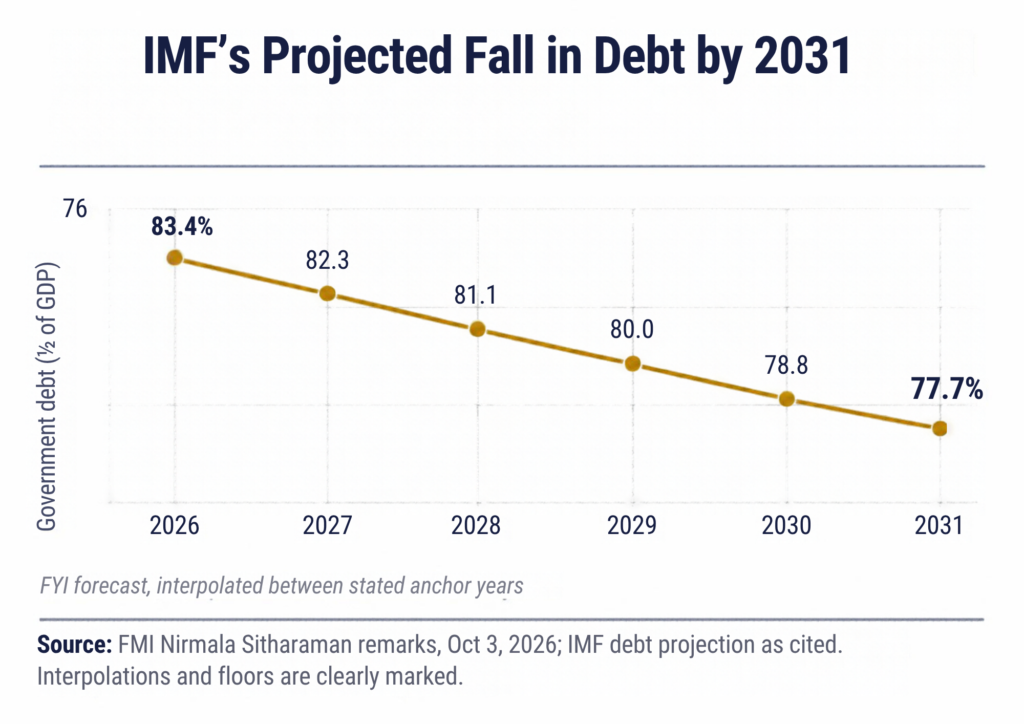
READ MORE: Delhi’s 2047 Housing Plan Targets Migrants with Affordable Rental Homes
Infrastructure investment was presented as a structural complement to regulatory change, rather than an independent line item. Since 2014, the national roadway network has grown by almost 61%, and the number of functioning airports has more than doubled. The government’s delivery architecture, which includes the PM MUDRA Yojana, which has approved over 52 crore collateral-free loans; the PM Awas Yojana; and Ayushman Bharat, was cited as proof that structural overhaul has resulted in measurable increases in public service access.