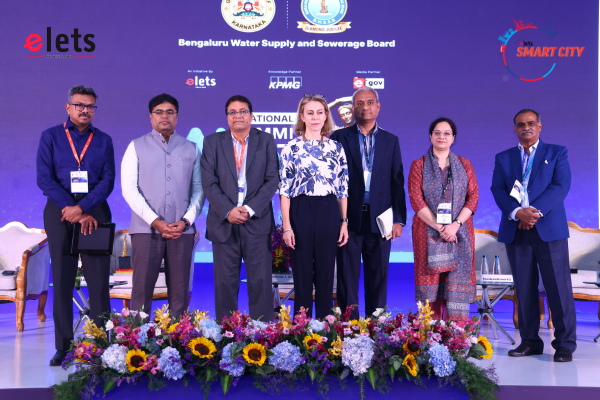
As artificial intelligence moves from pilot projects to core utility operations across India’s cities, a quieter but equally decisive question has come to the fore: who pays for this transformation, and how? A dedicated panel on financing and enabling India’s intelligent water ecosystem brought together development finance practitioners, multilateral lenders, merchant bankers and public sector financiers to unpack this challenge, moving the conversation beyond sensors and algorithms to the harder terrain of capital structuring, risk allocation and institutional accountability.
The session, held during the National AI Summit on Water in Bengaluru on 27 May 2026, was framed around a central premise: the need for AI-driven water transformation is no longer in doubt, but the enabling conditions, financing instruments and risk-sharing mechanisms required to scale it remain underdeveloped. Panellists drew on experience ranging from bilateral development cooperation and World Bank-financed state programmes to municipal bond issuances and commercial banking, offering a layered view of how India’s water sector can mobilise capital at the scale its cities now require.
Speaker Perspectives
Ms Laura Sustersic, Project Director, GIZ
Moderating the session, Ms Laura Sustersic set the tone by noting that while much of the summit had focused on how AI improves utility management and service delivery, the deeper question was one of financing that transformation. Drawing on GIZ’s long-standing cooperation with India and Karnataka, spanning urban development, energy, environment and private sector engagement, she framed Bengaluru’s own water security challenges as illustrative of why the discussion mattered. She positioned the panel’s task as looking not at whether financing is needed, but at what enabling conditions, risk structures and instruments can help scale AI-linked investment in the sector.
Sri. Ajith Radhakrishnan, Senior Water Specialist & India Program Coordinator, World Bank
Sri. Ajith Radhakrishnan commended the Government of Karnataka and Bengaluru’s administration for convening the conversation, describing it as one of the frontier discussions the water sector needs more often. He argued that before financing can be discussed meaningfully, two foundational layers must be in place: the analogue infrastructure that supports digitalisation, such as reliable electricity, data centres and cloud infrastructure, and the digital infrastructure itself, including the AI and ICT products utilities are now deploying. Without both functioning in tandem, he cautioned, financing conversations would remain premature.
On the financing question itself, Sri. Ajith Radhakrishnan pointed to a structural gap: the water sector has historically captured only a small share of global climate finance, partly because water-related performance metrics are often absent from national adaptation plans and international climate finance mechanisms such as the Green Climate Fund. He suggested that integrating utility performance data into these larger policy frameworks could unlock more climate capital for the sector. He also highlighted a broader shift away from conventional loan financing toward performance-based financing, noting that the measurable, real-time data generated by AI-based monitoring tools is well suited to inform performance-linked loans. He cited the World Bank-supported Karnataka Urban Infrastructure Development and Finance Corporation project as an example of this approach, and pointed to blended finance models combining soft debt with grant funding, matching grants tied to non-revenue water reduction targets, and the experience of urban local bodies such as Indore Municipal Corporation in pooling resources through municipal bonds as emerging innovations worth building on.
Mr Chandrasekharan K.S., Vice President, TIPSONS Group
Bringing a merchant banking perspective, Mr Chandrasekharan K.S. described his firm’s experience mobilising municipal bond financing, including its role as transaction advisor for municipal corporations in Bengaluru and for a bond issuance by Ahmedabad Municipal Corporation. He offered a memorable framing for the panel, likening the enthusiasm around AI and IoT to a newly married couple everyone is eager to celebrate, while finance, by contrast, is treated like an in-law nobody wants to discuss, despite being central to whether any of these technologies can actually be deployed at scale.
Mr Chandrasekharan K.S. explained that urban local body finances are inherently complex, shaped by non-commercial objectives, multiple stakeholders and shifting political priorities, making them far harder to structure than conventional corporate balance sheets. He welcomed the Government of India’s incentive scheme under the updated urban mission framework, under which municipal bodies floating bonds receive incentive support scaled to the amount raised, and noted that early issuances have come largely from Gujarat, with Karnataka expected to follow. He pointed to a growing menu of instruments, including general obligation bonds, green bonds and blue bonds, and argued that accessing capital markets tends to bring greater transparency and financial discipline to municipal accounts. He noted that parastatal water bodies, including in Chennai and Bengaluru, are also exploring similar bond issuances to benefit from these incentives.
Sri. K. Kali, Deputy General Manager, Canara Bank
As the panel turned to the lender’s viewpoint, Ms Laura Sustersic invited Sri. K. Kali to bring a banking sector perspective on the challenges of financing large-scale water infrastructure and digital utility upgrades. His remarks were positioned as a deliberately critical, ground-level counterpoint to the policy and capital-markets discussion that preceded it, underscoring that any financing architecture for AI-enabled water systems must ultimately satisfy the risk and repayment considerations of commercial lenders such as Canara Bank.
Key Insights
- Financing AI-enabled water systems cannot be separated from foundational readiness: analogue infrastructure such as power and data centres must function alongside digital tools before performance-based financing becomes viable.
- The water sector’s limited share of global climate finance points to a policy gap; embedding utility performance metrics into national adaptation plans and international climate finance frameworks could help unlock additional capital.
- Performance-based and blended financing, combining soft loans, grants and measurable AI-generated data, is emerging as a more scalable alternative to conventional lending for utilities.
- Municipal bonds, supported by government incentive schemes and instruments like green and blue bonds, offer urban local bodies and water utilities a growing but still nascent avenue to raise capital, contingent on stronger financial transparency.
- Urban local body and utility finances remain structurally complex, shaped by non-commercial mandates and political dynamics, meaning technology adoption alone cannot substitute for disciplined financial management.
Also read: Building India’s Digital Water Stack: Bengaluru Panel Charts an AI-Led Path to Water Resilience
Conclusion
Across development finance, multilateral lending, capital markets and commercial banking perspectives, the panel converged on a shared recognition: India’s intelligent water ecosystem will only scale as fast as its financing architecture allows. The discussion made clear that enabling conditions, trustworthy data, foundational infrastructure, transparent utility accounts and supportive policy frameworks must precede or accompany any push for AI adoption, rather than follow it. With instruments such as performance-based lending, blended finance and municipal bonds gaining traction, and with institutions from GIZ to the World Bank, merchant banks and public sector banks actively engaged, the panel suggested that India stands at an early but promising stage of aligning capital with innovation in the water sector, provided the enabling conditions discussed continue to be built out deliberately and collaboratively.