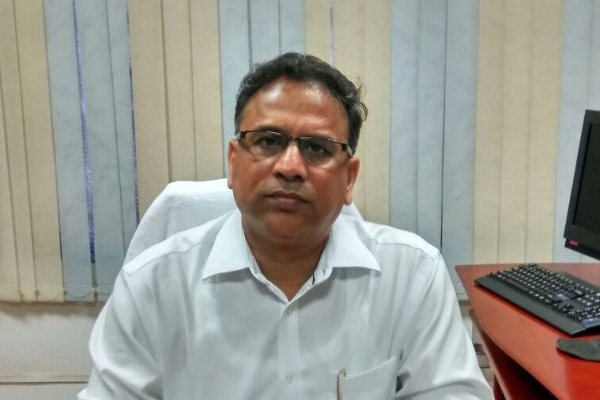
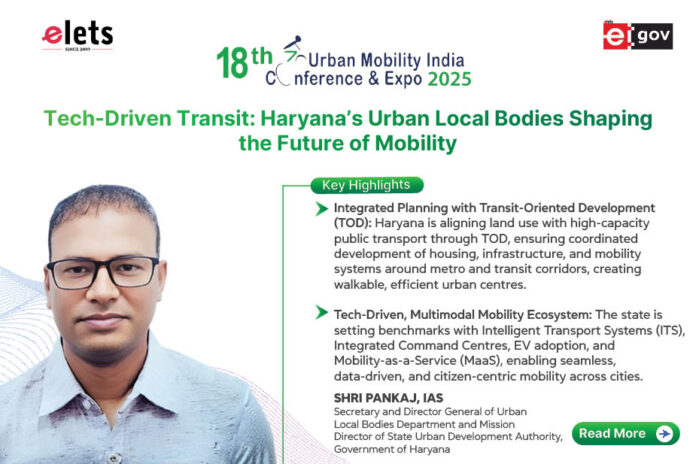
In an exclusive interaction, Shri Pankaj, IAS, Secretary and Director General of Urban Local Bodies Department and Mission Director of State Urban Development Authority, Government of Haryana, shares with Priya Singh of Elets News Network (ENN), on Haryana’s forward-looking urban mobility agenda.
How is the Department of Urban Local Bodies orchestrating an integrated approach to urban mobility across Haryana’s cities? Could you share some of the flagship initiatives that are setting new benchmarks for other states to follow?
Haryana is implementing a coordinated approach to land use and mobility, ensuring that growth is centred around high-capacity public transport rather than the reverse. Our Transit-Oriented Development (TOD) policy enhances this connection by designating TOD zones along the MRTS and major transit corridors, aligning density, permitted uses, and infrastructure investments to optimise access to public transport and foster mixed-use, walkable areas. This approach necessitates close collaboration among GMDA, HSVP, HSIIDC, local authorities, and transport agencies when approving new residential and commercial developments, ensuring that infrastructure (such as roads, footpaths, feeder services, charging stations, and last-mile facilities) is planned in advance.
Pilot projects and demonstrations include the establishment of dedicated bus depots and terminals along key corridors to serve as mobility hubs, the integration of land-use approvals for new sectors with bus and feeder services, and initial TOD pilots around major MRTS/Metro and regional rail nodes to test higher Floor Space Index (FSI) and structured developer contributions linked to public transport provision. These pilots enable us to refine land-value capture mechanisms, developer responsibilities, and streamlined approval processes, ensuring that housing, services, and mobility are developed concurrently rather than sequentially.
A few initiatives being undertaken/ conceptualised by the state are:
Integrated Urban Mobility Strategy
• Transformation of urban mobility through a combination of policy incentives, infrastructure upgrades, and multi-stakeholder collaboration.
• Establishing a connection between planned urban growth and smart transportation systems.
• Regular events such as the Urban Mobility India Conference serve as platforms for sharing best practices, innovations, and fostering cross-learning between cities.
Green Public Transport
Upgradation of fleet, including the introduction of eco-friendly buses (Electric and Hydrogen Vehicle) initiatives in city routes to reduce emissions and reliance on private vehicles.
Shared and Multi-modal Mobility
Provision of supporting infrastructure for Intermediate Public Transport (IPT) and Non-Motorised Transport (NMT) modes of transportation, such as rickshaw stands, bicycle stands, etc.
Flagship Initiatives Leading the Nation
• Electric Vehicle (EV) adoption by offering buyer incentives and installing charging stations throughout urban and semi-urban centres. Promoting EVs for both private and commercial use, including electric two-wheelers, cars, and green public buses.
• Integrated Command and Control Centres (ICCCs) in all major cities, enabling data-driven decision-making and efficient traffic management. The Gurugram Metropolitan Development Authority (GMDA) has pioneered the Smart Mobility Management System, which integrates multiple transport services through a unified digital platform. Additionally, the expansion of the metro network connecting Gurugram, Faridabad, Bahadurgarh, and Kundli exemplifies our commitment to regional connectivity.
What role is technology playing in transforming Haryana’s urban mobility landscape? How are innovations like smart traffic management systems, app-based public transport solutions, and data analytics being leveraged to create more efficient and citizen-centric mobility networks?
Technology is playing a pivotal role in transforming Haryana’s urban mobility landscape through various innovative solutions. We are moving from pilot to scaled deployments in several technology areas.
Here are some key aspects of how technology is being leveraged:
Intelligent Transport Management Systems (ITMS)
• Deployment of Intelligent Transport Systems (ITS), smart traffic signals and real-time monitoring via IoT sensors to enhance traffic flow, road safety, and commuter convenience.
• Haryana’s cities, including Gurugram, are deploying adaptive traffic control systems citywide, using cameras and real-time vehicle detection to dynamically adjust traffic signals to actual conditions. This has already been done in three cities as part of the Smart City mission. On a similar line, Haryana is establishing ICCCs in 7 more cities with ITMS as one of its core solutions.
• Artificial intelligence-powered systems to monitor traffic, detect violations, and enable instant e-challan enforcement, while integrated command centres coordinate responses to incidents and emergencies.
• Introduction of digital ticketing, GPS tracking, and mobile apps for public transport to improve operational efficiency and commuter experience.
• Haryana is integrating advanced ITS and Passenger Information Systems (PIS) in public transport. These systems enhance operational efficiency and improve the passenger experience by providing real-time information about bus schedules and routes.
App-Based and Digital Public Transport & Non-Motorised Transport Solutions
• Digitising public transport in Haryana, integrating app-based ticketing, route planning, and real-time tracking for buses and shared mobility services.
• These platforms allow citizens to access schedules, availability, and live updates, improving the commuter experience and reducing wait times.
• Public bike sharing
• Introduction of Non-Motorised Transport (NMT) modes like E-bikes equipped with GPS.
Data Analytics for Mobility Improvement
• Incorporating data-driven approaches to optimise traffic and transport operations.
• Platforms aggregate live traffic data from cameras, sensors, and app-based feedback to enhance decision-making for congestion management, law enforcement, and emergency response.
• Video surveillance, automatic number plate recognition, and adaptive control analytics help enforce rules and plan future infrastructure upgrades based on usage patterns.
Mobility-as-a-Service” (MaaS): These technological innovations will result in the creation of a unified mobility app that will integrate ticketing, payments, and scheduling across all modes of transport — a step towards “Mobility-as-a-Service” (MaaS) for Haryana’s citizens.
Electric Buses with Smart Features: The state has introduced electric buses equipped with real-time tracking and automated counters. These features not only support clean mobility goals but also ensure that passengers can monitor bus locations and expected arrival times.
Vehicle Location Tracking Devices (VLTDs): All public transport vehicles in Haryana are being equipped with VLTDs. This initiative enhances safety, particularly for vulnerable groups like women and children, by connecting them to emergency response services, such as the ‘112’ helpline.
Workshops and Initiatives: Events like the E-Trans 2025 workshop focus on driving digital innovations and strategies aimed at reducing road accidents. These workshops bring together stakeholders to discuss and implement new technologies in transport.
These innovations collectively contribute to creating more efficient and citizen-centric mobility networks in Haryana, making urban transport safer, more reliable, and user-friendly.
Haryana has been making significant strides in promoting sustainable transportation. Could you elaborate on the state’s strategy for expanding electric vehicle infrastructure, developing non-motorised transport options, and reducing the carbon footprint of urban mobility?
Haryana is making decisive steps towards promoting sustainable transportation. A few of the key initiatives being undertaken are:
Electric Vehicle Infrastructure Expansion: The state is working on various initiatives focused on the expansion of EV Infrastructure, including subsidised land, simplified approvals, and financial incentives for both private and public sector investments in charging stations, especially in urban and industrial areas.
Promotion of non-motorised transport (NMT): Developing dedicated cycling tracks and pedestrian-friendly zones to encourage active mobility, focusing on last-mile connectivity through e-rickshaws and shared bikes, ensures that sustainability goes hand in hand with accessibility.
Expansion of Public Transport Infrastructure
• The State is expanding the fleet of electric and CNG buses across Gurugram, Faridabad, and Panchkula to promote clean and energy-efficient mobility
• Development of Multi-modal Interchange/Transit Hub.
• Introduction of Bus Rapid Transit Systems (BRTS) and Regional Railway Transit Systems.
Reducing Urban Mobility Carbon Footprint
• Plans for 100% electrification of the state bus fleet, greatly reducing vehicular emissions.
Shared mobility solutions (e.g., electric rickshaws, app-based ride sharing) are promoted alongside improvements in public transport, further lowering pollution and traffic.
How is the Department addressing the critical challenge of last-mile connectivity in Haryana’s urban centres? What measures are being implemented to ensure that mobility solutions are accessible and inclusive for all segments of society, including differently-abled citizens and economically weaker sections?
One of the most critical challenges in urban mobility is ensuring that the transport network serves every citizen, regardless of economic status, physical ability, or geographic location. Haryana’s strategy for last-mile connectivity is rooted in inclusivity, accessibility, and affordability. Last-mile connectivity is central to our mobility strategy.
We are deploying a layered approach
1. Strengthening feeder services: High-frequency, short-route feeder buses and e-minibuses timed with mainline services to ensure low waiting times and seamless transfers.
2. Micro-mobility pilots: Regulated e-bike and e-rickshaw schemes operating from designated mobility hubs and terminals, integrated into route planning and parking management.
3. Non-motorised transport (NMT): upgrading pedestrian infrastructure, continuous footpaths, safe cycle tracks and secure bicycle parking at transit stations to make walking and cycling attractive and safe.
4. Expanding Metro & Bus networks: Haryana is expanding metro and bus networks, particularly in Gurugram and Faridabad, with the launch of app-based bus services directly linked to metro stations, improving seamless end-to-end journeys for urban commuters.
5. Encouraging bike Sharing: Encouraging cities to adopt public bike-sharing (PBS) programs, offering easy access to bicycles through mobile apps and docking stations. The upcoming Urban Mobility Hubs will integrate different modes -buses, metros, taxis, and NMT – into single, user-friendly interfaces.
6. Mobility-as-a-service (MaaS): The Department is exploring mobility-as-a-service (MaaS) frameworks to integrate multiple modes—bus, metro, e-rickshaw—under a unified digital platform for seamless commuter movement.
Integrated ticketing and wayfinding: simplifying payment and journey planning across modes so users can move from rail/bus to a micro-mobility leg without friction. We are also focusing on policy/regulatory clarity — designated pick-up/drop-off zones, speed-calmed streets around stations, and time-of-day loading rules — so last-mile modes can operate efficiently without impeding safety or traffic flow.
Making last-mile connectivity Accessible, Affordable, and Inclusive is the key to achieving seamless urban mobility.
A few of the initiatives being taken towards this include:
• Ensuring inclusivity through universal design standards- new infrastructure projects, including ramps, tactile paving, accessible pedestrian signals, and low-floor buses to support differently abled individuals.
• Affordable fare structures and digital ticketing initiatives are also being introduced to make travel easier for lower-income commuters.
• Public transport fleet upgrades, such as low-floor buses and digital ticketing, are designed to accommodate differently abled passengers and provide fare concessions or targeted services for economically weaker sections.
As Haryana continues to urbanise rapidly, what is your vision for the future of urban mobility in the state over the next five to ten years? What are the key challenges you foresee, and hsow is the Department preparing to address them while maintaining Haryana’s position as a leader in urban transport innovation?
Haryana’s long-term vision for urban mobility is to establish smart, sustainable, and inclusive transport systems that align with global best practices while addressing local needs
Vision for the Future
• Haryana aims to lead clean mobility in the National Capital Region (NCR) by rapidly expanding electric vehicle adoption, supporting eco-friendly public transport, and deploying shared mobility options like electric rickshaws and app-based ride-sharing services.
• Strategic infrastructure projects such as metro extensions and new rail corridors will enhance urban and industrial connectivity, encouraging sustainable long-distance and daily commuting.
• Smart city master plans focus on digital infrastructure, integrated utility networks, dedicated cycling/walking tracks, and high green space standards.
• The state is committed to phasing out high-emission vehicles, mandating compliance with new standards for commercial vehicles, and promoting renewable energy in urban projects.
• Encouraging public-private partnerships (PPPs) for innovation and investment in transport services.
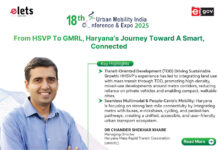
Also Read: From HSVP to GMRL Haryana’s Journey Toward a Smart, Connected
Key Challenges Ahead
• Rapid urbanisation could strain mobility networks; challenges include congestion, pollution control, and maintaining equitable access for all citizens.
• The need for adaptable digital and physical infrastructure as population density grows and urban patterns shift.
• Enforcement of emission standards and timely transition away from fossil-fuel vehicles, particularly in high-density urban corridors.
• Preparedness and Leadership Strategies
• Haryana is investing in automated and AI-enabled traffic management, integrated urban planning, and rigorous environmental compliance to future-proof its transport systems.
• Citizen-centric policies are being designed based on predictive analytics, stakeholder engagement, and ongoing benchmarking against global best practices.
• Regular knowledge exchange through national conferences and multi-sectoral partnerships ensures Haryana remains at the forefront of urban transport innovation.
• This integrated approach positions Haryana as a national leader, setting standards for clean, connected, and citizenfocused urban mobility while staying agile to upcoming challenges in the decade ahead.