Artificial Intelligence and water share a defining trait: both flow across ecosystems, touch everything they pass through, and reward those who learn to channel them well. This parallel frames a critical opportunity for India’s water sector. Over the last decade, India has built some of the world’s most admired digital public infrastructure, including Aadhaar for identity, UPI for payments, DigiLocker for documents, and CoWIN for vaccine delivery, transforming a low-access economy into a digitally inclusive one. Parallelly, more than 20 crore households have been connected to tap water under the Jal Jeevan Mission and AMRUT, generating vast volumes of infrastructure and consumption data. It is time to turn that data into intelligence by building an indigenous AI and Digital Water Stack for the country.
High-Impact Cases Across the Water Value Chain
Used effectively, an AI-powered water stack can act as a force multiplier across the entire value chain. The opportunity spans several concrete applications:
- Leak detection and non-revenue water reduction, where AI can help contain the 20 to 40 per cent water losses typically seen in urban systems
- Predictive maintenance, forecasting failures of pipes, pumps and valves before they occur
- Demand forecasting, predicting consumption based on weather patterns, population and usage trends
- Water quality monitoring, using AI to track and flag anomalies in real time
- Flood prediction and disaster management, combining rainfall data, satellite imagery and hydrological models
Multiple pilots already demonstrate these capabilities, but scale-up across the country has remained limited. Making this a national priority, backed by proper institutional mechanisms, is the next necessary step. Cross-agency data sharing, interoperability across platforms, incentives for utility adoption, and internal capacity building are the pillars needed to move from isolated pilots to a nationwide system. Bangalore Water Supply and Sewerage Board’s existing work in building data platforms based on SCADA, GIS, and IoT stands out as a pioneering foundation, since the data layer has already been created and is now ready to be built up into an AI-enabled national water data stack.
A Five-Layer Framework for Scale
Fundamentally, five layers are required to build this stack nationally:
- Infrastructure mapping: GIS and asset mapping of physical water infrastructure across utilities, with a unique identity for each water connection
- Data capture: sensors and IoT devices deployed at the right points across water systems
- Unified data lake: pooling data from sensors, satellites and weather agencies into a single accessible source
- Indigenous AI models: built on this data lake to address the use cases across leak detection, maintenance, demand and quality
- Citizen experience layer: delivering the resulting services directly to citizens
Priorities for Implementation
Building these layers requires careful phasing and prioritisation. Five priorities stand out:
- Build the infrastructure as a Digital Public Infrastructure (DPI), in line with efforts like the Agri Stack under the national AI mission
- Invest first in high-impact use cases such as non-revenue water reduction and irrigation
- Create an ecosystem for startups to innovate, leveraging the cloud infrastructure already established under the AI mission.
- Incentivise adoption so utilities treat implementation as a priority rather than an option.on
- Build internal capacity and talent, without which any system will be difficult to sustain over time.
Read More: Bengaluru’s Water Utility Turns to AI: Inside BWSSB’s Technology-Led Transformation
Conclusion: Water as a Public Good, Data as Infrastructure
India has already demonstrated its capacity for extraordinary scale through UPI, Aadhaar and CoWIN. Water presents a different kind of challenge, a physical infrastructure of ageing pipes and deeply local realities, yet it remains the most universal service of all. AI and water together should not be treated as a project but as a public good, benefiting generations to come. The future of water is no longer just about pipes; it is about pipelines of data. Whoever builds this AI water stack first will be the one that secures resilience and sustainability for India’s water future.
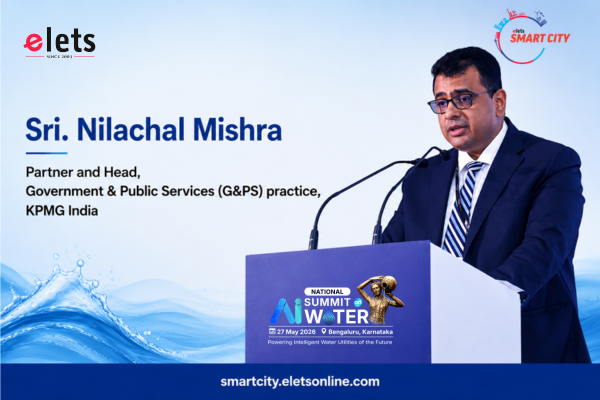
Insights shared by Sri. Nilachal Mishra, Partner and Head, Government & Public Services (G&PS) practice, KPMG India, at National AI Summit on Water 2026, in Bangalore