Bengaluru has come a long way over the years. From being known as Karnataka’s capital, it has grown into one of India’s leading technology and startup hubs, attracting companies, entrepreneurs, and skilled professionals from across the country and beyond.
But fast growth has brought its own challenges. Rising property and office costs, traffic and pressure on infrastructure are making the city more expensive and difficult to scale. At the same time, other cities across Karnataka are developing strong capabilities in technology, manufacturing, education, finance and skilled talent.
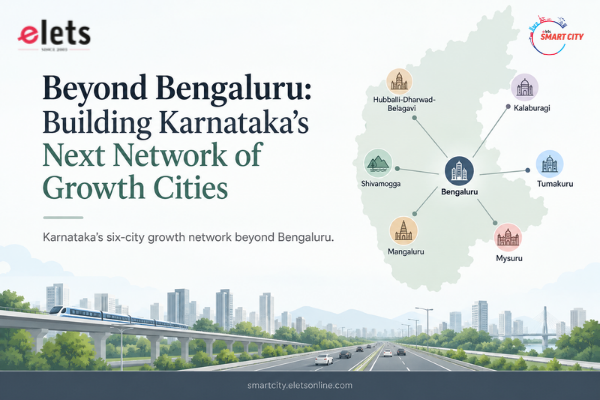
The Beyond Bengaluru initiative, led by the Karnataka Digital Economy Mission (KDEM), is building on this potential across six key clusters: Mysuru, Mangaluru, Hubballi-Dharwad-Belagavi, Kalaburagi, Shivamogga and Tumakuru.
Each city has its own strengths and opportunities. Mysuru is building a stronger technology and electronics base, Mangaluru is emerging around fintech and digital services, while the Hubballi-Dharwad-Belagavi region brings together technology, engineering and manufacturing. Kalaburagi, Shivamogga and Tumakuru are also developing their own economic and talent ecosystems.
The idea is simple: build on what each city already does well and create the infrastructure, skills and business environment needed for sustainable growth. Instead of concentrating opportunities in one place, Karnataka is gradually building a wider network of cities that can contribute to the state’s next phase of development.
Moving from One Hub to Many
The thinking behind Beyond Bengaluru is simple. Bengaluru will remain Karnataka’s leading technology and innovation hub, but emerging cities can take on specialised roles and develop as strong economic centres in their own right.
KDEM’s approach follows a hub-and-spoke model, with Bengaluru serving as the core and regional cities developing as connected economic spokes. The focus is on building local talent, attracting businesses, strengthening startups and improving the infrastructure needed to support long-term investment.
Policy support is also becoming stronger. Karnataka’s IT Policy 2025–30, backed by an outlay of ₹967 crore, aims to expand technology-led growth beyond Bengaluru. It includes measures covering talent relocation, recruitment, skilling, rental assistance, telecom infrastructure, innovation and R&D. The wider objective is to make operating in Tier-2 and Tier-3 cities commercially more attractive.
The opportunity extends well beyond IT. Electronics manufacturing, fintech, GCCs, advanced manufacturing, logistics, startups and emerging technologies are increasingly becoming part of the regional growth story.
This is why Beyond Bengaluru is important not just for Karnataka’s technology sector, but for its urban future.
Mysuru: Building a Second Technology Powerhouse
Mysuru is perhaps the most established of Karnataka’s emerging technology destinations. Its universities, skilled workforce, existing IT base and quality of life give it a strong foundation for further growth. Its proximity to Bengaluru is another advantage, allowing businesses to access the larger metropolitan ecosystem without facing all of its costs and pressures.
KDEM’s vision for Mysuru is ambitious: a US$10-billion digital economy by 2030. The city is being positioned around IT/ITeS, electronics, GCCs, cybersecurity, startups, and other technology-driven sectors.
Importantly, the growth story is moving beyond conventional IT services. Electronics manufacturing and ESDM are creating opportunities for a wider technology-manufacturing ecosystem. A KDEM Report of 2026 also highlighted strong interest among technology professionals in relocating to Mysuru, underlining the city’s potential to retain and attract talent.
The next challenge is to ensure that this interest translates into sustained investment, high-quality jobs, and infrastructure capable of supporting a growing urban economy.
Mangaluru: A Coastal Technology and Fintech Hub
Mangaluru brings a different set of strengths to the Beyond Bengaluru network.
The city has a long-established presence in banking, finance, education, healthcare, engineering and logistics. Its financial-services heritage gives it a natural advantage in fintech and digital services, while its coastal location provides opportunities linked to trade, logistics and the wider coastal economy.
Under the Beyond Bengaluru programme, Mangaluru is being developed as a technology and innovation centre with potential in IT/ITeS, fintech and emerging technologies. Its economic influence can also extend towards Udupi and Kodagu, creating a broader regional ecosystem.
The objective should not be to replicate Bengaluru’s model. Mangaluru can instead build around its own strengths, combining technology with finance, healthcare, education, entrepreneurship and coastal commerce.
Recent initiatives are already pointing in this direction. In 2026, TiE Mangaluru was selected to lead Karnataka’s first K-Combinator startup acceleration programme, aimed at supporting startups across the coastal region.
Hubballi-Dharwad-Belagavi: The Northern Growth Corridor
For North Karnataka, the Hubballi-Dharwad-Belagavi (HDB) region has the potential to become a major economic anchor.
Hubballi-Dharwad brings together education, engineering, commerce, logistics, and technology, while Belagavi has a strong industrial and manufacturing base. Together, they can create a connected economic corridor serving a much wider region, including districts such as Gadag and Haveri.
The cluster offers opportunities across manufacturing, engineering, electronics, IT services, AI and emerging technologies. Its strength lies in the possibility of spreading economic activity across several connected urban centres rather than concentrating it in a single city.
For this model to work, however, infrastructure planning will have to look beyond individual municipal boundaries. Better roads, logistics networks, industrial connectivity and coordinated regional planning will be critical.
Kalaburagi: Strengthening Kalyana Karnataka
Kalaburagi has a role that goes beyond its own economic development. As an important urban centre in Kalyana Karnataka, its growth can influence a much larger region.
The city can develop stronger capabilities in digital services, startups, education-linked enterprises, and industry while providing new employment opportunities for the local population. For a region that has historically faced development gaps, this makes the Beyond Bengaluru approach particularly significant.
The priority should be ecosystem creation rather than simply attracting companies. Better skills, incubation facilities, digital infrastructure, access to finance, and stronger links between educational institutions and industry will be essential.
If these elements come together, Kalaburagi can become a stronger economic anchor for Kalyana Karnataka.
Shivamogga: Turning Talent into Local Opportunity
Shivamogga represents another important part of the strategy: keeping talent closer to home.
The city has a strong educational base and access to a young workforce. Its potential lies in developing technology, digital services, startups and knowledge-based industries that can create opportunities locally.
This could have a wider urban impact. More employment within the city means greater demand for housing, retail, transport, healthcare and other services. In this way, technology investment can become a catalyst for broader urban development.
The objective is straightforward: talented young people should have the option of building their careers in Shivamogga rather than having to move to Bengaluru for every high-value opportunity.
Tumakuru: Bengaluru’s Industrial Counterpart
Tumakuru has perhaps the clearest geographic advantage among the emerging clusters.
Located close to Bengaluru, the city can benefit from the capital’s markets, talent and connectivity while developing its own industrial identity. Its future is closely linked to manufacturing, engineering, logistics and technology-enabled industries.
As Bengaluru faces increasing pressure on land and infrastructure, Tumakuru can provide space for industrial and commercial expansion that may not be feasible within the metropolitan region.
Its development can therefore benefit both cities, allowing Bengaluru to remain a technology powerhouse while Tumakuru takes on a larger role in manufacturing and logistics.
Why Businesses Are Looking Beyond Bengaluru
Cost is one of the strongest arguments for the emerging clusters.
Office space, housing and other operating expenses can be significantly lower than in Bengaluru, while these cities offer access to universities, engineering talent and growing digital infrastructure. Earlier KDEM assessments highlighted the cost advantages available across Beyond Bengaluru locations.
The state is reinforcing this advantage through policy. Karnataka’s ₹967-crore IT Policy 2025–30 provides incentives for companies operating outside Bengaluru, including support for employee relocation, recruitment, skilling, rentals and telecom infrastructure.
The government is also looking at ways to make industrial development outside Bengaluru more attractive, including greater development potential through higher Floor Area Ratio (FAR) for eligible industrial projects.
Together, these measures send a clear message to investors: Karnataka’s next growth opportunity does not have to be in Bengaluru.
Infrastructure Will Determine the Outcome
Attracting companies is only the first step. Keeping them, and the people who work for them, is a much bigger challenge.
The emerging clusters will need reliable electricity, high-speed connectivity, public transport, quality housing, healthcare, education, water supply, sanitation and efficient waste management. They will also need urban planning that anticipates growth rather than responding to problems after they appear.
This is where Karnataka has an opportunity to learn from Bengaluru.
The state can plan transport networks before congestion becomes severe, integrate housing with employment centres, develop mixed-use districts and build digital and physical infrastructure together. Regional planning will also become increasingly important as economic activity spreads across city clusters and corridors.
The larger objective should be to ensure that economic growth translates into better urban living, rather than simply creating new pockets of commercial development.
A More Balanced Urban Future
The success of Beyond Bengaluru should not be judged simply by the number of companies that open offices outside the capital. Its real measure will be whether these investments create complete and sustainable urban economies.
Mysuru can strengthen its position in technology and electronics. Mangaluru can build around fintech, digital services and its coastal economy. Hubballi-Dharwad-Belagavi can become a northern industrial and technology corridor. Kalaburagi can drive economic activity across Kalyana Karnataka. Shivamogga can turn its talent base into a stronger knowledge economy, while Tumakuru can emerge as a major manufacturing and logistics centre.
The ambition is not to create six smaller Bengalurus. It is to allow each city to develop its own economic identity and competitive advantage while remaining connected to Karnataka’s wider ecosystem.
If the strategy succeeds, Bengaluru will not lose its importance. Instead, its role could evolve. Rather than carrying the entire burden of Karnataka’s growth, it could become the anchor of a much larger network of thriving cities.
That is the real promise of Beyond Bengaluru: a Karnataka where economic opportunity is not concentrated in one metropolis, but spread across a connected network of ambitious, specialised and future-ready urban centres.