
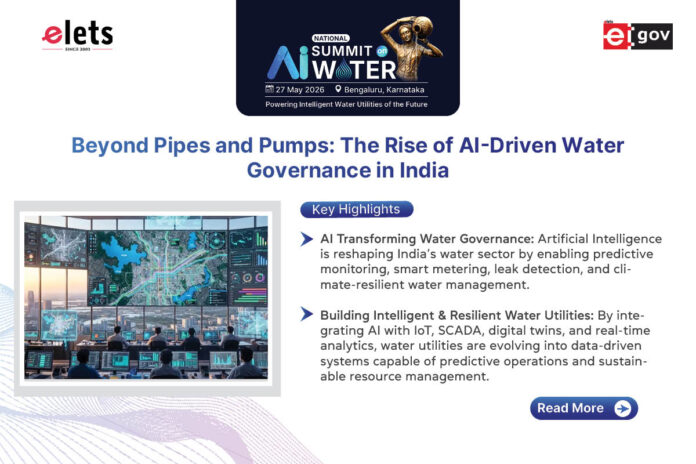
Facing unprecedented pressure from rapid urbanization, climate extremes, and aging infrastructure, Indian cities and water utilities are deploying artificial intelligence, IoT sensors, and predictive analytics to transform water management.
India’s water sector is facing a major turning point. Rapid urbanisation, declining groundwater levels, climate-induced floods and droughts, and ageing infrastructure are placing unprecedented pressure on water governance systems across the country. From Bengaluru’s recurring water stress to Chennai’s flood-drought cycles, traditional approaches to managing water are no longer sufficient for the scale and complexity of modern urban India.

At the same time, cities are moving towards smarter water systems. Artificial Intelligence (AI), combined with IoT, sensor networks, data analytics, and digital infrastructure, is beginning to reshape how cities monitor, distribute, conserve, and govern water resources. Across India, governments, utilities, and technology institutions are exploring how AI can improve operational efficiency, reduce losses, strengthen climate resilience, and deliver more citizen-centric services. Today, the future of water governance is no longer being built only through pipelines and reservoirs, but through data, predictive intelligence, and digital decision-making systems.
India’s National Push Towards AI-Driven Governance
India’s AI journey gained momentum with NITI Aayog’s National Strategy for Artificial Intelligence, which identified water as one of the priority sectors where AI could create large-scale public impact. The strategy emphasised the need for inclusive and scalable AI solutions tailored to India’s developmental challenges.
This vision was further accelerated through the IndiaAI Mission, launched with an investment of over ₹10,000 crore to strengthen sovereign AI capabilities, digital public infrastructure, compute capacity, and indigenous innovation ecosystems. Water resource management and urban infrastructure were identified among the mission’s critical application areas.
Simultaneously, the Ministry of Housing and Urban Affairs has been driving digital transformation through the Smart Cities Mission and Integrated Command and Control Centres (ICCCs), where AI-enabled monitoring systems are now being used for:
- Leak detection
- Demand forecasting
- Pressure management
- Smart metering
- Non-revenue water reduction
- Flood and drainage monitoring
These initiatives represent a larger shift in governance, moving from reactive management to predictive and data-driven operations.
Karnataka as a Water AI Innovation Hub
Among Indian states, Karnataka has emerged as one of the most progressive examples of AI-enabled water governance. Leveraging Bengaluru’s strong digital ecosystem and innovation capacity, the state has been actively integrating AI into urban water management, disaster resilience, and groundwater monitoring.
The Bengaluru Water Supply and Sewerage Board (BWSSB) has initiated several technology-led interventions aimed at improving operational efficiency and reducing water losses. Supported by thousands of IoT pressure and flow sensors deployed across Bengaluru, AI-enabled pressure zone management systems help utilities:
- Detect leakages in real time
- Predict burst events
- Optimise pump operations
- Improve supply efficiency
- Reduce non-revenue water (NRW)
These interventions are already demonstrating measurable impact in pilot zones, while also improving supply reliability in peri-urban areas. BWSSB’s transformation journey reflects a larger shift in how utilities are beginning to function—not merely as service providers, but as intelligent infrastructure systems capable of predictive operations and real-time decision-making.
Groundwater Intelligence and Predictive Governance
Groundwater depletion remains one of India’s most critical long-term challenges. Karnataka’s collaboration with the Central Groundwater Board under the National Aquifer Mapping and Management Programme represents a major step toward predictive groundwater governance.
AI-based analysis of long-term water table data, combined with satellite imagery and land-use mapping, is helping authorities identify stress trajectories across vulnerable regions. This enables governments to prioritise recharge interventions, improve planning, and move from reactive crisis response toward preventive resource management.
Architecture of the Digital Water Utility
India’s water utilities are gradually transitioning toward digitally integrated operational models. Under the Smart Water Management framework, the future utility architecture is expected to include three interconnected layers:
- Physical Infrastructure Layer: IoT sensors, smart meters, SCADA systems, pressure monitors, and connected treatment infrastructure.
- Digital Integration Layer: Unified data platforms and command centres capable of aggregating real-time operational information.
- AI and Analytics Layer: Predictive systems for leak detection, energy optimisation, demand forecasting, preventive maintenance, and citizen service delivery.
While the roadmap is ambitious, implementation challenges remain significant. Many urban local bodies still struggle with legacy infrastructure, data interoperability issues, limited sensor deployment, vendor-dependent systems, shortages of AI and data talent, and limited cybersecurity readiness. Bridging these gaps will require not just technology investments, but institutional capacity-building and long-term governance reforms.
Ethics, Equity, and Responsible AI
As AI becomes embedded into essential public services, questions of fairness, accountability, and inclusion become increasingly important. Water is a fundamental public resource; AI systems that optimise water distribution or demand forecasting must ensure that vulnerable populations, informal settlements, and underserved communities are not excluded from digital decision-making processes.
India’s emerging Responsible AI frameworks, led by the Ministry of Electronics and Information Technology (MeitY), are beginning to address critical concerns around the use of Artificial Intelligence in governance and public services. These frameworks focus on ensuring that AI systems remain transparent, accountable, and citizen-centric while protecting public trust. Key areas of emphasis include reducing algorithmic bias, strengthening transparency in automated decision-making, ensuring accountability in AI-led systems, safeguarding citizen consent and data privacy, and building secure digital ecosystems.
The implementation of smart metering and digital consumption monitoring also raises important concerns around privacy and data governance under the Digital Personal Data Protection framework. As utilities become increasingly data-driven, governance systems must ensure that technology strengthens inclusion rather than deepening existing inequalities.
Securing Critical Water Infrastructure
The digitalisation of water infrastructure introduces new vulnerabilities. AI-enabled utilities rely heavily on interconnected operational technology systems, sensors, cloud platforms, and SCADA networks. These systems are increasingly becoming part of India’s critical information infrastructure landscape, making cybersecurity a core pillar of digital water governance.
Indian policy frameworks now emphasise:
- OT-IT network segmentation
- Multi-factor authentication
- Secure telemetry transmission
- Continuous vulnerability assessments
- AI model integrity protection
- Critical infrastructure resilience
Several utilities are now moving toward air-gapped architectures and on-premise AI systems to strengthen operational security and digital sovereignty. As water systems become smarter, ensuring cyber resilience will be as important as improving operational efficiency.
Climate-Adaptive Water Management
AI is also becoming central to India’s climate adaptation strategy. The integration of AI with climate modelling, hydrological forecasting, and reservoir management is enabling governments to make more informed decisions under uncertain climate conditions.
Across India, urban utilities are adopting AI-enabled flood prediction models, digital twins for drainage and pipeline networks, reservoir optimisation systems, drought forecasting tools, intelligent wastewater reuse mechanisms, and energy-efficient treatment operations. In river basins such as the Cauvery, AI-driven simulation models are helping planners evaluate long-term water allocation scenarios under changing climate conditions, marking an evolution from static infrastructure planning to adaptive resource management.
The Road Ahead
Despite significant progress, India’s Water AI ecosystem remains at an early stage of maturity. Several structural challenges continue to slow large-scale adoption:
- Fragmented institutional coordination
- Limited high-quality datasets
- Rural sensor gaps
- Procurement rigidities
- Talent shortages
- Cybersecurity vulnerabilities
- Lack of independent AI oversight mechanisms
However, the momentum is undeniable. The convergence of IndiaAI Mission investments, Smart Cities digital infrastructure, Responsible AI frameworks, climate resilience agendas, and state-led innovation models like Karnataka is creating a foundation for the future of intelligent water governance in India.
Artificial Intelligence will not solve India’s water crisis on its own. But when combined with strong governance, resilient infrastructure, ethical safeguards, and citizen-centric policymaking, it can become one of the most powerful enablers of sustainable water management. As India moves toward smarter cities and climate-resilient infrastructure, AI-driven water governance may well become one of the defining pillars of the country’s next phase of urban transformation.
By Divya Tyagi | ENN