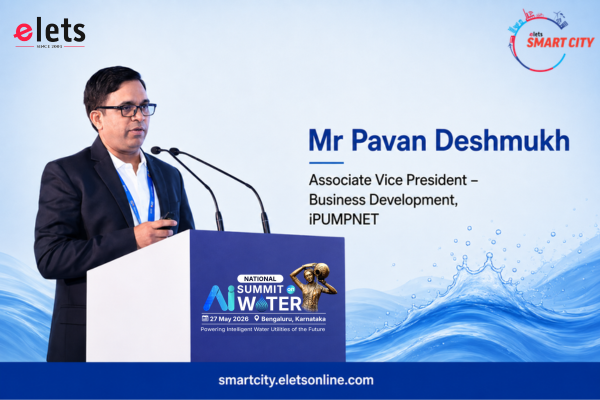
Water infrastructure is increasingly moving beyond conventional pumps, pipelines and motors towards data-driven cyber-physical systems powered by Artificial Intelligence, IoT, digital twins and predictive analytics. In this evolving landscape, Mr Pavan Deshmukh, Associate Vice President – Business Development, iPUMPNET, presented the company’s IPMS solution as an AI- and IoT-enabled platform designed to optimise pumping-station performance and improve lifecycle efficiency.
The presentation outlined four core components of IPMS: high-precision IoT sensors, hardware with embedded edge analytics, secure bidirectional communication, and a platform-independent hybrid-cloud architecture supported by a mobile application. The approach is designed to give utilities greater visibility into pumping-station performance by combining real-time operational data with historical analytics, enabling them to identify inefficiencies and potential failures before they lead to major operational disruptions.
From Installation Costs to Lifecycle Efficiency
A key focus of the presentation was the significant gap between the initial cost of installing a pumping station and the expenditure incurred over its operational life. While installation typically accounts for only 10–15% of total expenditure, around 85–90% is incurred subsequently through operations, maintenance and energy consumption. Energy alone can account for approximately 40–50% of lifecycle expenditure, making pumping efficiency a critical factor in the financial sustainability of water utilities.
According to the presentation, the absence of continuous real-time and historical performance data often makes it difficult for utilities to identify the underlying causes of operational inefficiencies. IPMS uses AI and historical analytics to detect and diagnose issues including cavitation, bearing failures, excessive vibration, reduced flow or pressure, overheating, corrosion, lubrication problems, seal failures and shaft imbalance. By identifying these conditions earlier, the platform aims to help utilities shift from breakdown-driven maintenance towards predictive and proactive intervention.
Reported Efficiency and Sustainability Gains
The solution was reported to deliver 5–35% improvements in operational efficiency, 5–40% reductions in energy costs, up to 50% extension in pumping-station life and 15–45% reductions in lifecycle costs. The presentation also highlighted the potential to nearly eliminate unscheduled breakdowns in deployments, with most implementations reportedly achieving a return on investment within one year.
The sustainability implications of improving pumping efficiency were also highlighted. The presentation estimated that reducing pumping energy consumption by 1 MW could save approximately 612 tonnes of CO₂ emissions per month, equivalent to planting nearly 21,500 trees. At a national scale, the potential deployment of such optimisation systems across India’s pumping infrastructure was estimated to generate energy savings of at least 5 GW, underlining the intersection between digital transformation, operational efficiency and decarbonisation.
From SCADA to Predictive and Prescriptive Intelligence
The presentation positioned the evolution of pumping infrastructure across three stages. Traditional metering and SCADA systems primarily help utilities understand what is happening within their infrastructure. Digital twins take this further by creating virtual representations of physical assets that can be used for simulation and scenario analysis. AI and machine learning add another layer by helping utilities understand why something is happening and determine what action to take.
This progression represents a broader shift from reactive to predictive and prescriptive operations. Rather than waiting for equipment to fail and responding after the event, AI-enabled systems can continuously analyse operating conditions, identify emerging anomalies and support timely interventions. The presentation also showcased a 24×7 central command-centre deployment, illustrating how continuous monitoring and AI-driven intelligence can provide utilities with a centralised view of distributed pumping infrastructure.
Conclusion
The presentation demonstrated that the digital transformation of water infrastructure is increasingly about optimising the entire asset lifecycle, rather than simply automating individual processes. With energy and maintenance representing the largest components of long-term pumping expenditure, the ability to continuously monitor equipment, identify emerging failures and optimise performance can have significant financial and operational implications for utilities.
Also read: AI for Water Governance: Building Intelligent and Future-Ready Water Utilities
The transition from SCADA and conventional monitoring to digital twins and AI-powered predictive intelligence also signals a broader change in how water infrastructure can be managed. By moving from understanding what is happening to understanding why it is happening and determining what action should follow, AI can enable utilities to operate pumping systems more efficiently, extend asset life, reduce unexpected failures and lower energy consumption. In doing so, intelligent pumping infrastructure can become an important component of India’s wider transition towards smarter, more efficient and more sustainable water utilities.