

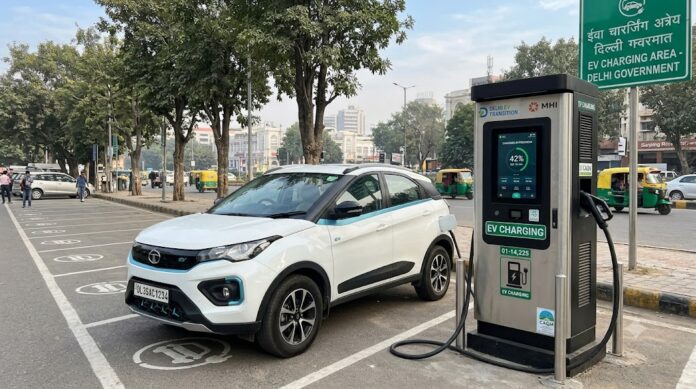
Delhi has exceeded its year-end target for electric vehicle charging points, three months ahead of schedule, according to government officials.
As of September 30, the city had 14,225 charging points installed. The target set by the Commission for Air Quality Management in the National Capital Region and Adjoining Areas for December 2026 was 13,913. Officials said the city added 5,312 points between January 1 and September 30.

Power Minister Ashish Sood said the government was committed to expanding the network as the city shifts toward electric mobility. He framed the effort as part of a wider push on air quality, saying that tackling pollution “requires bold, practical action.”
The policy behind the numbers
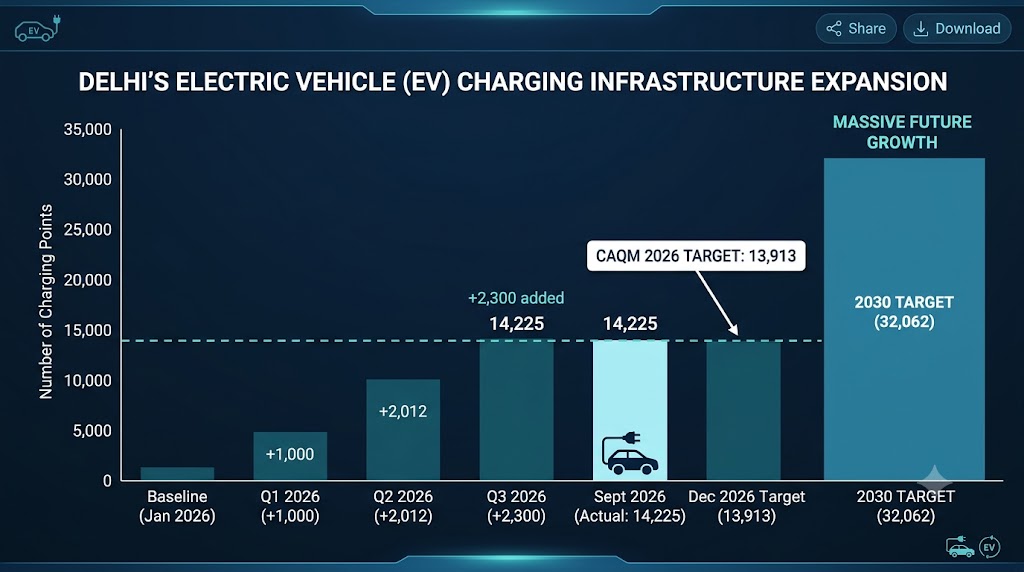
The expansion is part of the Electric Vehicle Policy 2026, which was notified on June 30. The government aims to increase the number of charging points to 32,062 by December 2029. The policy also sets timelines for shifting new vehicle registrations toward electric models. From January 1, 2027, only electric three-wheelers and N1-category goods vehicles will be registered in Delhi. The mandate for electric two-wheelers takes effect on April 1, 2028.
Officials have said that charging access matters for commercial fleets and heavy vehicles, which need dependable charging to limit downtime. Officials also argue that reliable infrastructure gives private buyers more confidence to switch.
Heavy vehicles and public sites
The Ministry of Heavy Industries has sanctioned a subsidy of Rs 8.9 crore for 10 public charging stations for electric trucks. The stations will have 20 high-capacity 360-kW chargers.
Separately, under the Centre’s PM E-DRIVE scheme, 180 of 382 approved charging sites have been found suitable for composite chargers of 12 kW, 60 kW and 120 kW, according to Sood. The Centre has sanctioned Rs 127.16 crore in subsidies for those 382 sites, and tendering and approvals are under way through Delhi Transco Limited.
Stations are not points
The article distinguishes between the two terms. A charging station is a physical location, while a charging point is an individual connection that can serve one vehicle. A single station can house several points. Setting up either requires suitable land, adequate power supply and supporting electrical infrastructure.
Where the expansion is headed
Officials say the government plans to expand charging at government offices, public parking areas, Metro stations and highways, which they say would help address concerns about access and driving range. The policy also envisages phased electrification of public transport, government fleets and delivery operations, with school bus fleets expected to reach 30% electrification by 2030.
ALSO READ: SSCL CEO Reviews Smart City Projects, Directs Timely Completion and Better Maintenance
The government has said the transition is aimed at reducing vehicle emissions and improving air quality. Whether the points are built where drivers need them, and whether they are used, will determine how much the milestone changes daily travel.
ALSO READ: Namma Metro crossing the 100 km mark