India’s metro rail network has surged to an impressive 1,155 kilometres across 26 cities by July 2026, as reported by the Ministry of Housing & Urban Affairs. This remarkable growth marks a staggering 365% increase from just 248 km, which served 5 cities in 2014. Such a transformation underscores the monumental infrastructure investments made under the Smart Cities Mission and comprehensive urban development initiatives, a bold leap towards modern urban mobility.
The expansion was driven by a thoughtful strategy. From 2014 to 2026, the number of metro projects grew significantly. Initially, there were only five metros: Delhi, Bangalore, Hyderabad, Kolkata, and Mumbai. Now, there are 26 systems that are either operational or under construction. New cities have joined this metro-building journey, including Pune, Nagpur, Lucknow, Kanpur, Ahmedabad, Indore, and Jaipur.
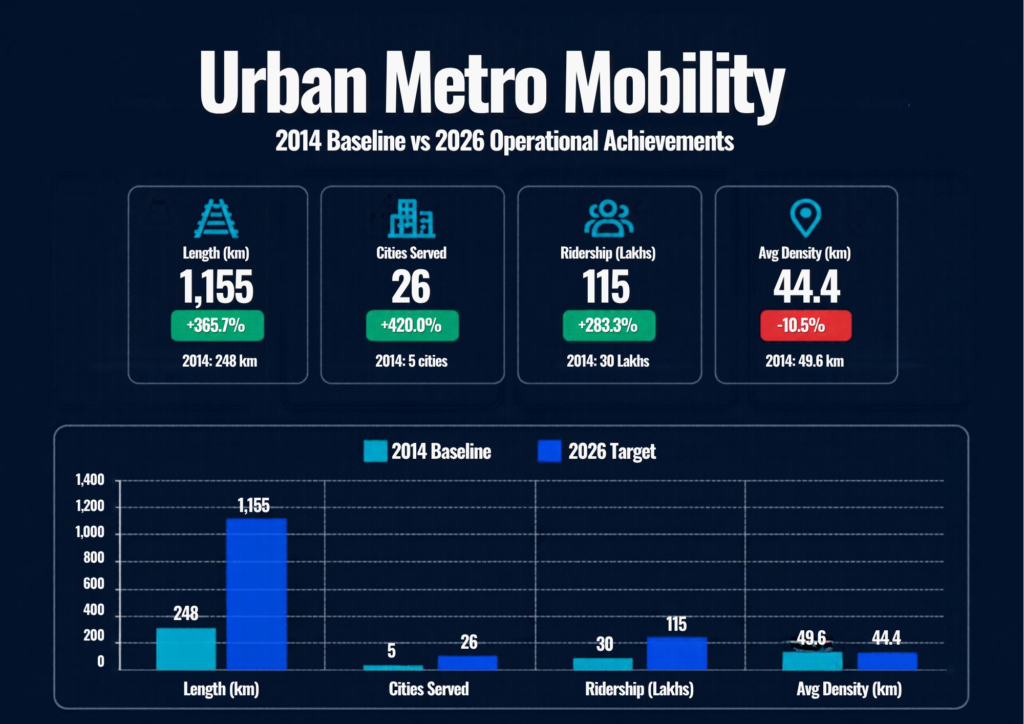
Daily ridership across operational metro systems has surpassed 1.15 crore passengers, reflecting a significant shift towards mass transit, especially in Tier-2 cities that previously lacked rapid transit infrastructure. While this growth enhances urban mobility and connectivity for residents, it also highlights critical implementation gaps, as the 1,155 km network across 26 cities averages only 44 km per city; needless to say, this is insufficient for achieving transformative impact.
Project execution timelines reveal persistent challenges. It took more than 15 years for the oldest metros like Delhi, Bangalore, and Hyderabad to reach a network density that was useful. Kanpur got permission for its metro in 2016, and the first line opened in 2023. The whole project took seven years to complete. Thus, cities that were given metro status between 2018 and 2020 won’t have working systems until 2028 to 2030, which is a long time after the original Smart Cities Mission 2020 deadline.
Maharashtra, with its metros in Mumbai and Pune, dominates the national network in terms of length. Tamil Nadu’s metro (Chennai) remains limited in reach. Tier-1 states have captured disproportionate metro investment, while lower-income states still lack rapid transit systems entirely. This creates a regional disparity that the metro expansion narrative often glosses over. What is essential now is a focus on completion metrics rather than just expansion figures. With over 280 km of sanctioned metro projects across 15 cities, it is crucial to prioritise timely project closures rather than merely announcing new corridors.