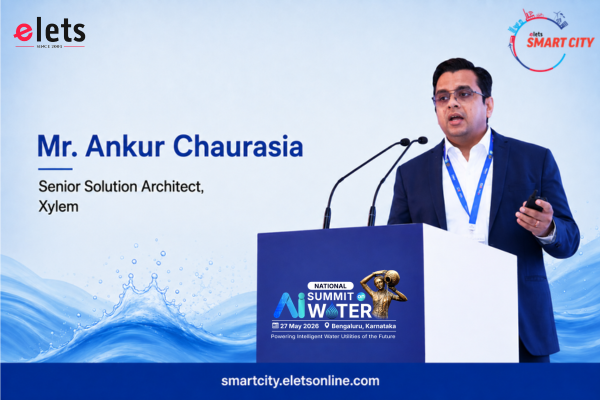
As water utilities generate increasing volumes of information from networks, treatment plants, sensors, weather systems and operational platforms, one of the sector’s biggest challenges is no longer the absence of data but its fragmentation. At the National AI Summit on Water 2026, Mr. Ankur Chaurasia, Senior Solution Architect, Xylem, presented Xylem Vue as a digital water platform designed to bring fragmented utility data into a unified environment and use AI to support smarter operational and infrastructure decisions.
The presentation traced the platform’s development to a collaboration initiated in 2019 with Idrica, the technology arm of Spanish utility operator Global Omnium. Drawing on more than two decades of digital-transformation experience and over 400 projects globally, Xylem Vue is built around a purpose-designed Smart Data Engine and data lake for water utilities. The platform is designed to ingest information through open protocols, estimate and correct inconsistencies, and consolidate disparate datasets into a single source of truth that can support applications across water and wastewater management.
Creating a Single Source of Truth
A central challenge addressed by the platform is the fragmented nature of operational data within water utilities. Information generated by different systems may vary in quality, format and consistency, making it difficult for utilities to develop a reliable view of network or plant performance. Xylem Vue addresses this by bringing information into a common environment, where data can be estimated, corrected and consolidated before being used by downstream applications.
This unified data foundation enables multiple applications to work from the same information. These include network management, plant operations, water-loss management, digital twins, sewer-overflow prevention and flood management. Instead of deploying separate digital systems for individual operational challenges, the approach aims to establish a common data layer that can support multiple use cases while improving consistency across the utility.
Four AI Pillars for Water Management
The platform incorporates four broad AI capabilities: machine-learning models, optimisation algorithms, generative AI, and heuristic/neural-network approaches. These capabilities are applied according to the operational problem being addressed, ranging from optimisation of treatment processes to predictive asset management and natural-language interaction with utility data.
One demonstrated application was plant-performance optimisation, where AI can analyse operational conditions and help utilities improve plant performance. Another was a capital-improvement “pipe planner”, designed to help utilities prioritise asset replacement while working within defined budget constraints. By combining asset information with predictive analysis and financial limitations, such systems can support more structured decisions about where infrastructure investment should be directed.
The platform also integrates weather data, including information from the India Meteorological Department and other sources, to support operational decision-making. Weather conditions can influence water demand, treatment requirements and network behaviour, making the integration of external data an important component of more responsive utility management.
Optimising Wastewater Networks
Wastewater management was another key application demonstrated during the presentation. AI can be used to optimise pumping schedules across wastewater networks while helping prevent treatment plants from becoming overloaded. By analysing network conditions and operational requirements, utilities can coordinate pumping activity more effectively rather than responding only after capacity constraints emerge.
This represents a shift towards predictive and coordinated wastewater operations. Instead of managing individual pumping stations or treatment assets in isolation, an integrated platform can consider network-wide conditions and optimise operations accordingly. Such capabilities become particularly important in complex urban systems where multiple assets need to operate together to maintain treatment capacity and prevent disruptions.
Bringing AI Closer to Utility Users
Another application demonstrated was an AI assistant capable of generating thematic maps and analytical outputs through simple natural-language queries. This reduces the dependence on specialised GIS expertise for routine analysis and allows utility personnel to interact with complex spatial information using everyday language.
The significance of this capability extends beyond convenience. Water utilities often possess extensive geospatial and operational datasets, but access to these insights can be restricted by the technical expertise required to query and interpret them. A natural-language interface can make these datasets more accessible to a wider group of decision-makers, allowing them to ask questions and obtain analytical outputs without having to build GIS queries manually.
Germany: Optimising Treatment Performance
A case reference from Germany, involving Fox 7, demonstrated the long-term application of AI in treatment-process optimisation. The AI-enabled system has reportedly been operational since 2016, delivering energy savings of 20–30% and reducing dry-weather energy consumption by up to 37%.
The case illustrates how AI can contribute directly to the efficiency of treatment operations by continuously analysing plant conditions and supporting optimisation. Energy consumption is a significant component of water and wastewater operations, making improvements in process efficiency relevant not only to operating costs but also to the sustainability of utility infrastructure.
USA: Predicting and Preventing Sewer Overflows
The presentation also highlighted a case from Richmond, USA, where real-time weather integration and predictive operational controls contributed to an approximately 70% reduction in combined sewer overflows. The improvement was accompanied by a significant decline in complaints associated with overflows.
The case demonstrates the value of connecting external information, such as weather forecasts, with real-time utility operations. Rather than waiting for heavy rainfall or system stress to result in an overflow, predictive controls can help utilities anticipate changing conditions and adjust operations accordingly. This creates a more proactive approach to wastewater management and can improve both infrastructure performance and customer outcomes.
Predicting Pipe Failures
Another application focused on pipe-failure prediction, with demonstrated reductions in pipeline failures of approximately 70%. Predicting failures before they occur can have significant implications for network reliability and water-loss management, particularly in utilities operating large and ageing distribution networks.
By identifying assets that are more likely to fail, utilities can potentially move towards condition-based and risk-based maintenance. This allows limited capital and maintenance resources to be directed towards higher-risk assets while reducing unexpected failures and associated water losses. The approach also supports a broader shift from reactive repairs towards predictive asset management.
Also read: Building Digital and Sustainable Water Systems: From Hydraulic Models to AI-Enabled Digital Twins
Conclusion
The presentation positioned Xylem Vue as an example of how water utilities can move from fragmented digital systems towards a unified data and AI environment. The underlying principle is that AI is only as effective as the data infrastructure supporting it. By creating a common data foundation capable of ingesting, correcting and consolidating information from multiple sources, utilities can establish a more reliable basis for analytics, optimisation and decision-making.
The range of applications demonstrated, from treatment-plant optimisation and pipe-replacement planning to wastewater pumping, sewer-overflow prevention and natural-language analytics, illustrates the breadth of potential AI applications across the water lifecycle. The case references further highlighted measurable operational outcomes, including reported energy savings of up to 37%, approximately 70% reductions in combined sewer overflows and around 70% reductions in pipeline failures.
Ultimately, the presentation highlighted a shift from isolated digital applications towards integrated water intelligence. With a unified data layer supporting machine learning, optimisation, generative AI and predictive models, utilities can move towards systems that not only explain what is happening but increasingly help determine what is likely to happen and what action should be taken next. This transition could enable water utilities to become more predictive, efficient and resilient while making complex operational intelligence accessible to a broader range of users.