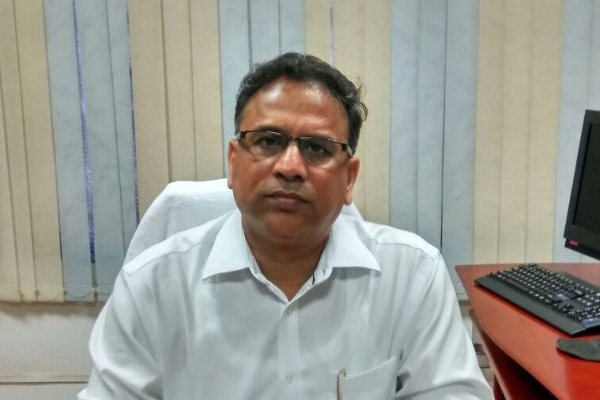
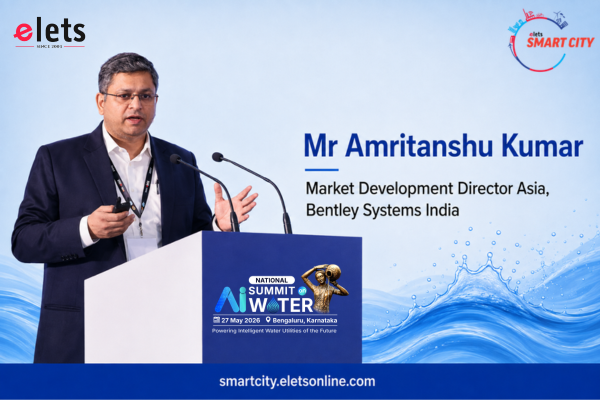
As water utilities confront rising demand, rapid urbanisation, persistent non-revenue water (NRW) and increasing climate-related pressures, the ability to manage infrastructure through reliable, connected data is becoming increasingly important. At the National AI Summit on Water 2026, Mr Amritanshu Kumar, Market Development Director Asia, Bentley Systems India, presented a holistic approach to building digital and sustainable water-management systems, highlighting how hydraulic modelling, geospatial information, SCADA, metering, asset data and digital twins can be brought together to create more intelligent and responsive water networks.
The presentation began by examining global megatrends shaping the sector, including the projected growth of the global population from approximately 8.2 billion today to 9.7 billion by 2050, increasing water demand, rapid urbanisation and persistent NRW challenges. Climate-related pressures are adding further complexity, making it increasingly important for utilities to understand not only current network conditions but also how infrastructure can perform under changing demand and environmental conditions.
The Hydraulic Model as the Foundation
At the heart of the approach was the hydraulic model, described as the “bible” of a water network. Rather than functioning as an isolated engineering tool, the hydraulic model can serve as the foundation for integrating geospatial information, real-time SCADA data, pumping systems and metering infrastructure. Bringing these sources together can provide utilities with a more comprehensive view of network performance and help reveal issues that may remain hidden when systems operate independently.
The presentation positioned digital transformation as a gradual journey of interconnected steps, rather than a complete replacement of existing systems. Utilities can preserve their existing investments while progressively connecting data sources and improving operational visibility. A comprehensive digital asset repository was also identified as critical, containing information such as asset size, age, geometry, material composition and expected service life. Such information can support better lifecycle management, capital planning and long-term infrastructure decisions.
Connecting Design, Construction and Operations
A key element of the approach is the use of digital twins to connect different stages of the infrastructure lifecycle. Traditionally, design, construction and operations may generate information that remains separated across departments and systems. Digital workflows can help create continuity between these stages, allowing information developed during planning and construction to remain useful during operations.
This creates a more continuous and data-driven framework for managing infrastructure. By combining the physical representation of assets with hydraulic models, operational information and asset records, utilities can build a digital environment that supports both day-to-day management and long-term planning. The objective is to create a system where data does not simply describe infrastructure but actively contributes to decisions about maintenance, investment and network optimisation.
Nagpur: Making Network Performance Visible
The presentation highlighted Nagpur, where integrated hydraulic modelling was used to support management of the city’s approximately 750 MLD water network. The modelling revealed zone-wise demand and pressure mismatches that were not visible through siloed systems, enabling corrective interventions.
The example demonstrated the importance of viewing the water network as an interconnected system. Demand and pressure can vary significantly between different zones, and understanding these variations can help utilities identify where network performance is diverging from expectations. By integrating information through hydraulic modelling, utilities can develop a clearer picture of these relationships and target interventions more effectively.
Singapore: AI-Enabled Leakage Localisation
Another case reference focused on PUB Singapore, where digital technologies were used to support leakage localisation in a network already operating at single-digit NRW levels. The hydraulic model was transformed into a live, AI-enabled digital twin environment, allowing network information to be used for more precise analysis.
The case illustrated that digital intelligence remains valuable even for utilities that have already achieved relatively low levels of NRW. By continuously analysing network conditions, AI-enabled digital twins can support the identification of potential leakage locations and help utilities pursue further efficiency gains. The approach represents a shift from static modelling towards a more dynamic understanding of network performance.
Ayodhya: Accelerating Infrastructure Delivery
The presentation also highlighted Ayodhya, where integrated digital workflows and planning approaches reportedly reduced project timelines by approximately 90%. This demonstrated that digital transformation can influence not only the operation of existing infrastructure but also the way new water projects are planned and delivered.
By connecting information and workflows across project stages, digital tools can improve coordination and reduce inefficiencies during infrastructure development. This extends the role of digital water technologies from operational monitoring to the broader infrastructure lifecycle, linking planning and construction with future asset management.
Targeted Action Against NRW
NRW remains one of the most significant challenges facing water utilities, making accurate leakage detection and localisation particularly important. The integrated methodology presented was reported to identify leakage-prone areas within approximately 1% of the pipeline network, contributing to NRW reductions of around 20%.
Such precision can allow utilities to focus investigation and intervention efforts on areas with the highest likelihood of leakage rather than undertaking broad and resource-intensive network assessments. When hydraulic models, asset information, operational data and AI are brought together, utilities can develop a more targeted approach to reducing water losses and improving network efficiency.
Also read: Powering Smarter Pumping: How AI Is Transforming Water Infrastructure
Conclusion
The presentation demonstrated that the future of water infrastructure will depend increasingly on the ability to connect physical assets with digital intelligence. Population growth, urbanisation, rising demand, NRW and climate pressures are creating increasingly complex challenges for utilities, making isolated monitoring systems insufficient for long-term water management.
The experiences from Nagpur, Singapore and Ayodhya illustrate how integrated digital approaches can support different stages of the water infrastructure lifecycle, from identifying demand and pressure mismatches and localising leakage to accelerating project delivery. The reported ability to identify leakage-prone areas within approximately 1% of the pipeline network and contribute to NRW reductions of around 20% further highlights the potential of combining hydraulic modelling with digital technologies.
Ultimately, digital transformation in the water sector is not about replacing existing infrastructure overnight. It is about connecting existing investments, data and systems to create greater visibility and intelligence. By integrating hydraulic models, geospatial information, SCADA, metering, asset repositories and digital twins, utilities can build the foundation for AI-enabled decision-making and more proactive management. This connected approach can help create water networks that are more efficient, responsive and resilient, while supporting better long-term planning and sustainable management of one of India’s most critical resources.