
In the contemporary global landscape, transportation has transcended its traditional role as a simple utility. It is now recognized as a fundamental driver for achieving the United Nations’ Sustainable Development Goals (SDGs) for 2030. As the United Nations Secretary General has articulated, the true value of transport lies not merely in the physical movement of goods and people, but in its capacity to move ideas, opportunities, and possibilities. To view mobility through this strategic lens is to understand it as the essential backbone of societal progress and economic connectivity.
The scale of this challenge is most acutely visible in the explosive growth of regional vehicle ecosystems. In the State of Assam, for instance, the vehicle population has surged from approximately 12–13 lakh in 2012 to nearly 70 lakh today. This 5.5x expansion in just over a decade outpaces traditional urban planning cycles, necessitating a complete overhaul of regulatory frameworks and infrastructure strategies. This asymmetric growth between vehicle volume and physical space demands a shift from legacy management toward a more sophisticated, integrated approach to mobility.

This massive influx of vehicles, while indicative of economic vitality, creates systemic friction that manifests as both a severe financial burden and a public safety crisis.
Quantifying the Crisis: The Economic and Human Cost of Friction
Addressing traffic congestion and improving road behavior is no longer just a matter of urban convenience; it is a critical economic mandate essential for national stability. When transport systems become inefficient, they act as a persistent drain on national resources, siphoning off wealth that should be directed toward innovation and social development.
Data from the World Bank highlights the staggering scale of this economic leakage, primarily driven by the time wasted in gridlock and the fuel consumption of idling vehicles.
Beyond the financial metrics, the most distressing aspect of current mobility patterns is the human toll. Every year, more than 1.7 lakh fatalities occur on our roads. Analysis reveals that these deaths are largely the result of poor road behavior and systemic safety failures. These statistics are not merely numbers; they represent a non-negotiable call for “smart and safe” integration. We must transition from a chaotic growth model to one governed by safety and digital precision.
To bridge this gap between systemic failure and public safety, we must weaponize India’s existing digital dominance to transform our infrastructure.
The Digital Giant: Exploiting India’s Technological Infrastructure
India stands as a “digital giant,” a position that provides a unique competitive advantage in the global race to transform transportation. Our strength in digital infrastructure is the primary engine that will allow us to bypass traditional developmental hurdles and leapfrog into a smart, integrated transport future.
The current “Opportunities Landscape” is defined by several key digital and technological markers:
• Connectivity Penetration: 96% district penetration of 4G/5G: This near-universal coverage is the prerequisite for Vehicle-to-Everything (V2X) communication. By reducing latency, we enable real- time coordination between vehicles and infrastructure, which is essential for alleviating congestion and preventing accidents before they occur.
• Transaction Velocity: 62 billion annual digital transactions in transport This volume represents a massive data goldmine for predictive traffic modeling and infrastructure load balancing. Beyond user comfort, this allows for data-driven governance where transit authorities can adjust flows based on real-time economic activity and movement patterns.
• Electrification Targets: Trajectory toward 1 crore electric vehicles Scaling to 10 million EVs is not merely an automotive shift; it is a pillar of national energy security and decarbonization. Integrated digital monitoring of this fleet allows for a more sustainable ecosystem that aligns transport growth with international environmental mandates.
These digital strengths provide the tools necessary to manage the immense human scale of the coming decade.
Navigating Toward a 2030 Vision
As we look toward 2030, the scale of urban mobility in India will be staggering, with the user base expected to reach 600 million people, a population almost twice that of the United States. This looming demographic shift necessitates a total reimagining of how we perceive and manage movement.
The current landscape presents a stark dichotomy: while the statistics regarding economic loss and road fatalities are alarming, the opportunities presented by our digital infrastructure are equally vast. By leveraging our status as a digital giant, we can convert the friction of the past into the flow of the future. Transport must be championed as more than a logistical requirement; it is the fundamental engine for moving the opportunities, possibilities, and ideas that will define the next decade of progress.
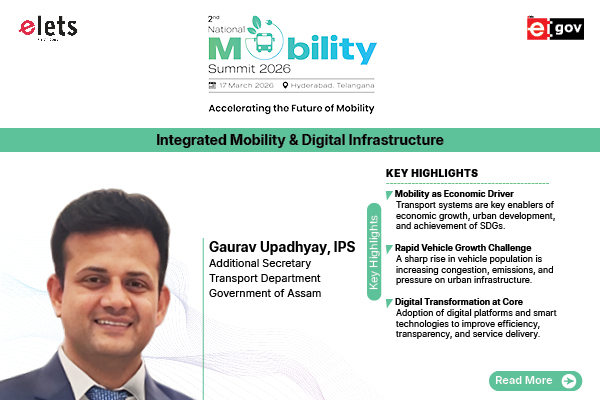
Views expressed by: Shri Gaurav Upadhyay, Additional Secretary, Transport Department, Government of Assam at the National Digital Innovation Summit 2025, in Guwahati.