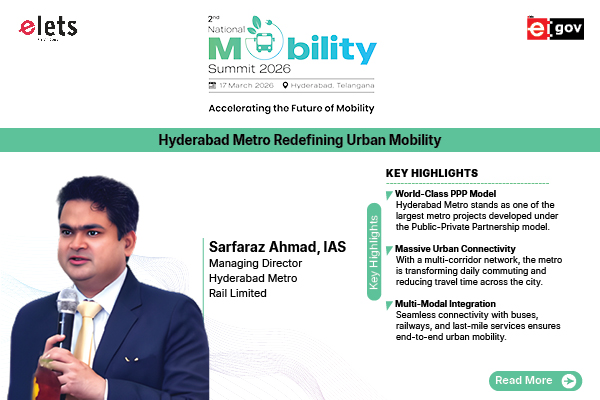
By any measure, Hyderabad Metro Rail is more than a transport system—it is a bold experiment in urban transformation. Conceived as the world’s largest metro project in Public Private Partnership (PPP) mode, Phase-I of the Metro has already altered the rhythm of the city, easing congestion, cutting pollution, and reshaping public spaces into vibrant hubs of activity.
Mr. S. Jaipal Reddy played a pivotal role in the sanctioning and approval of the Hyderabad Metro Rail project. As Union Minister, he was instrumental in securing Government of India’s support, including viability gap funding, and in resolving critical policy issues such as the adoption of standard gauge for metro systems.

In the month of July, 2010 Larsen & Toubro (L&T) emerged as the lowest bidder for the project. Larsen & Toubro Metro Rail Hyderabad Private Limited (LTMRHL) is the concessionaire of the project. The ground works of the project started in July 2012 and the operations of the system commenced from November 2017 onwards
Spanning 69 km across three dense corridors, Phase-I came at a cost of ₹22,204 crore.
Hyderabad Metro Rail has paid special attention to last mile connectivity, ensuring that passengers can seamlessly reach their final destinations beyond the metro stations. To achieve this, the system has introduced Metro shuttle services, corporate shuttles, carpooling options, and rental facilities for cars, bikes, and bicycles. In addition, there is multi-modal integration with RTC buses and Indian Railways, allowing commuters to switch modes without hassle.
Hyderabad Metro Rail has partnered with like Rapido and Svida Mobility—for last mile connectivity. Rapido provides bike-taxi and ride-hailing services linked to metro stations, while Svida Mobility operates shuttle buses across multiple routes, serving thousands of passengers daily. This holistic approach makes the Metro not just a standalone transit system but a well-connected urban mobility network, reducing dependence on private vehicles and making public transport more attractive, efficient, and sustainable.
Global Recognition
The Metro has won over 350 national and international awards, with case studies published by Harvard and Stanford praising the leadership and problem-solving skills behind its execution. Despite daunting challenges, the project was rolled out in five stages between November 2017 and February 2020, and today carries 5 lakh passengers daily.
Hyderabad Metro is a showcase of innovation
■ Asia’s largest precast yards ensured smooth construction
with minimal traffic disruption.
■ Pre-fabricated stations inspired by the “spine & wings” of a bird were erected seamlessly.
■ India’s first CBTC technology enabled 2-minute train
frequency and future driverless operations.
■ IoT-based asset management and outsourced O&M models cut costs to among the lowest worldwide.
■ Regenerative braking produces 22 million units of power annually, while solar panels and rainwater harvesting make deposits energy and water surplus.
Highlights of Hyderabad Metro Rail
■ Stations at approximately every kilometre.
■ Connects major offices, retail and residential areas – The two tracks (up and down lines) pass through the arterial roads of the city.
■ Connects major bus stations at Miyapur, MGBS, Koti, Dilsukhnagar, Charminar and Jubilee Bus Station.
■ Integration with all the main rail terminals of the city at Secunderabad, Begumpet and Nampally.
■ Link to MMTS services at Bharatnagar, Begumpet, Khairatabad, Malakpet.
■ Feeder bus services to stations from different areas of the city.
■ Green & Eco-friendly mode of travel – reduces carbon
emission, fuel consumption and pollution.
■ Faster, safer and comfortable air-conditioned travel with reduced travel time.
■ Ultra-modern coaches.
■ High frequency of trains with hardly any waiting time.
■ User-friendly stations with lifts, staircases and facilities for the disabled.
■ Parking facility at strategic locations along the route at the designated areas.
■ Automatic ticket vending machines – reducing waiting time
in queues and counters.
■ Automatic fare collection system – hassle free entry and
exit from the stations.
■ Essential facilities at stations – toilets, public address and
information system, telephones.
Beyond Transit: A City Reimagined
The Metro is not just about trains—it is about urban rejuvenation. Stations double as shopping malls, multiplexes, clinics, and restaurants, while skywalks, sidewalks, greenery, and street furniture have turned corridors into people-friendly spaces. Safety is enhanced through CCTV integration with city police networks, making the Metro especially popular among women commuters.
Hyderabad Metro Rail has also set benchmarks in social inclusion and gender empowerment. In a pioneering move, the Metro appointed transgender employees at stations, giving them dignified employment opportunities and visibility in mainstream society. This initiative not only promotes inclusivity but also sends a strong message about equality in public spaces. Equally inspiring is the induction of women drivers for metro trains, breaking stereotypes in a field traditionally dominated by men. Their presence at the helm of advanced, high-tech trains symbolizes the city’s commitment to diversity, empowerment, and progressive urban culture. Together, these steps make Hyderabad Metro not just a transport system, but a platform for social transformation.
The Road Ahead: Phase-II
Building on Phase-I’s success, the Government of Telangana
has submitted ambitious expansion plans:
■ Phase-II(A): 5 corridors, 76.4 km
■ Phase-II(B): 3 corridors, 86.1 km
Together, these add 162.5 km to the network, bringing the Metro to 232 km across 11 corridors once sanctioned.
Brisk works are underway on the Hyderabad Metro’s Old City corridor (MGBS–Chandrayangutta, 7.5 km), with road widening and land acquisition nearing completion. This long-awaited stretch is finally moving forward after decades of anticipation, promising to bring modern connectivity to one of Hyderabad’s most historic neighborhoods
Hyderabad Metro Rail is more than steel and concrete—it is a symbol of innovation, resilience, and vision. It has redefined how a city moves, breathes, and lives. With Phase-II on the horizon, Hyderabad is poised to join the ranks of the world’s most connected, sustainable, and people-centric cities.
Views expressed by: Shri Sarfaraz Ahmad, Managing Director, Hyderabad Metro Rail Limited.