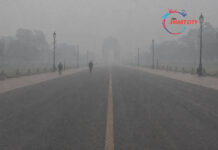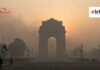


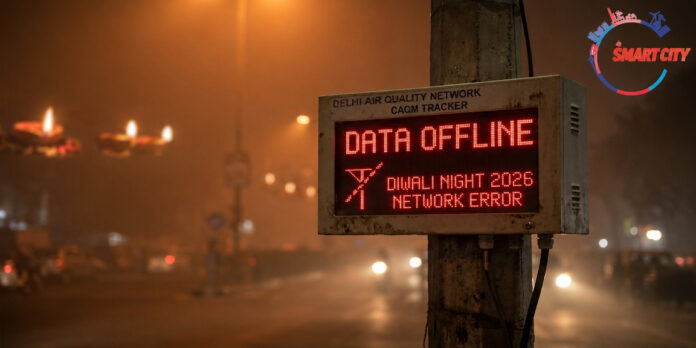
NEW DELHI — Many of Delhi’s air quality monitoring stations stopped reporting readings on Diwali night, November 8, as pollution rose, according to a Press Trust of India analysis of the network’s data. The gaps peaked in the early hours of Monday, across a network of 59 stations.
ALSO READ: Delhi Air Quality Turns ‘Very Poor’ After Diwali

Why Stage III was ordered before Diwali
Two days before Diwali, on Nov. 6, the Commission for Air Quality Management in the National Capital Region and adjoining areas ordered Stage III restrictions under the Graded Response Action Plan. The order cited a recorded air quality index of 382, in the “very poor” category, and forecasts that the reading would slip into the “severe” range. The restrictions were therefore ordered on a forecast by the India Meteorological Department.
What the data shows

The PTI analysis found the number of stations with missing readings rose as Diwali night went on. At 7 a.m. on Monday, 13 stations had missing data. At 8 a.m., seven did. By 9 a.m., two were not reporting, and one was still missing readings at 11 a.m.
Outlook India reported that the dashboard stopped displaying readings from several stations after 9 p.m. on Diwali night. Stations named in its report include RK Puram, Nehru Nagar, Mundka, Sonia Vihar and Dwarka. The same report said the station at Jawaharlal Nehru University kept reporting and showed a PM2.5 reading of 786 micrograms per cubic meter by 11 p.m.
ALSO READ: CAQM Launches PAVAN-I3C Command Centre to Track Delhi-NCR Air Pollution
What is still unknown
The Delhi Pollution Control Committee’s monitoring protocol triggers an operational alert when a station fails to transmit for three consecutive hours. Several questions remain open. The Delhi Pollution Control Committee has not explained which stations went offline, for how long, or whether its own three-hour alert was triggered. The order’s citizen charter tells residents to check the AQI. On Diwali night, at some of those stations, the reading stopped updating.
What the order requires
Under the Stage III order, construction and demolition work faces strict restrictions across the region, stone crushers and mining are to close, and BS-III petrol and BS-IV diesel light vehicles face restrictions in Delhi and high-density districts. Schools up to Class V are to hold hybrid classes. The sub-committee said it would review conditions from time to time.