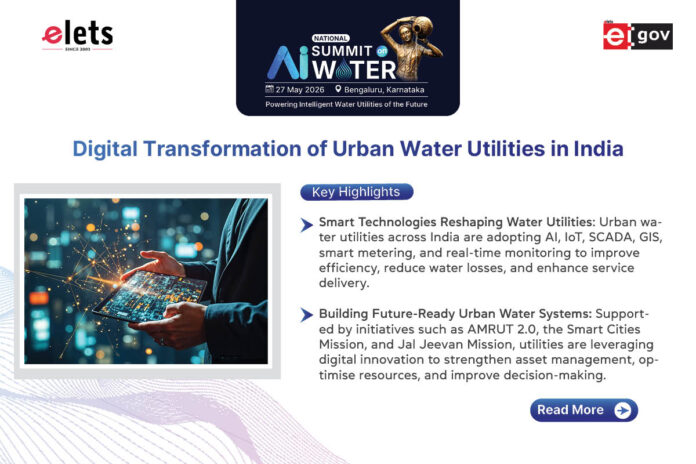
Water has always been at the centre of India’s development story. It powers industries, sustains agriculture, supports public health, and enables economic growth. Yet for many urban local bodies, ensuring a reliable and equitable water supply remains one of the most complex governance challenges of our time.
India’s cities are expanding at an unprecedented pace. By 2030, nearly 40 per cent of the country’s population is expected to live in urban areas, placing extreme pressure on water infrastructure that was often designed decades ago. At the same time, climate variability is altering rainfall patterns, groundwater reserves are declining in several regions, and citizens increasingly expect uninterrupted, high-quality public services.
With increasing pressure on urban water systems, utilities are beginning to realise that better management can be just as important as new infrastructure. The focus is gradually shifting from simply expanding water networks to making them smarter and more efficient. Technologies such as smart meters, real-time monitoring systems, data analytics, and Artificial Intelligence are helping utilities detect problems earlier, manage resources more effectively, and deliver better services to consumers.
Across India, utilities are deploying smart meters, sensor-based monitoring systems, GIS mapping platforms, digital command centres, and AI-powered analytics tools to gain real-time visibility into their networks. What was once a largely reactive system, responding to leaks, breakdowns, and consumer complaints after they occurred, is gradually evolving into a proactive and predictive model of utility management.
The journey has only just begun, but the impact is already visible. Cities are using technology to cut water losses, improve operations, and make faster, more informed decisions. As India builds smarter and more resilient cities, intelligent water utilities will be essential to managing one of our most valuable resources, water.
HOW INDIA MADE DIGITAL WATER A PRIORITY
For many years, digital technologies in the water sector were treated as optional upgrades that cities adopted only when funds were available. That changed with the launch of AMRUT 2.0 in 2021, which made technology a key part of urban water management. Backed by an investment of ₹2.99 lakh crore, the programme requires cities to adopt solutions such as water quality sensors, real-time monitoring systems, automated billing, and citizen-friendly digital platforms. It also promotes regular tariff revisions to help make water services more sustainable in the long run.
The impact of this shift is already visible. By Mid-2025, states and Union Territories had taken up 5,873 AMRUT projects worth ₹82,222 crore, while 4,676 projects valued at ₹32,793 crore had been completed. The focus is no longer just on expanding infrastructure, but also on improving efficiency, reducing losses, and using data to make better decisions.
AMRUT 2.0 is supported by other major initiatives as well. The Smart Cities Mission has helped cities test and refine smart water solutions, while the Jal Jeevan Mission has introduced digital monitoring and sensor-based systems in rural water networks. Together, these programmes are laying the foundation for smarter, more efficient, and data-driven water management across India.
THE EMERGENCE OF THE SMART WATER UTILITY
The concept of a smart water utility goes beyond automation. It refers to a utility that uses data continuously and systematically to improve operational efficiency, service delivery, and long-term planning.
Traditionally, many utilities relied heavily on manual inspections, paper-based records, and periodic monitoring. As a result, leaks often went undetected for weeks, asset information remained fragmented, and decision-making was based on limited data.
Today, digital technologies are creating a different reality. A modern smart water utility typically integrates:
- Smart water meters for automated consumption monitoring
- SCADA (Supervisory Control and Data Acquisition) systems for real-time operational oversight
- GIS-based asset mapping of pipelines, reservoirs, and pumping stations
- IoT sensors that monitor flow, pressure, and water quality
- Digital customer service and billing platforms
- AI and machine learning tools for predictive analysis
- Integrated command-and-control centres that provide a unified operational view
Together, these technologies enable utilities to understand what is happening across their networks in real time and respond more effectively to operational challenges. The result is not only greater efficiency but also improved transparency, stronger financial sustainability, and better customer experience.
- Manual Inspections
- Undetected Leaks
- Fragmented Asset Information
- Periodic monitoring
- Decisions Based on Limited Data
KEY OUTCOMES & BENEFITS
- GREATER EFFICIENCY
- IMPROVED TRANSPARENCY
- STRONGER FINANCIAL SUSTAINABILITY
- BETTER CUSTOMER EXPERIENCE
NOT ONE INDIA, BUT THREE: THE DIGITAL DIVIDE IN WATER
India’s water sector is often discussed as a single national system, but the reality on the ground tells a very different story. The level of digitalisation across urban water utilities varies dramatically from one city to another.
In cities such as Nagpur, water utilities use real-time monitoring systems, digital dashboards, and AI-based tools to detect leaks and manage distribution networks more efficiently. In contrast, many other cities continue to depend on manual monitoring, making it harder to track water losses and respond quickly to problems.
These differences are not isolated examples. They reflect a broader digital divide that exists across India’s urban water ecosystem. Today, Indian states can broadly be grouped into three levels of digital maturity:
- Tier 1 – Advanced: Cities with integrated SCADA systems, smart metering, GIS-based asset mapping, IoT sensors, and emerging AI applications.
- Tier 2 – Emerging: Utilities that have adopted several digital solutions but still face challenges related to integration, coverage, and scalability.
- Tier 3 – Early Stage: Utilities where digitalisation remains limited to pilot projects, and manual processes continue to dominate day-to-day operations.
Across the country, cities are embracing smart water technologies at varying levels. The following examples highlight where different states stand on the digital readiness spectrum.
MAHARASHTRA (TIER 1 – ADVANCED)
- Nagpur is widely recognised as one of India’s leading examples of smart water management, reducing non-revenue water (NRW) from nearly 40% to below 29% through AI-enabled leak detection, IoT sensors, acoustic monitoring, and robotic pipeline inspections.
- Pune operates a SCADA-enabled 24×7 water supply system, allowing real-time monitoring and management of distribution networks.
- The state has also introduced policy frameworks that encourage greater use of digital technologies and data-driven governance in urban water utilities.
TAMIL NADU (TIER 1 – ADVANCED)
- Chennai Metrowater has begun deploying smart water meters across nearly one lakh commercial establishments and high-rise residential buildings.
- The utility is leveraging NB-IoT and LoRaWAN technologies to improve data collection, monitoring efficiency, and cost-effectiveness.
- Smart metering initiatives are being complemented by rainwater harvesting and blue-green infrastructure projects to enhance long-term water security and climate resilience.
GUJARAT (TIER 1 – ADVANCED)
- Ahmedabad and Surat have emerged as leaders in utility modernisation, supported by successful municipal
bond financing for water infrastructure projects.
- Both cities operate SCADA-enabled water supply systems integrated with smart billing and monitoring platforms.
- Sustained investments in leak detection, pressure management, and network monitoring have helped maintain NRW levels below the national average.
MADHYA PRADESH (TIER 1 – ADVANCED)
- Bhopal operates a city-wide SCADA-based automated water management system, enabling real-time operational control.
- Indore has expanded Automated Meter Reading (AMR) systems and GIS-based asset mapping to improve infrastructure management.
- Continued investments in digital technologies are strengthening network planning, maintenance, and service delivery across urban centres.
DELHI (TIER 1–2 – TRANSITIONAL)
- Delhi Jal Board has deployed wireless AMR meters across multiple service zones, improving remote billing and consumption monitoring.
- Digital tools have enhanced visibility into water usage patterns and
operational performance.
- However, NRW remains close to 48%, highlighting the need for stronger maintenance practices, infrastructure upgrades, and governance reforms alongside technology adoption.
HARYANA (TIER 2 – EMERGING LEADER)
- Haryana has launched India’s first AI-enabled Water Atlas, creating a comprehensive platform for water resource monitoring and planning.
- The system combines satellite imagery, geospatial mapping, and sensor data to provide real-time insights into surface and groundwater resources.
- While city-level smart metering is still expanding, the state’s data-driven approach is emerging as a model for AI-enabled water governance.
HIMACHAL PRADESH (TIER 2 – EMERGING)
- Shimla is implementing a major 24×7 water supply project aimed at improving service reliability in a geographically challenging environment.
- The project incorporates SCADA-based monitoring across the distribution network for real-time
operational oversight.
- Once completed, it is expected to serve as a model for digitally enabled water management in hill cities under AMRUT 2.0.
WEST BENGAL (TIER 3 – EARLY STAGE)
- Kolkata continues to rely largely on legacy infrastructure and conventional monitoring systems.
- NRW levels are estimated to be among the highest among India’s major metropolitan utilities.
- Experts suggest that targeted investments in smart metering, network monitoring, and digital asset management could significantly improve efficiency and service delivery.
- Planned interventions under AMRUT 2.0 are expected to accelerate the city’s digital water transformation in the coming years.
SMART METERING: THE FOUNDATION OF SMARTER WATER MANAGEMENT
One of the most important steps in building a smart water utility is knowing exactly how much water is being consumed, where it is being used, and where losses are occurring. For many years, however, water consumption in Indian cities was measured through manually read meters or flat-rate billing systems, giving utilities only a limited understanding of actual usage patterns.
Smart meters are helping address these challenges by automatically recording and transmitting water usage data at regular intervals. This gives utilities real-time visibility into consumption patterns, enabling faster decision-making and more efficient network management.
For utilities, smart metering improves billing accuracy, strengthens revenue collection, reduces operational costs, and helps detect leaks or unusual consumption patterns early. For consumers, it offers greater transparency, a better understanding of water usage, and quicker identification of household leaks.
The adoption of smart water meters is steadily increasing under initiatives such
Automated Meter Reading
as AMRUT 2.0 and various city modernisation programmes. While deployment is still at a relatively early stage, smart metering is rapidly emerging as a key building block in India’s journey towards data-driven and intelligent water utilities.
ARTIFICIAL INTELLIGENCE: MOVING FROM MONITORING TO PREDICTION
As water utilities become more digital, they are generating large amounts of data every day, from water flow and pressure levels to consumption patterns and network performance. Artificial Intelligence (AI) is helping utilities make sense of this information and use it to make smarter decisions.
What makes AI particularly valuable is its ability to look beyond what is happening today and predict what might happen tomorrow. Instead of simply identifying problems after they occur, AI can help utilities anticipate issues, improve planning, and manage resources more efficiently.
Some of the key ways AI is being used in water management include:
- Predictive Leak Detection: AI can analyse pressure fluctuations, flow behaviour, and historical network data to identify potential leaks before they become visible, helping utilities reduce water losses and avoid costly repairs.
- Asset Health Monitoring: Machine learning models can assess the condition of pumps, valves, and pipelines, enabling preventive maintenance and reducing the risk of unexpected breakdowns.
- Demand Forecasting: By analysing weather patterns, seasonal trends, population growth, and historical consumption data, AI can help utilities accurately predict future water demand and optimise supply planning.
- Water Quality Monitoring: AI-powered systems can continuously analyse water quality parameters and quickly flag unusual readings that may indicate contamination or operational issues.
- Energy Optimisation: Since pumping and treatment operations account for a significant share of utility expenses, AI can identify the most efficient operating schedules, helping reduce energy consumption and operational costs.
From smart meters and sensor networks to AI-powered predictive analytics, India’s water utilities are embracing technology to tackle long-standing challenges such as water losses, operational inefficiencies, and growing urban demand. The result is the emergence of smarter, more responsive utility systems designed to secure the future of urban water management.
The biggest strength of AI lies in its ability to help utilities prevent problems rather than simply react to them. By turning data into actionable insights, AI is helping build smarter, more efficient, and resilient water systems.
BUILDING THE WATER UTILITY OF THE FUTURE
India’s urban water sector is undergoing a significant transformation. While investments in physical infrastructure will remain important, the future of water management will increasingly depend on how effectively utilities use data and technology to improve operations and service delivery.
National programmes such as AMRUT 2.0, the Smart Cities Mission, and Jal Jeevan Mission (Urban) are accelerating this shift by encouraging utilities to adopt smart meters, digital monitoring systems, IoT solutions, and advanced analytics. At the same time, strengthening digital skills, data management practices, and institutional capacity will be equally important for long-term success. Across the country, utilities are beginning to use data more strategically to reduce water losses, improve efficiency, and make faster, more informed decisions. As technologies such as AI and predictive analytics become more widely adopted, they will play an increasingly important role in shaping the future of urban water management. The opportunity ahead is clear: to build water utilities that are not only more efficient and resilient but also better equipped to meet the growing needs of India’s cities in a sustainable manner.
Written by Sahaj Anand | Elets News Network (ENN)