As Bengaluru continues to expand its wastewater treatment capacity, the city’s large network of decentralised sewage treatment plants (STPs) presents both an opportunity and an operational challenge. With approximately 4,200–4,500 decentralised STPs, these facilities represent a significant source of treated and alternative water that can support the city’s growing water requirements. However, ensuring consistent operation and maintenance across such a widely distributed network requires skilled manpower, reliable monitoring and timely intervention.
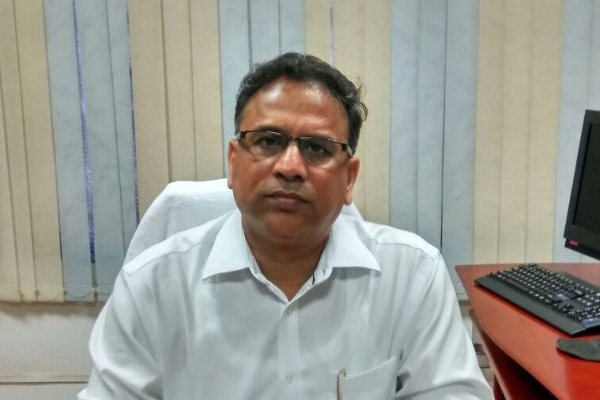
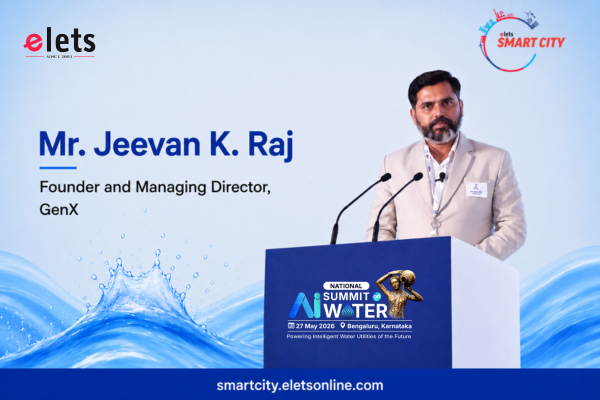
At the National AI Summit on Water 2026, Mr Jeevan K. Raj, Founder and Managing Director, GenX, presented an AI-enabled remote-operations model designed to address these challenges. The approach shifts STP management from a predominantly on-site operating model towards centralised, digitally enabled supervision, allowing skilled mechanical and environmental engineers to monitor and manage multiple treatment facilities from a central command centre.
Addressing the Manpower Challenge
The scale and decentralised nature of Bengaluru’s STP network makes manpower availability a critical operational issue. Maintaining skilled personnel at thousands of individual facilities can be resource-intensive and can also make it difficult to ensure consistent technical oversight across the network.
GenX’s model seeks to overcome this limitation by creating a centralised operations environment where specialised engineers can remotely monitor multiple plants. Instead of requiring personnel to be physically present at each facility, operational information is transmitted to a central command centre, enabling technical teams to assess plant conditions and respond to emerging issues remotely.
This model can potentially make skilled expertise available across a much larger number of facilities while reducing the operational burden associated with maintaining dedicated personnel at every plant.
Combining AI, IoT and Remote Monitoring
The GenX solution combines several technologies to establish real-time visibility into plant operations. AI-enabled cameras, ultrasonic level sensors and IoT-based monitoring systems collect and transmit information from individual facilities to the central command centre.
Critical pump parameters, including temperature, vibration, current and voltage, can be monitored continuously. These parameters provide important indicators of equipment health and operating conditions. Instead of relying solely on periodic physical inspections, operators can access a continuous stream of operational information and identify abnormal conditions as they emerge.
The system also incorporates predictive alerts, enabling the operations team to identify potential equipment problems before they develop into failures. For instance, when operating conditions indicate that a pump may be approaching a failure state, operators can take corrective action and switch pumps before an actual breakdown occurs. This can help reduce downtime, minimise maintenance requirements and improve the overall reliability of decentralised treatment facilities.
From Reactive Maintenance to Predictive Operations
One of the key shifts enabled by the model is the movement from reactive maintenance to predictive intervention. In conventional operations, equipment problems may only become apparent when a pump stops functioning or when an operator physically identifies an abnormality at the site.
Remote monitoring changes this dynamic by continuously analysing equipment performance. Historical and real-time information can be used to identify deviations from normal operating conditions, allowing operators to act before failures disrupt plant operations.
For a network containing thousands of decentralised facilities, this shift can be particularly significant. Even relatively small equipment failures can affect treatment performance when they occur repeatedly across multiple locations. Predictive monitoring can therefore provide utilities and operators with a mechanism to prioritise interventions and manage equipment more proactively.
Demonstrating Remote Operation in Existing Infrastructure
The presentation included a live demonstration involving an older manually operated facility that had been retrofitted to enable complete remote operation. According to the presentation, the facility reportedly operated for six months without equipment failures and without requiring on-site personnel.
The demonstration highlighted the potential to apply digital technologies to existing infrastructure rather than relying exclusively on new-build smart treatment plants. Retrofitting existing facilities with sensors, cameras and IoT connectivity can create the digital layer required for remote monitoring and control.
For cities such as Bengaluru, where a substantial decentralised STP network is already in place, this approach could be particularly relevant. Instead of replacing existing infrastructure, utilities can potentially enhance its operational capabilities through targeted digital interventions.
Improving Safety and Reducing Carbon Footprint
The benefits of remote operations extend beyond equipment efficiency. Reducing the need for regular personnel visits to individual STPs can also lower travel requirements and associated carbon emissions. Fewer equipment failures can further reduce unnecessary maintenance trips and improve overall resource efficiency.
Worker safety is another important consideration. Sewage treatment facilities can expose personnel to potentially hazardous gases, including methane and carbon monoxide. By reducing the need for routine physical presence at individual facilities, remote monitoring can limit exposure to these risks while allowing technical personnel to supervise operations from a safer central location.
The model therefore connects operational efficiency with environmental and occupational-safety objectives. Remote management can reduce physical interventions while maintaining continuous oversight of critical infrastructure.
Creating a Transparent Data Ecosystem
Another major benefit highlighted was access to real-time and historical operational data. Traditional manually operated facilities can make it difficult to maintain consistent and centralised records of plant performance. Digital monitoring creates a continuous operational history that can be accessed by authorised teams from the central command centre.
This information can support more informed maintenance planning, performance assessment and troubleshooting. Historical trends can also help operators understand recurring equipment issues and identify patterns that may not be apparent through individual site visits.
The availability of structured operational data also enables greater transparency. Instead of relying on periodic reports or manual observations, decision-makers can access information on plant conditions and equipment performance in a more consistent and timely manner.
Linking Operations with ESG Reporting
The presentation also highlighted the ability to integrate operational information with corporate ESG reporting systems. This creates a direct connection between day-to-day wastewater operations and broader sustainability objectives.
Data generated through remote monitoring can potentially contribute to tracking indicators related to energy use, operational efficiency, equipment performance, emissions and maintenance. Integrating these insights into ESG frameworks can help organisations demonstrate measurable sustainability outcomes rather than relying solely on high-level commitments.
For wastewater infrastructure, where environmental performance and resource efficiency are increasingly important, such integration can strengthen the connection between operational technology and sustainability reporting.
Also read: AI-Driven Intelligence at Chennai’s 45 MLD Koyambedu Tertiary Treatment RO Plant
Conclusion
The GenX presentation demonstrated how AI, IoT, and remote operations can address some of the fundamental challenges in managing Bengaluru’s extensive decentralised sewage treatment infrastructure. With approximately 4,200–4,500 STPs, maintaining skilled personnel at every facility is a significant challenge. A centralised command-centre model offers an alternative by enabling specialised engineers to remotely monitor multiple plants, using real-time data and predictive alerts to support timely interventions.
The combination of AI-enabled cameras, ultrasonic sensors and IoT-based monitoring can provide continuous visibility into critical equipment parameters, while predictive alerts can help operators prevent failures before they occur. The reported six-month operation of a retrofitted facility without equipment failures or on-site personnel further illustrated the potential of this approach.
More broadly, the model represents a shift in wastewater management from physical presence to digital oversight, reactive maintenance to predictive operations, and isolated facilities to centrally coordinated infrastructure. For cities managing large decentralised treatment networks, such technologies could improve operational reliability while addressing manpower constraints, worker safety, carbon reduction and data transparency.
As Bengaluru looks to maximise the value of its wastewater infrastructure, AI-enabled remote operations could provide an important pathway towards making decentralised STPs more efficient, safer, data-driven and scalable, while strengthening their role as a critical component of the city’s future water-security strategy.