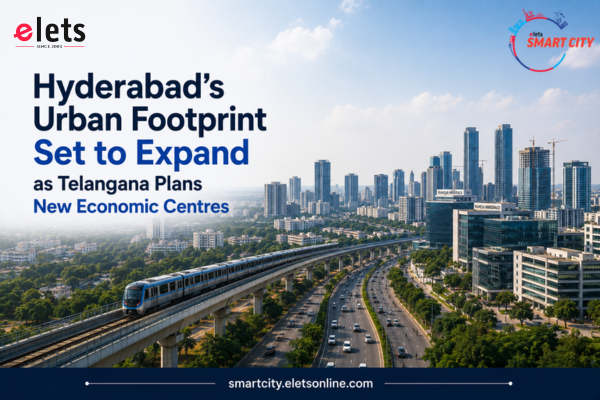
Telangana is planning a major expansion of Hyderabad’s urban footprint through the development of new economic centres around the city. The initiative is aimed at creating multiple growth hubs beyond the existing metropolitan core, supporting economic activity, improving regional connectivity, and reducing pressure on Hyderabad’s rapidly expanding urban infrastructure.
The proposed development strategy focuses on creating new economic and employment centres in areas surrounding Hyderabad. These hubs are expected to accommodate commercial activity, industries, residential development, and supporting infrastructure, enabling more balanced urban growth across the metropolitan region.
The expansion comes as Hyderabad continues to experience rapid population growth and increasing demand for housing, office space, transport infrastructure and public services. The concentration of economic activity within the existing city has placed growing pressure on roads, public transport, utilities and land availability. Developing new centres is therefore being considered as a way to distribute growth and create alternative destinations for businesses and residents.
A key element of the strategy is strengthening connectivity between Hyderabad and the proposed economic centres. Improved road networks, public transport and other supporting infrastructure will be important to ensure that these emerging hubs are effectively integrated with the metropolitan region. Better connectivity could also encourage businesses to establish operations outside the traditional commercial districts while providing residents with improved access to employment opportunities.
The planned expansion is expected to have significant implications for the real estate sector. New commercial and residential developments are likely to emerge around the proposed growth corridors as infrastructure improves and economic activity expands. Developers could increasingly look towards peripheral areas where land availability is higher and large-scale projects can be planned with integrated infrastructure.
The approach also reflects a broader shift towards polycentric urban development, where multiple economic centres function alongside a major metropolitan core. Instead of concentrating jobs, businesses and services in central Hyderabad, the model seeks to create distributed hubs that can support local employment and reduce the need for long-distance daily commuting.
For Telangana, the development of new economic centres is also linked to its broader economic growth strategy. Establishing specialised commercial and industrial clusters could attract new investments, support entrepreneurship, generate employment and strengthen the state’s competitiveness. Such hubs could eventually develop into self-sustaining urban centres with their own residential, commercial and social infrastructure.
Also read: Heavy Rain Triggers Orange Alert in Delhi as Temperature Drops
However, the success of the expansion will depend on coordinated urban planning and timely infrastructure development. Authorities will need to ensure that transportation networks, water supply, sewage systems, power infrastructure, waste management and public services grow alongside private real estate development. Without adequate planning, rapid peripheral growth could result in fragmented development and increased pressure on existing infrastructure.